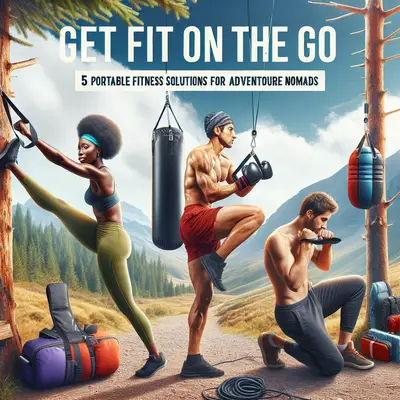
You don’t need a full gym to stay powerful on the road—you just need the right tools and a battle plan. Whether you’re sprinting through airport terminals, chasing Wi-Fi in mountain cafes, or working from a beach bungalow, portable equipment can turn every stop into a training ground. This isn’t about “staying kinda active.” It’s about keeping your body mission-ready while your passport fills with stamps.
Below is your field guide to portable gear, smart tactics, and five road-tested fitness tips that keep travelers and digital nomads strong, stable, and ready for whatever the map throws at them.
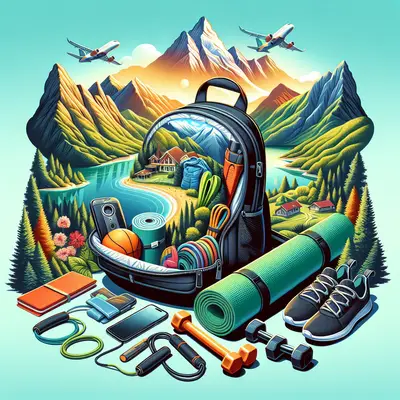
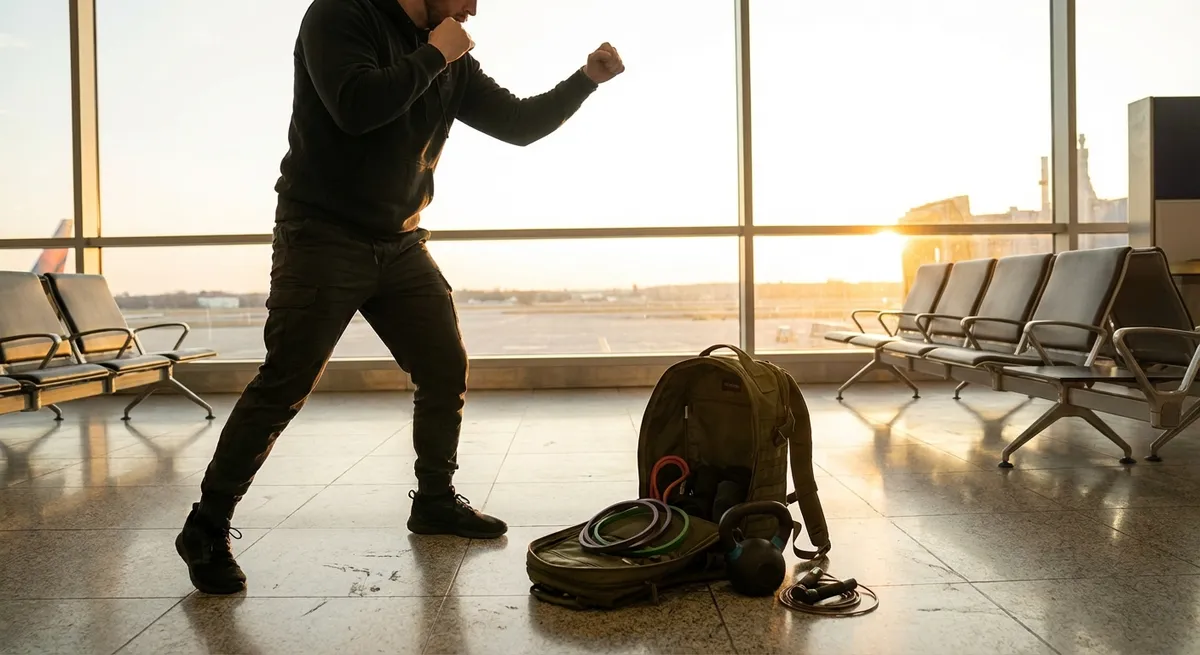
Build a “Go-Bag” Gym That Lives in Your Luggage
Think of your training kit like survival gear: small, versatile, durable, and always packed. The goal is a setup that weighs under 2–3 kg, fits in a carry-on, and covers strength, mobility, and conditioning.
A minimalist go-bag might include:
- Long resistance band (medium & heavy) – For rows, presses, hip hinges, and assisted pull-ups when you find a bar.
- Short loop band – Lights up glutes, hips, and shoulders in tiny hotel rooms.
- Light suspension trainer or door anchor strap – Bodyweight rows and presses anywhere there’s a door or beam.
- Compact jump rope – Cardio, coordination, and power in a palm-sized package.
- Collapsible massage ball or small lacrosse ball – Mobility work after flights, buses, or long laptop sessions.
Keep these in one packing cube so every time you unzip your bag, your gear is staring at you like, “No excuses.” If weight is a major issue (budget airlines, trekking, moto travel), prioritize bands and a rope; they punch far above their weight for full-body training.
Smart Gear Choices for Different Types of Travelers
Not every trip is the same. Your gear should match your route and your realities.
For fast-moving backpackers:
You’ll be hauling your life on your shoulders, so go ultralight. Stick to:
- 1–2 long resistance bands
- 1 loop band
- Jump rope (optional if you’ll be hiking a lot)
You’ll rely heavily on bodyweight (push-ups, squats, lunges, isometrics) and use bands to add resistance without bulk.
For digital nomads staying 1–3 months per spot:
You have more room to play. Consider:
- Bands (long + loop)
- Suspension trainer or doorway pull-up bar (if luggage and housing allow)
- Minimalist sliders (or just use towels on tile floor)
You can set up a semi-permanent “micro-station” in your room and treat it like your home base gym.
For road-trippers and vanlifers:
You’ve got vehicle storage, so you can add:
- Adjustable dumbbells or a single kettlebell
- Yoga mat or thin travel mat
- Small ab wheel or homemade slider alternatives
Your vehicle becomes a gear locker; your campsite, parking lot, or roadside viewpoint becomes a training deck.
5 Field-Tested Fitness Tips for Travelers and Nomads
Here are five practical tactics to keep your training sharp without needing perfect conditions.
1. Train by “Checkpoints,” Not by Days of the Week
Instead of “I’ll work out Monday, Wednesday, Friday,” use trip checkpoints:
- Every new city or town = 1 quality workout within 24 hours of arrival.
- Every long travel day (flight, bus, train) = 1 short mobility + core session.
- Every week = at least 2 strength-focused sessions using your portable gear.
This method works when time zones and schedules go sideways. You tie your training rhythm to your route, not the calendar.
2. Use the “20-Minute Mission” Template
On the road, long workouts often die on the altar of “I’m too tired.” Instead, run ultra-efficient 20-minute missions with your portable kit. Example:
- 5 minutes: Warm-up (air squats, arm circles, band pull-aparts, hip circles)
- 12 minutes: EMOM (Every Minute On the Minute)
- Minute 1: 10 band rows + 10 push-ups
- Minute 2: 12–15 band squats or lunges
- Minute 3: 30 seconds jump rope or fast high knees
- 3 minutes: Stretch calves, hip flexors, chest
Repeat for 4 cycles.
You can swap exercises based on gear and space, but keep the timebox small and ruthless. When you know it’s only 20 minutes, you’re far more likely to start.
3. Turn Your Gear Into Travel-Specific Armor
Use portable equipment to protect the muscles and joints that travel abuses most:
- Loop bands for hips and glutes after long sits: lateral walks, clamshells, monster walks.
- Long bands for posture: band pull-aparts and face pulls to counter rounded shoulders from laptops and backpacks.
- Mini mobility circuits with a band and ball:
- Calf and hamstring stretch with a band around the foot
- Glute release with a ball against wall or floor
- Chest/pec stretch with band anchored in a doorway
Aim for 5–10 minutes of “armor work” after flights or long work blocks. This keeps your joints adventure-ready for hiking, surfing, or spontaneous city walks.
4. Anchor Your Routine to Fixed Daily Habits
Travel shakes up schedules, so tether your training to things that don’t move. For example:
- After your first coffee = 10–15 minutes of band work + mobility.
- Before dinner = quick conditioning circuit with rope or bodyweight.
- Post-check-in = one mini session before you even unpack.
Combine this with a visible cue: leave your band or suspension trainer out in the room, not buried in your bag. Visual friction is real—if you see the gear, you’re far more likely to use it.
5. Train for Performance, Not Punishment
Travel often brings big food, late nights, and unpredictable routines. Instead of using workouts to “burn off” what you ate, focus on performance markers:
- More push-ups with perfect form
- Deeper, more controlled squats or lunges
- Longer unbroken jump-rope sets
- Cleaner single-leg balance and control with bands
Portable gear is perfect for progressive overload on the road—you can move further from the anchor, increase tempo, change angles, or slow the eccentric phase to make each rep tougher. Track one or two simple metrics in your notes app. As the numbers climb, your body will follow.
Space-Constrained? Here’s How to Train in Tiny Rooms
Not every hotel, hostel, or rental has room to sprawl. Portable gear shines in small spaces if you plan your movement patterns wisely.
- Train “on the spot” instead of moving across the room: vertical jumps, squats, band presses, and rows need almost no horizontal space.
- Use doorways as anchor points: most suspension trainers and some bands come with door anchors—just test the door closes securely and pulls towards the hinges, not away from them.
- Work diagonals instead of straight lines: diagonal lunges, rotational band presses, and anti-rotation holds (Pallof presses) build real-world strength without needing much floor.
If noise is an issue (thin walls, late hours), skip jumping and do tempo work: slow 4-second descents on squats, push-ups, and hip hinges with a band. Your muscles will complain louder than your neighbors.
Turning Every Destination into a Training Playground
Portable equipment isn’t just about surviving without a gym—it’s about turning the entire world into a training playground:
- A tree branch becomes your pull-up bar.
- A park bench becomes your step-up and dip station.
- A beach or field becomes your sprint track, with bands for resistance drills.
The real mindset shift: you’re not “off your routine” when you travel. This is the routine—modular, flexible, and built around gear that fits in a corner of your bag.
When your kit is always packed and your tactics are simple, you stay strong enough to say yes to more: sunrise hikes, impromptu climbs, surf lessons, or just another full day of wandering a new city on foot.
Conclusion
Staying fit on the road doesn’t require a membership card or perfect conditions—just a small arsenal of smart portable equipment and a plan that respects the chaos of travel. Pack a go-bag gym, train by checkpoints, and lean on short, focused missions instead of idealized long sessions.
The reward: a body that can keep up with your passport. Wherever you land tonight—hostel bunk, van, guesthouse, or city high-rise—you’re never more than 20 minutes and a resistance band away from feeling stronger, looser, and ready for the next adventure on the map.
Sources
- [American Council on Exercise – Resistance Band Workouts](https://www.acefitness.org/resources/everyone/blog/7440/how-to-design-a-resistance-band-workout/) – Covers benefits of resistance bands and examples of full-body workouts using minimal equipment.
- [Centers for Disease Control and Prevention – Physical Activity Guidelines](https://www.cdc.gov/physicalactivity/basics/adults/index.htm) – Official recommendations on weekly activity levels for adults, useful for planning travel-friendly routines.
- [Mayo Clinic – Exercise: 7 Benefits of Regular Physical Activity](https://www.mayoclinic.org/healthy-lifestyle/fitness/in-depth/exercise/art-20048389) – Explains the broad health benefits of staying active, supporting why consistent movement during travel matters.
- [Harvard Health Publishing – The Importance of Stretching](https://www.health.harvard.edu/staying-healthy/the-importance-of-stretching) – Details why mobility and stretching are essential, especially after long periods of sitting while traveling.
- [Cleveland Clinic – Bodyweight Exercises You Can Do Anywhere](https://health.clevelandclinic.org/bodyweight-exercises) – Provides examples of no-equipment movements that pair well with portable gear in small spaces.
Key Takeaway
The most important thing to remember from this article is that this information can change how you think about Portable Equipment.