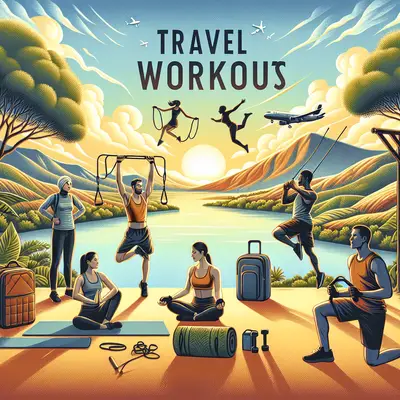
Long layovers, border crossings, and shuttle sprints don’t have to wreck your training—they can be your training. When your life lives in a backpack and your “home gym” is whatever space you can claim for 20 minutes, you need workouts that are rugged, fast, and impossible to excuse away. This guide is for travelers and digital nomads who want to stay adventure-ready with nothing more than bodyweight, a carry-on, and some creativity.
Turning Transit Time Into Training Time
Travel days feel like dead zones for fitness: cramped seats, bad food, and endless scrolling. Flip the script. Think of every movement—walking a terminal, hauling your pack, climbing hostel stairs—as raw material for training.
Instead of waiting passively at gates or in lobbies, designate micro-sessions: 5–10 minute blocks with one clear goal (mobility, strength, or conditioning). Use delays and boarding calls as natural timers. Your brain stops viewing travel as a disruption and starts treating it as a training field.
Build a simple rule: whenever you’re stuck waiting more than 20 minutes and you’re not handling logistics, you move. Sometimes that’s a mobility reset in a quiet corner; sometimes it’s a brisk, loaded walk with your pack. The key is consistency, not perfection. You’re conditioning your body—and your mindset—to treat motion as default and sitting as the exception.
Tip 1: Build a “No-Excuse” Bodyweight Circuit
Your first line of defense is a workout you can run anywhere—hotel room, rooftop, campsite, or the sliver of floor between two bunks.
Try this minimalist circuit:
- 10–15 push-ups (elevate hands on a bed or luggage if needed)
- 15–20 air squats
- 10–15 hip hinges/“good mornings” (hands on hips or behind head)
- 20–30 seconds side plank per side
- 20–30 seconds fast high knees in place
Move through 3–5 rounds with minimal rest. Adjust reps so you’re working hard but not wrecked—you should be able to repeat this 3–4 times per week, even on the road.
This circuit hits upper body, lower body, core, and heart rate without equipment. To progress, slow down the lowering phase of push-ups and squats, add pulses at the bottom, or turn air squats into jump squats every other round. The goal isn’t bodybuilding symmetry; it’s durable, travel-proof strength that supports hiking, surf sessions, and long-haul bags-on-your-back days.
Tip 2: Treat Your Backpack Like a Mobile Kettlebell
If you’re carrying a bag, you’re carrying a training tool. Load your backpack or daypack with what you already have—laptop, water, clothes—then put it to work.
Use your pack for:
- Loaded squats: Hug the pack to your chest and squat, keeping heels down.
- Backpack deadlifts: Stand with feet hip-width, pack on the floor, hinge at the hips, grab the straps, stand tall.
- Single-arm rows: One hand braced on a bed or chair, the other hand rowing the pack toward your hip.
- Front-loaded marches: Pack held at chest height, march in place, driving knees high.
Focus on control and posture, not speed. This turns every city or country into potential gym space. If you stay longer in one place, you can get creative: fill water bottles or a small dry bag with sand or rocks for heavier loads, then empty them before moving on. It’s strength training that respects baggage limits.
Tip 3: Walk Like You Mean It (And Stack Extra Load)
Travel naturally hands you steps; your job is to make them intentional. Instead of defaulting to rideshares or escalators, treat walking as core conditioning for your adventure life.
Some practical tactics:
- Commit to walking any distance under 2 km if it’s safe and daylight.
- Always take stairs in hostels, stations, and airports when possible.
- Turn one daily walk into a “ruck”: wear your heaviest pack and walk 20–40 minutes at a purposeful pace.
Research consistently links brisk walking with improved cardiovascular health and reduced all-cause mortality, and you don’t need a perfect training plan to benefit from it. Layering load (your pack) onto walking quietly builds leg and core strength that carries over to hikes, climbs, and city marathons. On work-heavy days, a single loaded walk at sunrise or sunset might be your main training—and that still counts.
Tip 4: Mobility Rituals That Survive Time Zones
Travel beats up your joints: cramped seats, awkward beds, and endless screen time add up fast. A short, daily mobility ritual keeps you from feeling older with every border crossing.
Use this 8–10 minute sequence:
- 1 minute: neck rolls and gentle side-to-side turns
- 2 minutes: cat-cow on the floor or seated spine flex/extend and twists
- 2 minutes: hip circles and deep squat sit (hold onto something if needed)
- 2 minutes: calf stretches and ankle circles
- 2–3 minutes: long exhale breathing lying on your back or sitting against a wall
Slide this in first thing in the morning or right after a long ride or flight. The goal isn’t yoga-level flexibility; it’s restoring basic range of motion so you can hike, paddle, or roam a new city without feeling like your body is lagging behind your passport. Over time, this tiny investment prevents the “travel stiffness” that kills motivation to move.
Tip 5: Use Simple Intervals to Keep Your Engine Tuned
You don’t need a gym or perfect running route to keep your conditioning sharp. You just need intervals—short bursts of focused effort with planned recovery.
Choose your tool: stairs, a short stretch of quiet street, a jump rope, or just your body in place.
Example bodyweight interval session (10–15 minutes total):
- 30 seconds fast high knees
- 30 seconds rest
- 30 seconds alternating reverse lunges
- 30 seconds rest
- 30 seconds mountain climbers
- 60 seconds rest
Repeat 3–5 times depending on your fitness level. Intervals like this are time-efficient and travel-friendly, and research shows that high-intensity interval training can improve cardiovascular fitness in less time than traditional steady-state cardio. Keep at least one full rest day between hard conditioning sessions, and avoid all-out sprints right after long-haul flights when you’re exhausted or dehydrated.
Aligning Your Training With Your Itinerary
Your training doesn’t live in a vacuum; it lives next to red-eye flights, coworking deadlines, and last-minute bus changes. Instead of forcing a rigid plan, build a simple weekly structure that flexes with your route.
A practical “nomad framework” might look like:
- Most days: 8–10 minutes mobility + walking as transportation
- 2–3 days/week: strength focus (bodyweight circuit + backpack work)
- 1–2 days/week: conditioning focus (intervals or fast-paced walking/rucking)
- At least 1 day/week: intentional light day (mobility + gentle walking only)
When you know a heavy travel day is coming, shift your harder session to the day before and treat the transit day as active recovery. When you land somewhere with great terrain—beach, hills, trails—let your training merge with exploration: hike hard instead of doing squats in your room. The goal is a lifestyle where fitness amplifies your travel instead of competing with it.
Conclusion
You don’t need a gym membership, perfect schedule, or checked luggage full of equipment to stay strong on the road. You need a few durable habits, a willingness to sweat in imperfect spaces, and a mindset that sees every terminal, alley, and hostel stairwell as part of your training ground.
Carry-on conditioning isn’t about chasing aesthetic perfection; it’s about building a body that can haul bags across cities, climb last-minute trails, and say “yes” to whatever wild invitation your next destination throws at you. Keep it light, keep it portable, and keep moving—border to border, rep to rep.
Sources
- [Harvard T.H. Chan School of Public Health – Benefits of Physical Activity](https://www.hsph.harvard.edu/nutritionsource/benefits-physical-activity/) – Overview of how regular activity like walking and bodyweight exercise supports long-term health
- [Mayo Clinic – Walking: Trim Your Waistline, Improve Your Health](https://www.mayoclinic.org/healthy-lifestyle/fitness/in-depth/walking/art-20046261) – Explains the health impacts of brisk walking and practical ways to integrate it into daily life
- [American Council on Exercise (ACE) – High-Intensity Interval Training](https://www.acefitness.org/education-and-resources/lifestyle/blog/6643/high-intensity-interval-training-what-you-need-to-know/) – Breaks down the benefits, structure, and safety considerations of interval training
- [Cleveland Clinic – Benefits of Strength Training](https://health.clevelandclinic.org/benefits-of-strength-training) – Details why resistance work (including bodyweight and loaded packs) is key for overall fitness and joint health
- [Johns Hopkins Medicine – The Importance of Stretching](https://www.hopkinsmedicine.org/health/wellness-and-prevention/the-importance-of-stretching) – Covers how mobility and stretching routines support joint function and reduce stiffness, especially relevant for frequent travelers
Key Takeaway
The most important thing to remember from this article is that this information can change how you think about Travel Workouts.