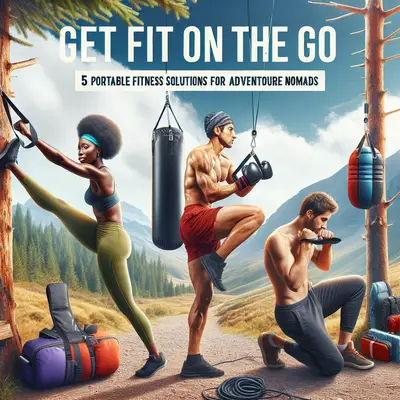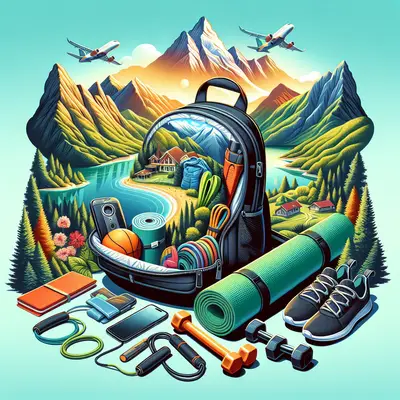
Airports, hostels, sleeper trains—your calendar looks like a departure board, not a training plan. But adventure doesn’t have to cost you your strength. With the right portable gear and a few smart tactics, you can keep your body adventure-ready whether you’re in a jungle lodge, a city micro-apartment, or a 12-bed dorm with questionable curtains.
This guide is for the traveler who refuses to trade pull-ups for pastries and wants equipment that earns its space in the backpack.
Building a “One-Bag” Training Arsenal
When you live out of a carry-on, every gram has to fight for its spot. Your fitness gear should be just as ruthless: lightweight, multi-purpose, and durable enough to survive overhead bins and dusty bus floors.
Think of your setup as a modular system rather than a traditional gym bag. The goal: gear that can turn any doorway, park, or hostel balcony into a training ground in under two minutes.
Key principles for your portable kit:
- Weightless resistance over heavy metal: Focus on tools that use your bodyweight, elastic resistance, or leverage, not iron.
- Multi-use beats single-use: If a piece of gear only does one thing, it needs to do it exceptionally well—or stay home.
- Pack-flat over pack-bulky: If it doesn’t compress or coil, it’d better be critical.
- Durability first: Cheap gear snapping mid-set in a foreign country is more than annoying—it can be dangerous.
A well-curated kit lives in one packing cube, weighs under 3 kg (often under 1 kg), and covers strength, mobility, and conditioning.
The Core-On-Tour Gear Shortlist
You don’t need a mobile gym; you need a few high-impact pieces that unlock dozens of movements. Here’s a battle-tested lineup that works for most travelers and digital nomads.
1. Resistance Bands (Long Loop + Mini Bands)
Long-loop bands and mini bands are the backbone of portable strength:
- Use long loops for rows, presses, squats, deadlift variations, face pulls, and assisted pull-ups.
- Mini bands crush glute activation, hip work, and shoulder stability.
- They roll up smaller than socks and weigh almost nothing.
Look for layered latex or fabric-coated bands from reputable brands (cheap ones tear fast and unpredictably).
2. Lightweight Suspension Trainer (or DIY Straps)
A suspension trainer (like TRX-style straps) anchors to a door, tree, or beam and instantly creates a full-body strength station:
- Rows, presses, fallouts, hip hinges, pistols, and core work—all in one tool.
- Adjust the angle to change difficulty instead of hunting for heavier weights.
- Packs flat and doubles as a stretching/mobility aid.
If you’re ultra-minimalist, you can build a simple version using climbing slings and carabiners—but buy quality hardware.
3. Travel-Friendly Jump Rope
The jump rope is your pocket-sized conditioning beast:
- Use it for high-intensity intervals when you can’t run or don’t trust the neighborhood.
- Great warm-up and coordination tool.
- Choose a coated cable or durable PVC rope that won’t fray on rough surfaces.
Bonus: it’s easy to replace if lost and costs a fraction of a monthly gym membership.
4. Compact Massage Ball or Peanut Roller
Long flights, bus rides, and laptop sessions wreck your tissues:
- A small lacrosse ball or peanut roller digs into hips, glutes, back, and feet.
- Helps offset long sitting hours and tight hostel mattresses.
- Weighs little, doubles as “emergency” grip trainer when bored.
5. Door-Frame Pull-Up Bar (Optional, Location-Dependent)
If you’re semi-settled in one place for a month or more and your accommodation allows it:
- A removable door-frame bar gives you a vertical pulling anchor you’ll actually use.
- Combine with bands for assisted pull-ups, hangs, and core.
For full-time nomads bouncing weekly, this is usually optional—but a game-changer when you stay put a bit longer.
Five Trail-Proof Fitness Tips for Nomads
You don’t need a perfect routine; you need a reliable one that survives flight delays, client calls, and surprise sunsets. These five tips keep you strong while your life stays unpredictable.
Tip 1: Anchor Your Day With a 12-Minute “Non-Negotiable”
Waiting for the perfect 60-minute workout means you’ll train once a week—if that. Instead, build a daily 12-minute non-negotiable session you can do in a tiny room with zero gear:
Example circuit (3 rounds, 40s on / 20s off):
- Push-up variation (incline, standard, or decline)
- Squat variation (air squats, tempo squats, or split squats)
- Hip hinge / glute bridge
- Plank or hollow hold
If you have bands:
- Swap bodyweight squats for band-resisted squats or deadlifts.
- Add band rows hooked around your feet or a sturdy object.
Treat this like brushing your teeth: it happens every day, no debate. Longer workouts are a bonus, not the baseline.
Tip 2: Program for Chaos, Not Perfection
Travel eats routines for breakfast. Instead of a rigid schedule, use a priority-based framework:
- Green days (plenty of time/energy): Full-body strength session (30–45 minutes) using your bands + suspension trainer. Focus on pushing, pulling, hinging, squatting, and core.
- Yellow days (moderate time/energy): Choose 2–3 big movements (e.g., rows, push-ups, split squats) and run them as supersets for 15–20 minutes.
- Red days (destroyed by transit/time zones): Hit your 12-minute non-negotiable and 5 minutes of stretching. Then sleep.
This way, you’re not “off the plan” just because your bus broke down or your client moved a call.
Tip 3: Use Your Surroundings Like a Playground
Portable equipment is your base, but the environment is your multiplier. Train your eye to see options:
- Benches and low walls: step-ups, Bulgarian split squats, incline/decline push-ups, box jumps (if safe).
- Railings and sturdy tables: inverted rows, incline push-ups, supported squats.
- Stairs: loaded stair sprints (with a backpack), calf raises, unilateral step-ups.
- Trees and beams: anchor your suspension trainer or bands for rows and presses.
Combine gear + environment: loop a band around a pole for rows or presses, attach your suspension trainer to a tree for a complete strength setup in a park.
Tip 4: Travel-Light Nutrition Tactics to Back Your Training
You can’t out-band-resistance-train a week of airport pastries and random vending machine dinners. You also don’t need perfection—just a few rules you can apply anywhere:
- Protein first: At every meal, lock in a clear protein source (eggs, Greek yogurt, lentils, tofu, chicken, canned fish). If the local menu’s unreliable, consider a small bag of travel protein powder.
- Fiber insurance: Keep portable fiber on hand—single-serve instant oats, nuts, seeds, or even psyllium packets. They can save your digestion after street food marathons.
- Hydration rule: One full bottle between every flight, long ride, or big work block. Add electrolytes if you’re in hot climates or sweating heavily.
- Snack with intent: Swap random pastries for nuts, jerky, fruit, and yogurt whenever you can. Not perfect, just better.
Nutrition doesn’t have to be “clean”—it just has to support recovery and energy while you keep moving and training.
Tip 5: Build a Weekly “Movement Audit” Ritual
Every week, pick a consistent check-in time (e.g., Sunday night) to audit your movement and adjust:
Ask:
- How many days did I hit my 12-minute non-negotiable?
- How many full-body strength sessions did I fit in?
- Did I walk or move enough outside of workouts (step count, hikes, city explorations)?
- What derailed me—logistics, energy, access, or motivation?
Then adjust your upcoming week:
- If nights kept failing, move training to mornings.
- If you were always “too tired,” shorten sessions and lift the intensity.
- If your environment was the issue, pre-scout parks, gyms, or safe outdoor spaces before you arrive in the next city.
This one ritual keeps you from drifting into “I’ll get back on track when I’m home”—because home is now a moving target.
Packing Strategy: Making It All Fit
Your gear should slide into your existing packing system, not dominate it. A practical layout:
- One compression cube: Bands, jump rope, compact roller/ball, and suspension trainer in a single organizer cube.
- Micro-pocket access: Keep your lightest band and jump rope in an easily accessible pocket so you can train during layovers or before check-in.
- Weight budgeting: If your entire training kit is heavier than your laptop, reconsider what’s actually pulling its weight in your routine.
Pro tip: color-code or label bands and straps so you don’t waste time untangling a rubber spaghetti monster when you’re tired and jet-lagged.
Conclusion
Your passport and your strength don’t have to be in competition. With a tight portable gear kit, a flexible training framework, and a “non-negotiable” daily movement anchor, you can stay strong enough to sprint for trains, shoulder your backpack, and say yes to last-minute hikes without hesitation.
You’re not just “fitting in some exercise while traveling.” You’re turning the entire world into your training ground—and your gear is just the catalyst.
Pack light, move often, and let your carry-on be the only thing that looks small—never your capacity.
Sources
- [American Council on Exercise: Resistance Bands 101](https://www.acefitness.org/resources/everyone/blog/7441/resistance-band-exercises-and-benefits/) - Overview of resistance band benefits, safety tips, and programming ideas.
- [Mayo Clinic: Exercise – How Much Do You Need?](https://www.mayoclinic.org/healthy-lifestyle/fitness/in-depth/exercise/art-20048389) - Evidence-based guidelines for activity levels and how to structure weekly movement.
- [Harvard T.H. Chan School of Public Health: Healthy Eating Plate & Protein](https://www.hsph.harvard.edu/nutritionsource/healthy-eating-plate/) - Practical guidance on building balanced meals with an emphasis on protein and whole foods.
- [Cleveland Clinic: Jump Rope Workout Benefits](https://health.clevelandclinic.org/jump-rope-workout) - Details on cardiovascular and conditioning benefits of jump rope training.
- [CDC: Physical Activity Guidelines for Adults](https://www.cdc.gov/physicalactivity/basics/adults/index.htm) - Official recommendations for aerobic and muscle-strengthening activity levels.
Key Takeaway
The most important thing to remember from this article is that this information can change how you think about Portable Equipment.