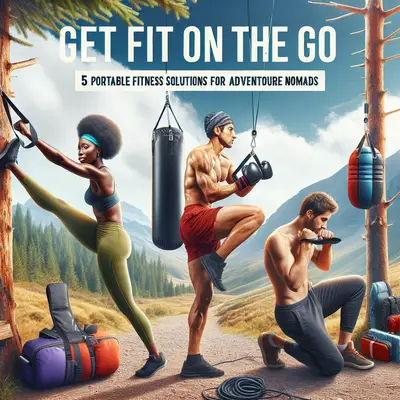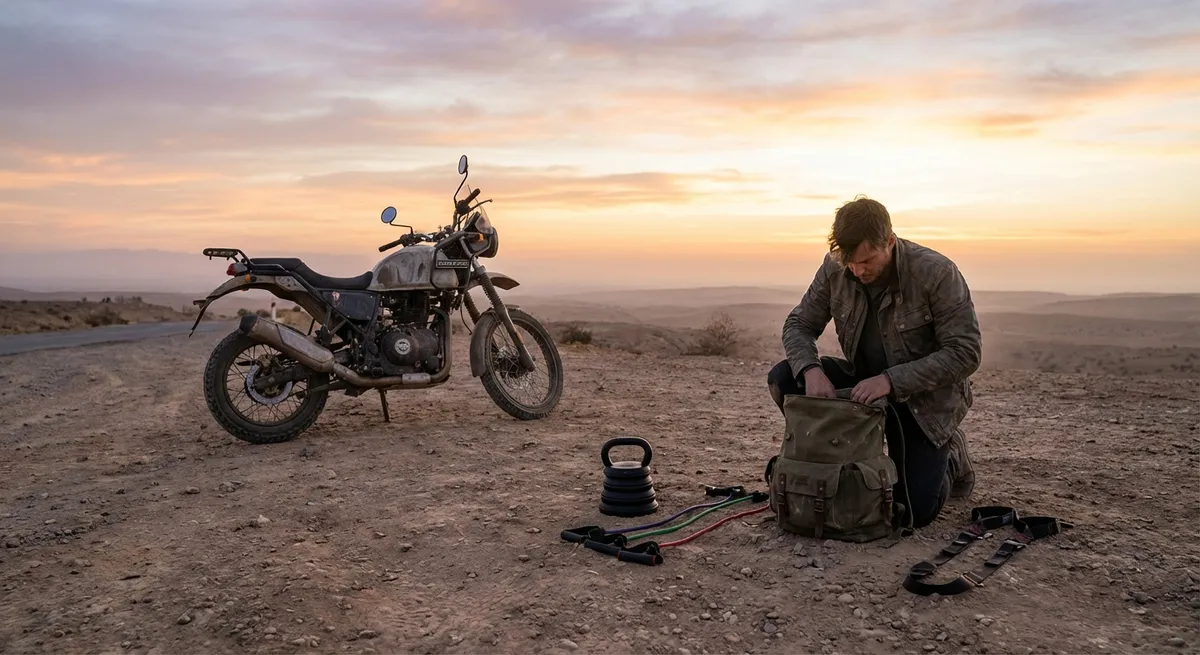
Your suitcase is your gym bag, your hotel room is your training ground, and your passport is basically your membership card. If you live out of a backpack, bounce between client calls and border crossings, and still want to feel strong, you don’t need a fancy facility—you need a compact, ruthless little kit and a game plan that travels as hard as you do.
This guide is your field manual for portable equipment and strength tactics that fit into carry-ons, daypacks, and overhead bins—plus five road-tested fitness tips built for travelers and digital nomads who refuse to go soft between flights.
The Mobile Strength Mindset: Train Like You’re Always “Deployed”
When your environment changes every week, your training can’t rely on routines that demand perfect conditions. You need a mindset that treats every new location as neutral ground: neither an excuse nor an upgrade—just terrain.
Think of portable gear as force multipliers, not crutches. Your bodyweight is always the primary tool; your equipment exists to increase load, tension, or instability. That way, if your bag gets lost or security confiscates something, your entire plan doesn’t crumble.
Prioritize movements that:
- Hit multiple joints at once (push, pull, hinge, squat, carry).
- Scale easily with minimal load changes (tempo, pauses, single-leg work).
- Require as little space as possible (hotel rooms, tiny Airbnbs, narrow balconies).
If you train like you might lose access to anything at any time, you’ll always have a fallback plan—and you’ll stay consistent, which is the only “secret” that actually matters.
The Core-On-Tour Kit: Gear That Punches Above Its Weight
You don’t need a truckload of gear; you need a few tools that do many jobs. Focus on items that are:
- Lightweight
- Compressible
- Multi-use
- Airport-friendly
Here’s a compact setup that can turn almost any space into a training zone:
1. Long Resistance Bands (Loop or Tube)
These are your traveling barbell. They can mimic rows, deadlifts, presses, and carries, and they pack down to the size of a T-shirt. Loop them around bed frames, sturdy doors (with a door anchor), or railings. Heavier bands double as assistance for pull-ups if you find a bar in a park.
2. Mini-Bands / Hip Loops
Tiny, brutal, and perfect for glutes, hips, and shoulder stability. Use them for lateral walks, monster walks, clamshells, or to light up your upper back before push-ups. They weigh almost nothing and can live in your laptop sleeve.
3. Suspension Trainer (e.g., TRX-style)
Optional but powerful. A suspension trainer locks into a door, tree, or balcony rail and turns your environment into a full-body training grid: rows, presses, core, single-leg work. If you want one “hero” piece of gear, this is it.
4. Collapsible Water Containers or Fillable Bags
Instead of lugging weights, carry containers you can load on arrival—water jugs, collapsible water bags, or even a tough tote bag to fill with books, bottles, or sand. These improvised kettlebells and sandbags are perfect for carries, cleans, squats, and swings (if the handle is secure).
5. Jump Rope
If you tolerate impact, a rope turns any patch of concrete into a conditioning lab. It’s brutally efficient when time is tight and hotel gyms are nonexistent. Adjust length so it handles well in cramped spaces or outdoor corners.
Everything above fits into a single packing cube. With that, your “gym” becomes any door, wall, tree, or patch of floor you can claim for 20 minutes.
Five Travel-Grade Fitness Tactics for Nomads Who Don’t Sit Still
These five tips aren’t abstract “stay healthy” platitudes. They’re plug-and-play strategies you can deploy from a hostel bunk, airport hotel, coworking space, or mountain village with questionable Wi-Fi.
Tip 1: Build a Three-Move “Anywhere” Strength Circuit
Create a default session you can run on autopilot when you’re jet-lagged, under-caffeinated, or short on willpower. Pick:
- One Lower-Body Move
- Examples: split squats, banded deadlifts, suspension squats, step-ups.
- One Upper Push
- Examples: push-ups (feet elevated, band-resisted, or slow-tempo), banded presses.
- One Upper Pull
- Examples: band rows, suspension rows, towel rows in a door (only if door is secure).
- 8–12 reps each
- 3–5 rounds
- Rest 45–60 seconds between moves or run as a circuit if you’re pressed for time.
Run them as:
This “three-move battle plan” removes decision fatigue. New city? New schedule? Same core circuit. You can then layer in variety when life calms down.
Tip 2: Turn Transit Days into Mobility and Micro-Strength Opportunities
Airports, trains, and bus stations are usually code for stiff hips, wrecked backs, and terrible food choices. Instead of writing transit days off, use them as light training opportunities.
- At the Gate or Platform
- Ankle rocks, hip circles, standing calf raises, mini-band lateral walks.
- 10–15 bodyweight squats every time you check the departure board.
- On the Plane or Train
- Seated ankle pumps, glute squeezes, gentle neck rotations, shoulder blade squeezes.
- Stand and walk the aisle when allowed; do a few calf raises while waiting for the restroom.
- After Arrival
- 5–10 minutes of dynamic work in your room: cat-camels, hip flexor stretches, thoracic rotations, light band work for shoulders.
You’re not chasing PRs on travel days; you’re keeping joints alive and tissue responsive so you can hit harder sessions once you land.
Tip 3: Use Load “Illusions” When You Can’t Carry Heavy Equipment
You’ll rarely travel with heavy weights, but you can make light loads feel heavy by manipulating how you move.
Try these tactics:
- Tempo Training: 3–5 seconds down, 1–2 seconds pause, controlled up. Suddenly, a banded squat or push-up feels savage.
- Single-Leg & Single-Arm Work: Step-ups, lunges, single-leg RDLs, one-arm presses and rows. Halve the limbs, double the difficulty.
- Extended Range of Motion: Elevate your front foot in split squats, deficit push-ups on books or folded towels, deeper hip hinges with bands.
- Mechanical Drop Sets: Start with a harder version (feet-elevated push-up), then shift to an easier one (regular push-up, then incline push-up) without stopping.
These “load tricks” let you build and maintain solid strength and muscle with nothing more than bands, bodyweight, and improvised weights.
Tip 4: Program for the Week, Not the Day, So Chaos Can’t Derail You
Nomad life is unpredictable. Instead of strict day-by-day plans, think in weekly targets:
Aim to hit each of these at least once per week:
- Lower-Body Strength Session
- Upper-Body Strength Session
- Conditioning Session (rope, stairs, brisk walking, intervals)
- Mobility/Recovery Block (15–20 minutes of dedicated movement)
- One full-body strength day + one upper-only + one lower-only.
- Or three full-body days with different emphases.
- “Heavy” work on stable days (no major travel).
- “Medium” or “light” circuits on transit or high-meeting days.
- Mobility-only when your sleep or recovery is wrecked.
These can be split or combined:
Then plug them into your reality:
This flexible frame keeps you progressing without feeling like you’ve “failed” your plan every time a flight gets delayed or a client shifts a call.
Tip 5: Lock in Two Non-Negotiables: Walk and Anchor One Movement
When everything else falls apart—gear stuck in lost luggage, red-eye flight, 14-hour work sprint—fall back on two non-negotiables:
Walk Daily, Anywhere
Use walking as your baseline conditioning and recovery tool: - Walk to coffee instead of ordering in. - Take walking calls. - Explore every new city on foot for at least 20–30 minutes.
This keeps your joints moving, your head clear, and your step count honest without “exercise mode” friction.
Anchor to One Movement You Never Skip
Choose a simple, equipment-free move you can do almost anywhere. For example: - 30–50 push-ups across the day - 40–60 bodyweight squats - 60 seconds of plank plus 60 seconds of dead bug - 3 sets of 15–20 band pull-aparts
When your schedule is wrecked, do that one thing. It keeps the habit alive and stops the “all-or-nothing” spiral. Many strong bodies have been maintained on nothing more than walking plus one anchor movement done consistently.
Conclusion
A portable training life is less about owning the perfect travel gadget and more about owning a system that survives airline chaos, timezone drift, and questionable hotel carpets. With a compact kit, a three-move fallback circuit, a weekly target mindset, and a couple of hard non-negotiables, you can land in any city on earth and still move like you’re mission-ready.
Your gear should fit in your hand luggage. Your plan should fit in your head. The world is your gym—your portable arsenal just makes it easier to prove it every time you zip your bag and move on.
Sources
- [American Council on Exercise – Resistance Bands: What You Need to Know](https://www.acefitness.org/resources/everyone/blog/6842/resistance-bands-what-you-need-to-know/) – Overview of band benefits, exercise ideas, and why they’re effective for portable strength training.
- [Harvard Health Publishing – The Benefits of Walking](https://www.health.harvard.edu/staying-healthy/walking-your-steps-to-health) – Evidence-backed breakdown of walking’s impact on cardiovascular health, mood, and longevity.
- [Mayo Clinic – Strength Training: Get Stronger, Leaner, and Healthier](https://www.mayoclinic.org/healthy-lifestyle/fitness/in-depth/strength-training/art-20046670) – Explains core principles of strength training that can be adapted to portable equipment.
- [CDC – Physical Activity Guidelines for Adults](https://www.cdc.gov/physicalactivity/basics/adults/index.htm) – Baseline recommendations for weekly activity volumes to maintain health while traveling.
- [Cleveland Clinic – Benefits of Flexibility and Stretching](https://health.clevelandclinic.org/why-flexibility-is-important/) – Covers why mobility and flexibility work matter, especially for frequent travelers spending long periods sitting.
Key Takeaway
The most important thing to remember from this article is that this information can change how you think about Portable Equipment.