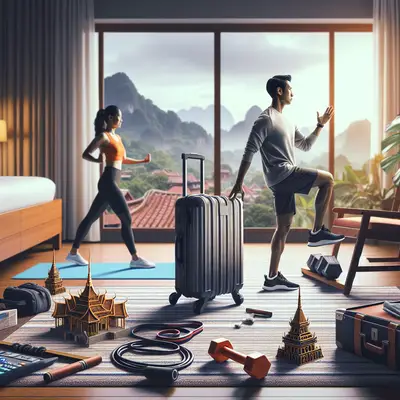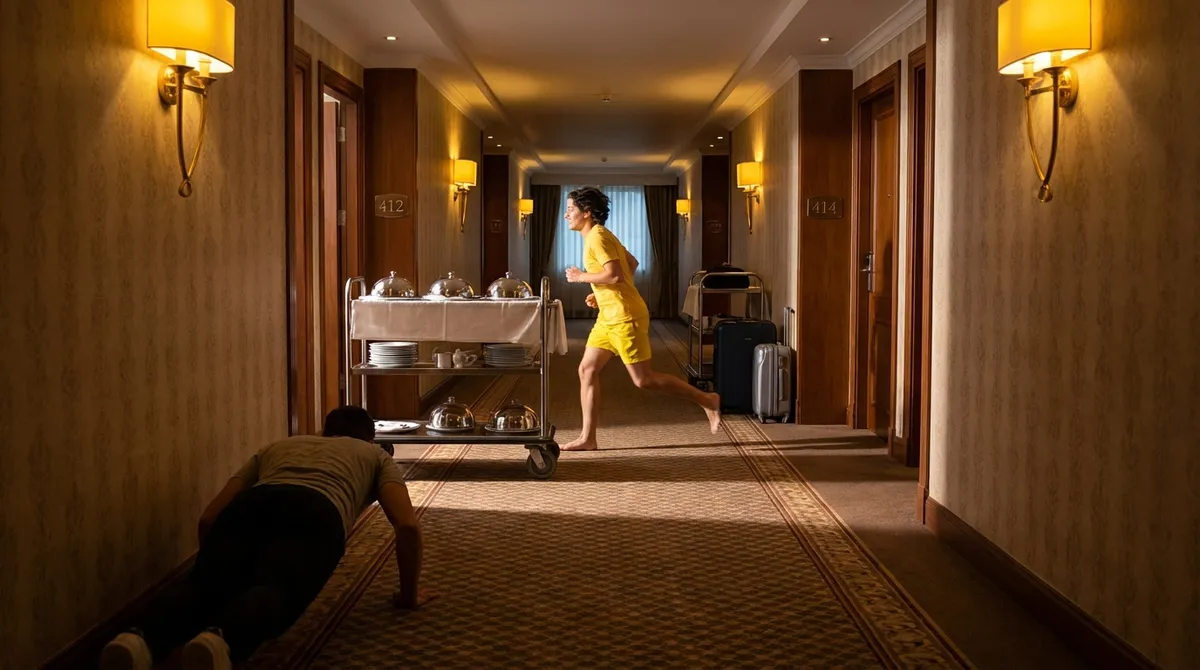
You checked in for the Wi‑Fi and the hot shower—but your body still wants adventure. Hotel walls, weird carpets, and a key card that only works half the time don’t have to kill your momentum. With a little creativity, that box of a room becomes a training ground that keeps you strong enough for sunrise flights, tight layovers, and spontaneous detours.
This isn’t about perfection. It’s about staying ready—anywhere, with almost nothing.
Map Your Micro-Gym Before You Unpack
Before you sink into the bed, scout the terrain.
Walk the room like you’re recon-ing a training site. Check the floor space between the bed and desk. Test the sturdiness of the chair and the edge of the bed. Peek at the hallway length and stairwells. Look for a quiet corner near the fire exit, or an outdoor terrace nobody uses at dawn.
Once you’ve mapped it, claim it. Decide: “This two-meter strip of floor and that chair? That’s my gym.” Your brain starts to associate that zone with movement, not emails. If there’s a fitness center, great—but don’t rely on it being open, stocked, or not crowded. Your primary “facility” is the space you control: the room, the corridor, the stairs. That mindset shift is what keeps your training consistent, no matter how weird the hotel layout is.
Tip 1: Build a Zero-Equipment Strength Circuit
You can train hard with nothing but your body and a patch of carpet.
Rotate these movements in a simple circuit, 30–45 seconds each, 15 seconds rest between, 3–5 rounds. Adjust intensity by slowing down, adding pauses, or speeding up.
- Bedframe Push Variations
Use the bedframe or desk edge for incline push-ups if you’re building strength, or the floor for standard or decline push-ups (feet on the bed). Keep your core tight like you’re in a moving train trying not to sway.
- Suitcase Squats
Load your backpack or carry-on with clothes, laptop, or books. Hug it to your chest and squat, keeping your heels down and chest up. This mimics goblet squats without a kettlebell.
- Doorframe Isometric Holds
Stand in the doorway, forearms against the frame, and push out as if you’re trying to widen the door. Hold for 10–20 seconds, rest, repeat. Great for upper-body tension when you can’t jump or drop weights.
- Towel Hamstring Slides
On a tile or hardwood patch, lie on your back, heels on a folded towel, hips up. Slide your feet away and back slowly, keeping hips lifted. Pure hamstring fire without needing a machine.
- Plank Walkouts
From a standing position, hinge at the hips, walk your hands out to a high plank, hold, then walk back. It’s part mobility, part core strength, part wake‑up call for your shoulders.
This circuit hits major muscle groups, raises heart rate, and respects thin hotel walls—no burpees crashing into the downstairs ceiling.
Tip 2: Turn Stairs and Hallways Into Your Cardio Track
When the treadmill is broken or occupied, your backup is built into the building.
Start with the stairs. Climb at a sustainable pace from the lobby to your floor and back down. Add challenge by:
- Doing double-step climbs (if your knees are healthy)
- Using intervals: one floor easy, one floor hard
- Wearing your loaded backpack for extra resistance
Hallways are perfect for low-impact conditioning when stairwells are busy. Pick a quiet stretch and alternate:
- Fast walks or light jogs (if noise allows)
- Walking lunges down, walk back
- Side shuffles or “defensive slides” for lateral work
- High-knee marching instead of running if you need to stay quiet
Keep sessions short and sharp—10–20 minutes is enough. Stair and corridor work mirrors real-world demands: climbing subway steps, hustling through terminals, chasing down a delayed connection. You’re training for the way travel actually feels.
Tip 3: Pack a Two-Item “Micro Kit” That Doubles Your Options
You don’t need a suitcase full of gear. Two light items can transform your hotel routine:
- Mini Resistance Bands (Loop Bands)
They weigh almost nothing and turn any room into a strength station. Loop one around your legs above the knees for squats and lateral steps. Hook one to your hands for push-up variations. Use it for rows by anchoring to a sturdy door hinge or bedframe (test carefully).
- Jump Rope or Speed Rope
If ceilings allow and neighbors won’t hate you, a rope is the most space-efficient cardio tool you can carry. If jumping isn’t an option, you can still do “ghost jumps” (same motion, no rope) to mimic the rhythm and intensity.
With just those two, you can run a full-body session:
- Band rows, band presses, band deadlifts with your suitcase as the anchor
- Glute bridges + band abductions to wake up hips wrecked by long flights
- Jump rope intervals: 20 seconds on, 20 seconds off for 5–10 minutes
If weight is ultra-tight, choose one: bands over rope. They give you strength work that’s hard to replicate with bodyweight alone in tiny spaces.
Tip 4: Use “Jet-Lag Blocks” for Short, Frequent Sessions
Travel rarely gives you a clean 60-minute workout window. You get fragments: 10 minutes before a call, 12 before checkout, 8 while your coffee brews.
Use “Jet-Lag Blocks”: 5–15 minute bursts scattered through the day. Aim for 2–4 blocks instead of one long session.
Example day in a hotel:
- Morning (Post-Shower):
2 rounds of: 12 push-ups, 15 squats, 30-second plank
- Midday (Call Break):
5 minutes of stair intervals: one flight fast, one flight slow
- Late Afternoon (Energy Slump):
10 band rows, 10 band presses, 12 split squats each leg, repeat 2–3 times
- Evening (Pre-Bed Reset):
5–7 minutes of slow stretching: hips, hamstrings, chest, and upper back
This structure matches the rhythm of digital nomad life—fragmented, timezone-shifted, unpredictable. You trade “gym perfect” for “mission consistent,” which matters more when days blur between airports and transient addresses.
Tip 5: Align Movement With Recovery So You Wake Up Ready to Roam
Training on the road is only half the equation; recovery keeps you from grinding into the ground.
In a hotel environment, focus on these anchors:
- Post-Flight Mobility
Hit five movements after long travel: hip flexor stretch, hamstring reach, chest opener against the doorframe, gentle spinal rotations, and ankle circles. Two minutes each. You’re telling your body, “We’ve landed, you can move again.”
- Light Evening Circulation, Not Hard Night Workouts
Go hard earlier in the day if you can. At night, favor walking, easy band work, and stretching. Intense late training plus blue screens wrecks sleep, which is already under attack from time zone jumps.
- Hydration and Simple Nutrition Rules
Drink water as soon as you hit the room—dehydration magnifies jet lag. Keep a basic rule: protein at each meal and at least one serving of something that grew in the ground. Hotel breakfast? Eggs plus fruit beats sugar bombs every time.
- Sleep Environment Hacks
Use the hotel’s notepad or a towel to block light leaks under the door. Turn the room temperature slightly cooler. If street noise is heavy, run the bathroom fan or use a white noise app. Better sleep means tomorrow’s workout won’t feel like survival training.
Recovery isn’t passive—it’s another form of training that keeps you mobile, clear-headed, and ready to say “yes” to unplanned adventures without your body revolting.
Conclusion
Every hotel stay can either soften you up or sharpen you. You don’t need a polished gym, perfect schedule, or heavy gear—just a willingness to treat corridors as tracks, stairwells as hills, chairs as benches, and a carry-on as a mobile weight stack.
Your room key doesn’t just open a door; it unlocks another chance to stay strong enough to keep moving, keep exploring, and keep saying yes to the next unexpected turn in the map.
Travel will always be chaotic. Your training doesn’t have to be.
Sources
- [American Council on Exercise (ACE) – At-Home/No-Equipment Workouts](https://www.acefitness.org/resources/everyone/blog/7726/ace-sponsored-research-no-equipment-no-excuses/) - Research and guidelines showing how effective bodyweight and minimal-equipment training can be
- [CDC – Physical Activity Basics](https://www.cdc.gov/physicalactivity/basics/index.htm) - Official recommendations on activity levels and how to break movement into smaller bouts
- [National Institutes of Health – Jet Lag and Sleep](https://www.ncbi.nlm.nih.gov/books/NBK279388/) - Overview of how travel and time-zone shifts affect sleep and recovery
- [Harvard Health – Why Strength Training Matters](https://www.health.harvard.edu/exercise-and-fitness/strength-training-builds-more-than-muscles) - Evidence-based explanation of the benefits of maintaining strength while aging and traveling
- [Mayo Clinic – Stair Climbing and Heart Health](https://www.mayoclinic.org/healthy-lifestyle/fitness/expert-answers/stair-climbing/faq-20057958) - Discussion of the cardiovascular benefits and practicality of stair climbing as exercise
Key Takeaway
The most important thing to remember from this article is that this information can change how you think about Hotel Fitness.