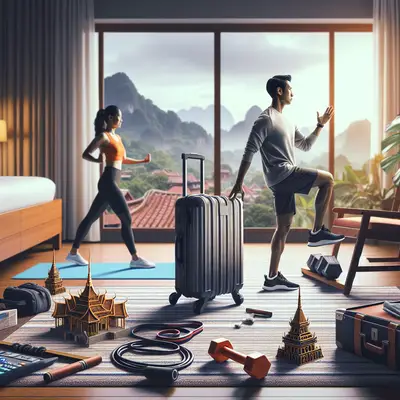
You don’t have to “pause” your strength just because your passport is getting stamped. Hotels are temporary bases, not excuses. With a bit of creativity and a few portable tools, you can walk into almost any property on the planet and treat it like a mini training ground—hallways, door frames, luggage, and all.
This isn’t about squeezing in random burpees beside the bed. It’s about building a repeatable hotel fitness system so your body stays strong while your itinerary gets wild.
Scout Your New “Training Zone” Like an Explorer
Before you open your laptop or crash on the bed, do a 5-minute recon of your surroundings. Think like you’re mapping a new climbing route or scouting a trail.
Walk the hotel:
- Hallways: Check length, corners, and quieter floors. Long, low-traffic corridors are perfect for loaded carries, walking lunges, or mobility laps.
- Stairs: Goldmine. Stairwells are usually empty and give you ready-made conditioning and leg strength options. Practice step-ups, calf raises, and stair intervals.
- Room Layout: Note door frames, solid furniture, wall space, and open floor area. This determines what bodyweight and band exercises you can safely do.
- Outdoor Spaces: Courtyards, parking decks, or nearby parks can become your “gym extension” for sprint intervals, walking lunges, and stretching sessions.
- Actual Hotel Gym (if it exists): Don’t just glance. Check what’s really there (dumbbells? cable station? only treadmills?). Decide right away how that gear fits your plan instead of wandering in later with no idea what to do.
Treat each new stop like a fresh level in a game: different layout, same mission—get in, train with what you’ve got, and get out stronger.
Tip 1: Anchor Your Day with a 20-Min Hotel Ritual
The longer you wait to train, the more likely travel chaos eats your discipline alive. Set a non-negotiable 20-minute block—ideally right after waking or immediately on check-in.
Use a simple structure that works in almost any room:
Activation (3–4 minutes)
- March in place or light hallway walk - Arm circles, leg swings, and hip circles - 10 slow bodyweight squats + 10 glute bridges
Strength Circuit (12–14 minutes)
Perform in a loop, minimal rest, 3–4 rounds based on time: - 8–12 push-ups (hands on bed or floor) - 10–15 squats or split squats - 8–12 bent-over rows (backpack loaded with clothes, books, or water bottles) - 20–30 seconds of a plank or suitcase carry with backpack
Cool-Down (3 minutes)
- Hamstring stretch using the bed or chair - Chest stretch in the doorway - Slow nasal breathing while lying on the floor or bed
This is your minimum viable workout. If travel days crush you, you still hit this ritual—no debate, no willpower drama. Anything extra (gym session, stair intervals) is a bonus, not a requirement.
Tip 2: Pack a Micro Gym That Fits in Your Laptop Bag
You don’t need a trunk full of steel to stay powerful on the road. A tight, portable kit can give you a ridiculous number of options in even the tiniest room.
Consider building a travel “micro gym” with:
- Loop Resistance Band (light–medium): For rows, pull-aparts, banded push-ups, hip work, and deadlifts.
- Mini-Band (hip circle): Takes up almost no space, great for glute activation and knee-friendly lower-body work.
- Suspension Trainer or Strong Door Anchor Strap: Lets you perform rows, face pulls, supported squats, and fallouts using just a door.
- Jump Rope (if ceiling height allows): Compact conditioning tool that beats slogging on a crowded treadmill.
- Collapsible Lacrosse or Massage Ball: For self-massage after long flights and suitcase hauls.
Build a default “Hotel Micro Gym Session” like this:
- Band Rows
- Band or Suspension Push-Ups
- Mini-Band Lateral Walks
- Band Deadlifts or Good Mornings
- Core: Suitcase hold with backpack or banded anti-rotation holds
Run 8–12 reps per move for 3–5 rounds. In under half an hour you’ve hit most major muscle groups with more structure than 90% of hotel guests bouncing between machines.
Tip 3: Make Luggage Work for You, Not Against You
Your suitcase is basically a soft-sided kettlebell that you’re already traveling with. Put it to work.
Ideas for using your carry-on or backpack:
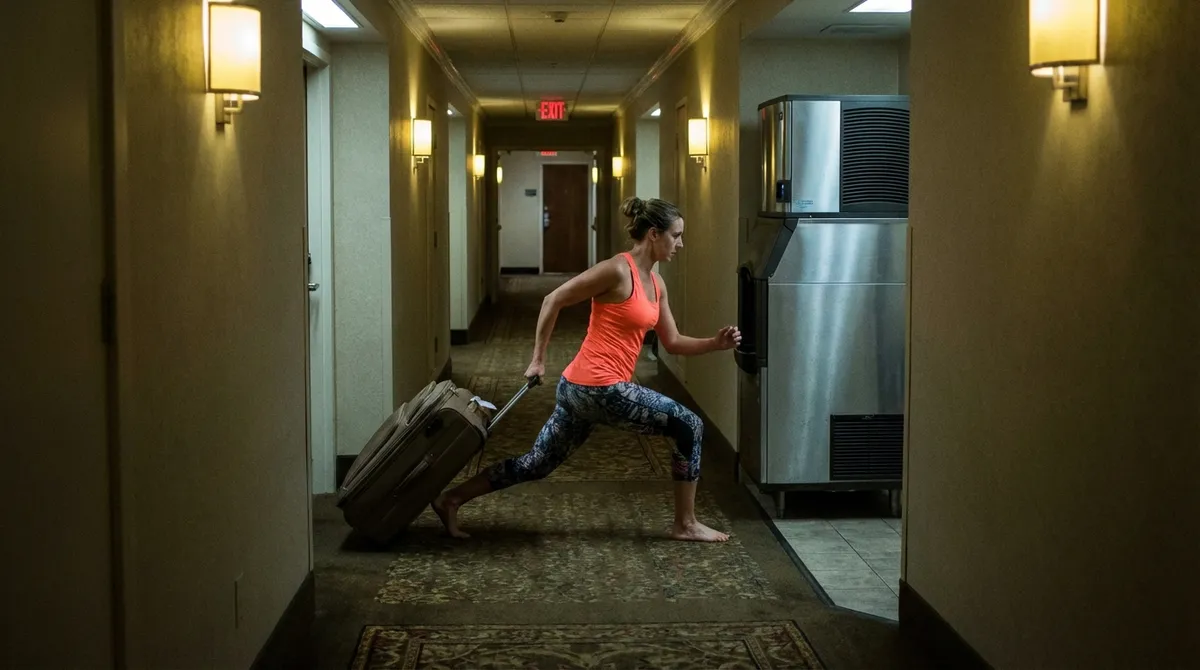
- Loaded Carries in the Hallway
- Suitcase carry (one side only, then switch)
- Front carry (hug backpack to chest)
- Overhead carry (if the bag is stable and light enough)
- Suitcase Deadlift & Row Combo
- Stand over the handle, hinge at the hips, deadlift to stand tall
- At the top, row the bag to your chest (if handle allows), then lower and repeat
- Backpack Goblet Squats & Lunges
- Hug the backpack against your chest as a weight for squats or reverse lunges
- Focus on control and range of motion—not speed
- Floor Press with Backpack
- Lie on your back, hold loaded backpack with both hands
- Press from chest to straight arms, squeeze for a second, and control it down
Try 20–40 meters each of:
Weight is adjustable: just add or remove clothes, books, water bottles, or travel gear. As your trip progresses, you can actually periodize your “program” based on how heavily you’ve packed.
Tip 4: Claim the Stairwell as Your Conditioning Playground
When the hotel gym is a battlefield of selfie-takers and treadmill joggers, the stairwell is usually deserted and brutally effective.
A sample stairwell session:
- Warm-Up: One easy walk up and down, ankle circles, and light quad/hip stretches.
- Intervals (10–15 minutes):
- Walk or lightly jog up 1–3 flights
- Walk back down slowly, focusing on control
- Repeat 6–10 times depending on fitness level and time
Add strength work between climbs:
- 8–10 incline push-ups on a landing rail
- 10–15 step-ups on a low step (each leg)
- 20–30 seconds of wall sit
Keep safety first: good shoes, no rushing on the way down, and use the rail if your legs start to wobble. The goal is controlled effort, not heroic collapse.
Stair sessions are powerful for short trips, jet-lag days, and when local neighborhoods don’t feel ideal for outdoor runs.
Tip 5: Use “Travel Rules” to Stay Consistent, Not Perfect
Travel wrecks rigid routines, so create simple, flexible rules that keep your body moving without obsessing over perfection.
Examples of travel fitness rules:
- The Arrival Rule: Within 2 hours of check-in, do one strength circuit or hallway walk, no matter how messy.
- The Movement Floor: Move your body for at least 15 minutes every day (could be walking, mobility, or a full workout).
- The Jet Lag Reset: When you wake up in a new time zone, immediately expose yourself to daylight and do 5–10 minutes of light movement (walking, mobility, or easy band work) to help your body clock adjust.
- The Screen Swap: Any time you feel yourself scrolling aimlessly in bed or on the desk chair, swap 5 minutes of scrolling for 5 minutes of stretching or light bodyweight movement.
These guardrails keep you from slipping into “I’ll start again when I’m home” mode. The goal on the road is maintenance and momentum, not setting personal records.
Conclusion
Every time you check into a hotel, you’re stepping into a fresh training environment. You don’t control the gym hours, equipment, or square footage—but you control your attitude, your micro gym, and your willingness to turn corridors and stairwells into a strength quest.
Keep your rituals light but non-negotiable. Let your luggage earn its ticket by doubling as weight. Build your sessions around what is available, not what’s missing. That’s the nomad advantage: you get stronger not in spite of the constant motion, but because you learned how to train through it.
Pack the bands. Scout the terrain. Own the stairwell. Your passport can collect stamps while your body quietly collects strength.
Sources
- [American Council on Exercise (ACE) – Exercise Anywhere: Body Weight Workouts](https://www.acefitness.org/resources/everyone/blog/7639/exercise-anywhere-body-weight-workouts/) - Practical ideas for bodyweight training without traditional gym equipment
- [Harvard Health Publishing – The Benefits of Strength Training](https://www.health.harvard.edu/staying-healthy/the-importance-of-strength-training) - Overview of why maintaining strength matters for health and longevity
- [CDC – Physical Activity Guidelines for Adults](https://www.cdc.gov/physical-activity-basics/guidelines/adults.html) - Evidence-based recommendations for weekly activity levels and intensity
- [Cleveland Clinic – How Climbing Stairs Benefits Your Health](https://health.clevelandclinic.org/climbing-stairs-benefits) - Details on the cardiovascular and strength benefits of stair climbing
- [Sleep Foundation – Jet Lag: Symptoms, Causes, and Treatment](https://www.sleepfoundation.org/jet-lag) - Explains jet lag and strategies like movement and light exposure for faster adjustment
Key Takeaway
The most important thing to remember from this article is that this information can change how you think about Hotel Fitness.