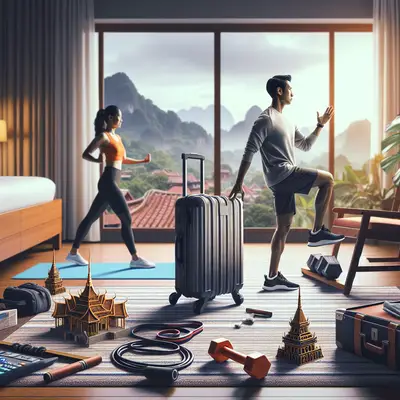
Your hotel isn’t just a place to sleep—it’s a temporary base camp waiting to be turned into a training ground. Whether you’re crashing for one night between flights or settling in for a month-long work sprint, you can build real strength and stamina without a fancy gym, a suitcase full of gear, or a perfect schedule.
This guide is all about portable, hotel-friendly tactics that keep you adventure-ready: minimal equipment, zero drama, and workouts you can smash in the time it takes room service to arrive.
Turning Any Hotel into a Movable Training Zone
Most travelers think “fitness” means hunting for a decent hotel gym or nearby studio. That’s optional. What you actually need is a system you can drop into any building—budget motel, boutique hotel, or serviced apartment—and run on autopilot.
Start by mapping your micro-terrain: your room, the hallways, stairs, and any quiet corner or emergency exit landing. Each becomes a station. The bed frame or sturdy chair turns into a base for rows and step-ups. The hallway becomes your sprint lane. Stairs become your hill repeats. Suddenly, you’re not trapped in a small room; you’re operating in a vertical playground.
The goal: remove negotiation. When you arrive, do a 3-minute scout—walk the hall, find the stairwell, test the furniture for stability. Once you know your zones, “I don’t have a gym” stops being a reason and becomes a challenge you’ve already solved.
Tip 1: Hallway Intervals That Beat the Treadmill
Most hotel treadmills are either broken, booked, or set to a speed that insults your legs. The hallway? Always open.
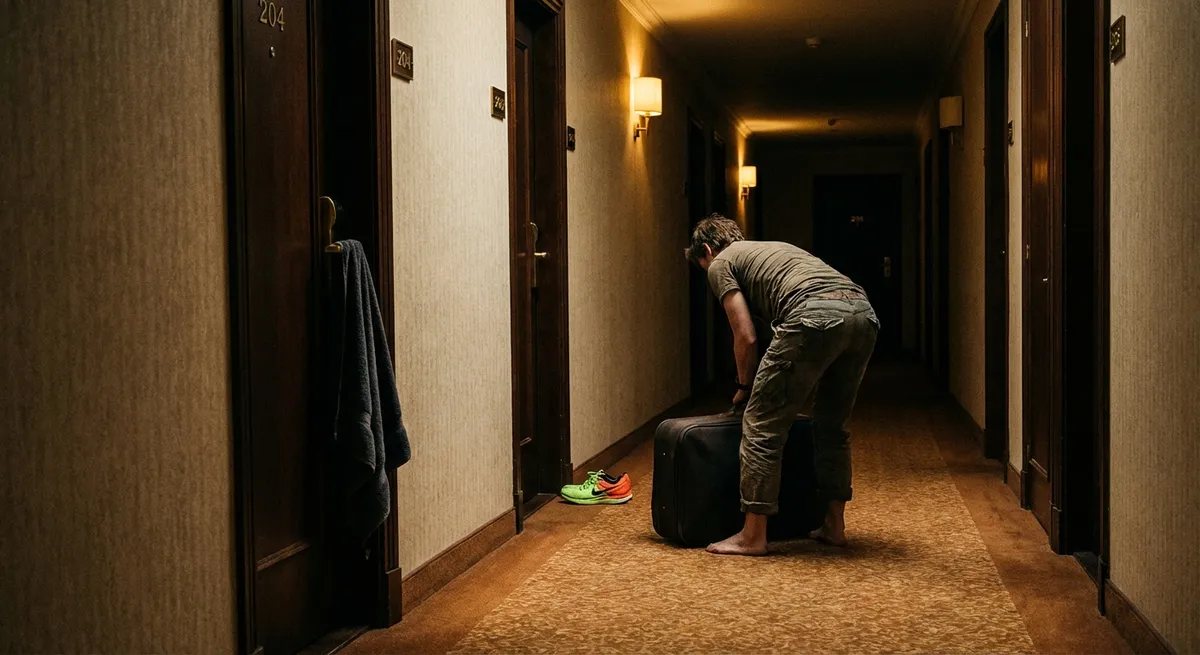
Pick two landmarks: your door and the fire exit, or two visible room numbers. That’s your “track.” After a quick warm-up (marching in place, arm circles, bodyweight squats for 3–5 minutes), you cycle through short bursts of speed and recovery.
Use a simple structure:
- 20–30 seconds fast walk or light run down the hall
- 40–60 seconds easy walk back
- Repeat for 8–12 rounds
If you’re worried about noise, make it a power-walk interval instead of a run—short steps, strong arm drive, pushing off the floor quietly. Aim for posture: tall spine, eyes forward, soft foot strike. You’re not just “getting steps in”; you’re building work capacity so that long hikes, city wandering days, or last-minute surf sessions don’t wreck you.
When you’re done, finish with an easy walk for a few minutes, then light stretching in your room. You’ve just turned a boring corridor into a cardio engine, no waiting for equipment, no sign-up sheet, no excuses.
Tip 2: Stairwell Strength for Legs That Travel Well
If the hallway is your track, the stairwell is your mountain. Stairs hit your glutes, quads, calves, and lungs in a way that translates directly to real-world adventure—trail climbs, long sightseeing days, and hauling luggage up sketchy hostel steps.
Start simple:
- Walk up one to three flights at a steady pace
- Walk back down with control (not crashing each step)
- Rest 30–60 seconds at the bottom
- Repeat for 6–10 rounds depending on your level
- 8–12 bodyweight squats
- 8–10 elevated push-ups on the rail or step
- 8–10 standing calf raises on the edge of a step
To add strength work, insert moves at the bottom or top of each climb:
Keep one hand near the rail if you’re fatigued, especially on the way down—descending is where you’re most likely to misstep. Focus on posture and breathing, not racing. You want your heart rate high but your movement controlled.
Stair sessions are short, intense, and hotel-proof. Even 10–15 minutes a few times a week will keep your legs ready for spontaneous detours—like ditching an Uber to explore a city on foot.
Tip 3: The “Carry-On Circuit” You Can Do in a 2-Meter Strip
Small room? No problem. You only need the length of your carry-on laid end-to-end to build a full-body circuit that trains strength, stability, and mobility.
Try this travel-safe routine:
- Squat to Calf Raise – Stand feet shoulder-width, squat down as if sitting into a chair, then push up and finish on your toes.
- Suitcase Deadlift – Use your actual suitcase. Stand with it in front of you, hinge at hips, slight knee bend, grab the handle, stand tall. Switch hands halfway through the set.
- Incline Push-Ups – Hands on desk, dresser, or sturdy nightstand. Easier on wrists and shoulders, still effective.
- Towel Rows – Loop a strong towel around a door handle on the hinge side (door fully closed). Lean back, pull your chest toward the door, squeeze your shoulder blades, then lower with control.
- Plank Shoulder Taps – High plank from hands, feet wider than hips, tap opposite shoulder without rocking your hips.
Run each move for 30–40 seconds with 20–30 seconds rest, cycling through 3–4 rounds. It’s controlled, quiet, and friendly for thin hotel walls. You’re using what you already carry—your bag, a towel, a desk—to build a mobile strength base that shows up whether you’re in Bangkok, Berlin, or a roadside motel.
Tip 4: Micro-Sessions for Packed Schedules and Jet Lag
Travel days don’t respect your training plan. Meetings move, flights delay, sunsets tempt you outside instead of into a gym. Waiting for a perfect 45-minute block means you’ll train far less than you think.
Instead, use “micro-sessions”—small training hits scattered through your day:
- Wake-Up Hit (3–5 minutes): 10 squats, 10 incline push-ups, 10 reverse lunges per leg, repeat once.
- Midday Reset (5–8 minutes): 30–60 seconds plank, 15–20 suitcase deadlifts, 10–12 towel rows, repeat.
- Pre-Shower Finish (5 minutes): 20 seconds fast hallway walk, 40 seconds slow walk, repeat for 4–6 rounds.
Micro-sessions are easier on jet-lagged bodies and unpredictable calendars. They keep your joints moving, your circulation high, and your brain awake for calls and creative work. Over a full travel day, these short bursts can match or even beat one “perfect” gym session that rarely happens.
Anchor them to non-negotiables: wake-up, after lunch, before shower. No calendar block required—just a decision.
Tip 5: Packable Tools That Actually Earn Their Luggage Space
You don’t need a trunk full of gear, but a few grams of smart equipment can multiply your hotel options. The key is choosing tools that are:
- Light
- Durable
- Multi-use
- Allowed in carry-on (no metal spikes, no bulky items)
- Mini loop bands: Great for glute activation, shoulder warm-ups, lateral walks, and hip work before long walking days.
- Long resistance band: Anchor it in a closed door for rows, presses, pulldowns, face pulls, and even assisted single-leg work.
- Jump rope (if your neighbors can tolerate it): Fast, portable cardio. If impact is an issue, mimic the rope move without actually jumping or use hallway power walks instead.
- Lacrosse or massage ball: Tiny, tough, perfect for rolling out feet, glutes, and upper back after long flights or bus rides.
High-ROI items:
Store it all in a small mesh pouch that lives in your bag. When you unpack, place it somewhere visible—on the desk or by the TV remote. If you see it, you’ll use it. If it stays buried, it might as well be back home.
When a hotel gym is decent, your bands upgrade every machine. When there’s no gym at all, those same bands turn your room into a strength lab.
Conclusion
Adventurous travel doesn’t have to erase your fitness—it can sharpen it. When you treat hotels as training zones instead of temporary holding pens, every corridor, stairwell, and room layout becomes part of your routine.
You don’t need perfect equipment, perfect time blocks, or perfect energy. You need a simple system:
- Hallways for intervals
- Stairs for strength and lungs
- A carry-on circuit for small spaces
- Micro-sessions for chaotic days
- A tiny kit of high-value tools
Dial those in, and you’ll land in each new city not just checked in—but charged up and ready to chase whatever the map throws at you.
Sources
- [Centers for Disease Control and Prevention – Physical Activity Basics](https://www.cdc.gov/physicalactivity/basics/index.htm) - Guidelines on recommended amounts and intensities of exercise for adults
- [American College of Sports Medicine – ACSM’s Guidelines for Exercise Testing and Prescription (Overview)](https://www.acsm.org/education-resources/trending-topics-resources/acsm-guidelines) - Evidence-based principles for cardio and strength training structure
- [Harvard T.H. Chan School of Public Health – Benefits of Physical Activity](https://www.hsph.harvard.edu/obesity-prevention-source/obesity-prevention/physical-activity-and-obesity/) - Research-backed health benefits of regular, moderate-intensity activity
- [American Heart Association – Interval Training and Heart Health](https://www.heart.org/en/healthy-living/fitness/fitness-basics/interval-training) - Explains how and why interval-style workouts (like hallway intervals) support cardiovascular fitness
- [Mayo Clinic – Exercise: 7 Benefits of Regular Physical Activity](https://www.mayoclinic.org/healthy-lifestyle/fitness/in-depth/exercise/art-20048389) - Overview of how consistent exercise improves energy, mood, and long-term health
Key Takeaway
The most important thing to remember from this article is that this information can change how you think about Hotel Fitness.