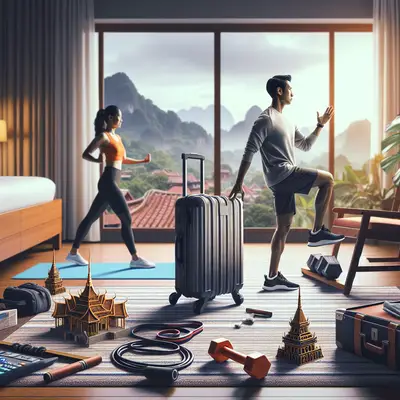
You don’t need a keycard to the hotel gym to stay strong on the road—you just need a plan that fits in your carry-on and survives flight delays, cramped rooms, and questionable time zones. This guide is for travelers and digital nomads who want adventure-ready strength, not just steps on a smartwatch. We’ll keep it light on gear, heavy on practicality, and built for real-world travel chaos.
Redefine “Workout”: Micro-Sessions That Fit Between Check-Ins
Forget the idea that you need a 60-minute uninterrupted session. On the road, consistency beats perfection.
Instead of one long workout, stack short “micro-sessions” through your day: 5–10 minutes each, 2–4 times. Think of them as strength snacks between flights, meetings, or sightseeing.
Pick 3–4 movements that hit your biggest muscles and use them across the day. For example:
- Morning (right after waking):
- 1–2 sets of slow squats (or suitcase goblet squats if you have a bag)
- 1–2 sets of incline push-ups (hands on desk or bed)
- Midday (before lunch or a call):
- 1–2 sets of split squats using the bed or chair for balance
- 1–2 sets of backpack rows (load a backpack and pull to your ribs)
- Evening (after work or exploring):
- 1–2 sets of glute bridges or single-leg hip lifts
- 30–60 seconds of a wall sit or plank
These short bursts keep your muscles engaged, fight travel stiffness, and are easier to start (and finish) when your routine keeps changing.
Fitness Tip #1: Stop chasing perfect workouts—chase frequent, short sessions. Set phone alarms titled “5-minute strength break” and treat them like non-negotiable meetings.
Turn Your Room into a Minimalist Training Ground
You don’t need machines; you need leverage. Hotel rooms come pre-loaded with tools if you know how to see them.
Use what’s already there:
- Desk or dresser – Elevated push-ups, hands-elevated planks, bodyweight rows if you can get under a sturdy edge.
- Bed – Bulgarians (rear-foot-elevated split squats), hip thrusts, modified decline push-ups (feet on bed, hands on floor).
- Wall – Wall sits, wall-supported handstand holds (for the adventurous), shoulder openers.
- Towel – Towel rows (loop around a sturdy door hinge side and row), isometric deadlifts (stand on towel, pull up without moving).
A simple full-body session with zero official “equipment”:
- 8–12 squats (or split squats)
- 8–12 incline push-ups
- 10–15 towel or backpack rows
- 20–30 seconds plank
- 20–30 seconds wall sit
Cycle that 2–3 times. If you’re short on energy, do just one round at a hard effort and call it a win.
Fitness Tip #2: When you enter a room, do a 30-second “scout”: find your squat space, your push-up surface, and your row setup. Claim your training zone before you collapse on the bed.
Pack a Pocket-Sized Power Kit (Without Building a Home Gym)
You don’t need a suitcase full of gear. One small kit can cover most of your strength needs while adding barely any weight.
Consider this ultra-portable setup:
- Mini loop bands – Great for glutes, shoulders, and warm-ups. Slide into any pocket.
- One light long resistance band – Anchor it in a door (hinge side, locked door) for rows, presses, pulldowns, and rotations.
- Jump rope (optional) – For quick cardio hits if your ceiling height allows.
- Lacrosse or tennis ball – For rolling feet, glutes, and upper back after long travel days.
Sample resistance band workout:
- Band rows (anchored in door)
- Band overhead press or chest press
- Band good mornings or Romanian deadlifts
- Band pull-aparts for posture
- Finish with band walks (around legs) for glutes
With progressive tension (shortening the band, stepping further out, or slowing the tempo), this can stay challenging for a very long time.
Fitness Tip #3: Create a “go bag” that never leaves your backpack: 1–2 bands + 1 ball. Knowing your tools are always there removes the “I don’t have equipment” excuse.
Anchor Your Strength to Your Travel Rhythm, Not the Clock
Time zones change. Check-out times shift. Flights get delayed. Instead of locking your training to a specific hour, tie it to daily events that happen no matter where you are.
Example anchor points:
- After your first coffee or tea → 5–10 minutes of mobility and core
- Before starting laptop work → One strength circuit (squats, push-ups, rows)
- After you return to your room for the night → Short decompression: hip stretches, light band work, breathing
This ritual-based approach makes training part of your travel ritual, not a separate chore you keep trying (and failing) to squeeze in.
A simple strength ritual before laptop time:
- 10 squats
- 8–10 push-ups (any variation)
- 10 rows (backpack, band, or towel)
- 20–30 seconds plank
Run it 1–3 times depending on time and energy. Do this most days and you’ve quietly built a serious base.
Fitness Tip #4: Replace “I’ll work out at 7 p.m.” with “I train right before I open my laptop.” Travel wrecks schedules, but it rarely cancels your first work session.
Move Like an Explorer, Not a Gym Member
Travel gives you a secret weapon: built-in adventure movement. Use your destination as part of your training instead of feeling guilty for missing a treadmill run.
Ideas that blend adventure and fitness:
- Choose stairs over elevators in hotels, hostels, and metros.
- Turn sightseeing into long walking tours; aim to cover parts of the city on foot.
- If safe and practical, walk or bike to co-working spaces instead of defaulting to rideshares.
- Use hills, beaches, or parks as natural training grounds for sprints, walking lunges, or step-ups on benches.
Think of your formal “hotel workouts” as your foundation, and your exploration as bonus conditioning. That mental shift keeps you active without obsessing over whether you “really worked out.”
Fitness Tip #5: Before you book, check maps for nearby parks, waterfronts, or stairs. Treat them like amenities just as important as Wi-Fi.
Conclusion
Hotel fitness for nomads isn’t about perfect facilities—it’s about portable habits. With micro-sessions, room-based training, a tiny gear kit, routine anchors, and movement baked into exploration, you can keep your body adventure-ready whether you’re in a luxury suite, a budget airport hotel, or a tiny guesthouse with paper-thin walls.
The world won’t organize itself around your training schedule. But with the right systems, your training can quietly adapt to wherever your passport takes you.
Sources
- [American Council on Exercise (ACE) – Bodyweight Training](https://www.acefitness.org/education-and-resources/lifestyle/exercise-library/equipment/bodyweight/) - Exercise ideas and guidance for effective bodyweight workouts without equipment
- [Mayo Clinic – Fitness: Tips for Staying Fit While Traveling](https://www.mayoclinic.org/healthy-lifestyle/fitness/in-depth/fitness/art-20048269) - Practical recommendations for keeping up with exercise routines on the road
- [Harvard Health – The Importance of Strength Training](https://www.health.harvard.edu/exercise-and-fitness/the-importance-of-strength-training) - Explains why maintaining muscle and strength matters for health and longevity
- [CDC – Physical Activity Basics](https://www.cdc.gov/physicalactivity/basics/index.htm) - Official guidelines on how much activity adults need and why consistency is key
- [Cleveland Clinic – Resistance Bands: How to Use Them and Why They Work](https://health.clevelandclinic.org/resistance-band-exercises) - Overview of resistance band benefits and sample exercises suitable for travel
Key Takeaway
The most important thing to remember from this article is that this information can change how you think about Hotel Fitness.