If your passport gets more action than your gym membership, hotel rooms become more than just places to sleep—they’re temporary basecamps. Between time zones, spotty gyms, and unpredictable schedules, staying strong on the road can feel impossible. But with a bit of strategy (and a carry-on-friendly approach), you can walk into any hotel, anywhere in the world, and know exactly how to keep your body adventure-ready.
This isn’t about chasing perfection. It’s about building a travel-proof fitness blueprint you can deploy whether you’re in a 5-star tower in Tokyo or a budget inn off a dusty highway.
Turn Any Hotel Room into a Micro-Gym
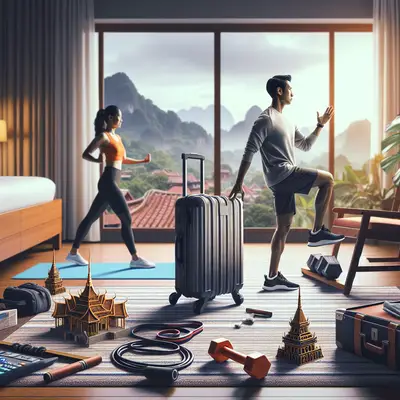
Most hotel rooms are basically the same: a bed, a chair, maybe a desk, and a bit of floor. That’s more than enough to train like a nomad who means business.
Start by claiming your training zone. Slide your suitcase to one side, move the desk chair, and clear a rectangle of floor space. That’s your “mat,” even if you don’t have one. Use the bed frame (if it’s sturdy and fixed) or the desk for elevated push-ups, incline planks, and triceps dips. Door frames can support isometric holds (like pushing your palms out against the frame) when you’re short on equipment and noise tolerance.
If your room has carpet, great—less impact on your joints. If it’s hard flooring, lay down a towel or hoodie for cushioning during ground work. Keep your “micro-gym” set up for the duration of your stay so there’s no friction or decision-making—just wake up, hydrate, and move. Think of every check-in as unlocking a new version of the same basecamp, not starting from scratch.
Tip 1: Build a No-Equipment Strength Circuit (That Fits Between Meetings)
Your best hotel workout is the one you can actually finish between calls, flights, or late check-ins. Aim for a simple, repeatable bodyweight circuit you can knock out in 15–20 minutes without waking up your neighbors.
Here’s a hotel-friendly blueprint you can adjust to your level:
- Lower body: Squats or split squats (using the bed or chair for balance)
- Push: Incline push-ups on the desk or bed edge
- Pull/upper back: Loaded backpack rows (fill your pack with clothes, books, or a laptop)
- Core: Planks or dead bugs on a towel
- Power/activation: Slow, controlled calf raises using the room step or thick carpet edge
Run 3–4 rounds, 8–15 reps per exercise (or 20–30 seconds for holds), with 30–45 seconds rest between moves. Focus on controlled tempo, full range of motion, and stable breathing. When you land in a hotel late and can’t face the gym, this circuit makes sure you don’t write off the day.
Tip 2: Pack a “Stealth Strength” Kit in Your Carry-On
You don’t need a trunk full of gear to stay strong when you travel—just a few ultra-portable tools that vanish into your bag but dramatically expand what you can do in a room.
Consider building a minimalist “stealth strength” kit:
- Light to medium resistance band: For rows, pull-aparts, face pulls, and hip work
- Mini-loop band: For glute activation, lateral walks, and squat variations
- Jump rope (if noise and ceiling height allow): For quick conditioning bursts
- Door anchor (if you use bands): To turn any solid door into a cable machine
These weigh almost nothing and give you pulling, rotational, and isolation options you can’t get from bodyweight alone. Use the resistance band for standing rows anchored in the door, “lat pulldowns” from above the door frame, or single-arm presses if the hotel gym is overcrowded or under-equipped.
Keep this kit in an easy-to-reach pocket of your luggage. If you only have 10 minutes before a call, you can grab your band, knock out a quick upper-body pump, and return to your laptop feeling sharper and more awake than if you’d scrolled your phone.
Tip 3: Use the Hotel Gym with a Plan, Not Just Good Intentions
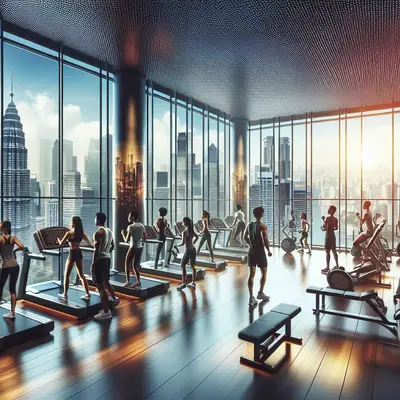
Hotel gyms are a gamble: sometimes you get a near-full setup, sometimes it looks like a treadmill museum. Either way, if you walk in with a simple plan, you won’t waste time trying to invent a workout on the fly.
A reliable three-move structure is:
- Push: Dumbbell bench press or push-ups
- Pull: One-arm dumbbell rows or band rows (if they only have light weights)
- Legs: Goblet squats, reverse lunges, or step-ups on a low bench
Layer in core (like suitcase carries with a single dumbbell or anti-rotation holds using a cable stack) and a short conditioning finisher (bike intervals, incline treadmill, or rower sprints) if time allows.
If the gym is packed or the dumbbells stop at “too light,” slow everything down: 3–5 seconds lowering the weight, 1–2 seconds holding at the bottom, then an explosive but controlled push back up. Increased time under tension keeps the work challenging even with less load and fewer options.
Think of hotel gyms as bonus resources, not necessities. You’re not dependent on them—you’re just exploiting them when they’re good enough.
Tip 4: Sync Movement with Your Flight and Work Schedule
Consistency on the road isn’t about matching a perfect weekly program—it’s about smart timing. When flights, time zones, and calls stack up, your body doesn’t care about your ideal plan; it cares about recovery, circulation, and keeping your baseline strength online.
Anchor your hotel training to moments that naturally happen:
- Post-arrival “de-kink” session: 10–15 minutes of light mobility, squats, band pull-aparts, and core after you drop your bags. This flushes out stiffness from sitting and helps reset your posture.
- Morning activation: Before you touch your laptop, 5–10 minutes of light movement—glute bridges, bird dogs, shoulder circles, easy planks. It’s not a “workout” so much as a wake-up sequence.
- Between-meeting bursts: 5 minutes of every-hour movement during long workdays—wall sits, push-ups on the desk edge, standing band rows. It keeps energy and focus from crashing.
On heavy travel days (long flights, airport sprints, late arrivals), treat movement as maintenance, not max effort. Save hard sessions for nights you sleep well and days with fewer logistics. Train your brain to recognize “today is a big travel day, so I’m in body-maintenance mode”—you’re still moving, just not emptying the tank.
Tip 5: Make Recovery Part of Your Hotel Ritual
Adventure-ready doesn’t just mean strong; it means able to hike, carry, sprint for gates, and sleep deeply enough to do it again tomorrow. That hinges on how well you recover inside the four walls of your room.
Start with the simplest tools you already have:
- Towel roll: Roll a towel tight and use it as a makeshift foam roller along your upper back and under your calves or hamstrings.
- Hot shower “contrast” reset: Alternate warm and slightly cooler water for a few cycles on your legs and shoulders to encourage circulation after long travel days.
- Bedtime unwind: 5–10 minutes of floor-based stretching—hip flexors, hamstrings, chest, and upper back. Keep the lights dim, screens off, and breathing slow and deep to help your nervous system downshift.
Protect your sleep like it’s your most important piece of equipment: use the hotel’s extra blanket to block light under the door, set the room fan or A/C to create white noise, and keep caffeine earlier in the day when crossing time zones. Movement without recovery leads to burnout; movement with recovery builds the kind of resilience that lets you say yes to last-minute adventures without hesitation.
Conclusion
Every hotel door you open can be more than just a room—it can be the next waypoint in a long-term strength journey that survives red-eyes, deadlines, and border crossings. When you treat each stay as a mini basecamp, you stop waiting for “when I’m back home” to take your fitness seriously.
Pack a tiny kit. Own your floor space. Use the gym when it helps, ignore it when it doesn’t. Move after flights, activate before work, and guard your recovery. Do that, and you won’t just be a traveler—you’ll be a traveler whose body is always ready for the next detour, summit, or sprint to the gate.
Sources
- [American College of Sports Medicine – Staying Active While Traveling](https://www.acsm.org/docs/default-source/files-for-resource-library/staying-active-while-traveling.pdf) - Practical guidance from ACSM on maintaining physical activity on the road
- [CDC – Physical Activity Basics](https://www.cdc.gov/physicalactivity/basics/index.htm) - Evidence-based recommendations on activity levels and health benefits
- [Harvard Health Publishing – Benefits of Strength Training](https://www.health.harvard.edu/staying-healthy/strength-training-builds-more-than-muscles) - Overview of why resistance training matters for long-term health and function
- [Sleep Foundation – How Travel Affects Sleep](https://www.sleepfoundation.org/travel-and-sleep) - Explains jet lag, hotel sleep challenges, and strategies to improve rest while traveling
- [Mayo Clinic – Exercise: 7 Benefits of Regular Physical Activity](https://www.mayoclinic.org/healthy-lifestyle/fitness/in-depth/exercise/art-20048389) - Summarizes broad health benefits of consistent exercise, relevant to frequent travelers
Key Takeaway
The most important thing to remember from this article is that this information can change how you think about Hotel Fitness.