Your passport’s full of stamps, your inbox is full of flight confirmations, and your body? It’s caught somewhere between time zones and hotel carpets. Staying fit on the road doesn’t require a full gym, a “perfect routine,” or monk-level discipline—just a bit of creativity, a carry-on mindset, and a willingness to turn every hotel into your temporary training basecamp.
This guide keeps things portable, simple, and adaptable, so you can land in any room, at any hour, and still feel strong, sharp, and ready for the next flight.
Turning a Hotel Room Into Your Micro Training Zone
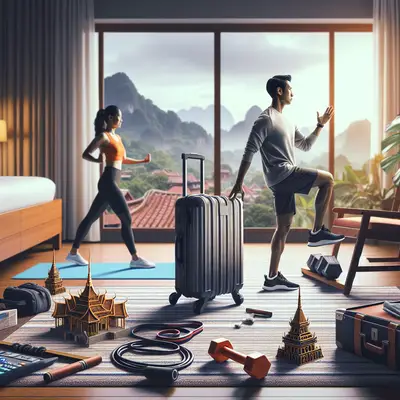
Forget the idea that you need a full rack of weights to get a real session. Hotel rooms are basically blank training boxes with doors that lock and furniture that moves.
Start by clearing your “training lane.” Slide a chair to the side, park your suitcase near the wall, and claim a strip of floor wide enough for you to lie down with arms out. If the carpet feels sketchy, use a towel or yoga mat as a barrier.
Use the environment:
- The bed for elevated push-ups or hip thrusts
- The wall for wall-sits and handstand practice (if your shoulders are ready for it)
- A sturdy chair for step-ups or Bulgarian split squats
- Your suitcase or backpack as a makeshift weight (load it with clothes, books, or even water bottles)
Think less “perfect gym,” more “functional hideout.” Your only job is to move with intent and keep your body ready for the next leg of your journey.
Tip 1: Build a 15-Minute “Jet Lag Circuit” You Can Do Anywhere
When you’re hopping time zones, consistency beats intensity. A simple, repeatable circuit you can do in 15 minutes is more powerful than a random hard session once a week.
Try this total-body hotel circuit:
- 40 seconds squats → 20 seconds rest
- 40 seconds push-ups (regular, incline on the bed, or knee) → 20 seconds rest
- 40 seconds glute bridges on the floor or feet elevated on the bed → 20 seconds rest
- 40 seconds reverse lunges → 20 seconds rest
- 40 seconds plank hold → 20 seconds rest
Complete 3 rounds. That’s it.
Keep the rules simple:
- Do this circuit within 2 hours of waking in a new time zone to signal “daytime” to your body.
- If you’re exhausted, cut it to 2 rounds but still show up.
- No equipment required, minimal noise, and it fits in almost any room.
This is your “no excuses” baseline—miss flights if you must, miss this as rarely as possible.
Tip 2: Pack a Pocket-Sized “Travel Strength Kit”
You don’t need a portable gym; you just need a few light, multi-use tools that disappear in your bag but punch way above their weight.
Consider this minimalist kit:
- Mini resistance bands: For glute activation, shoulder work, and added tension to squats or push-ups.
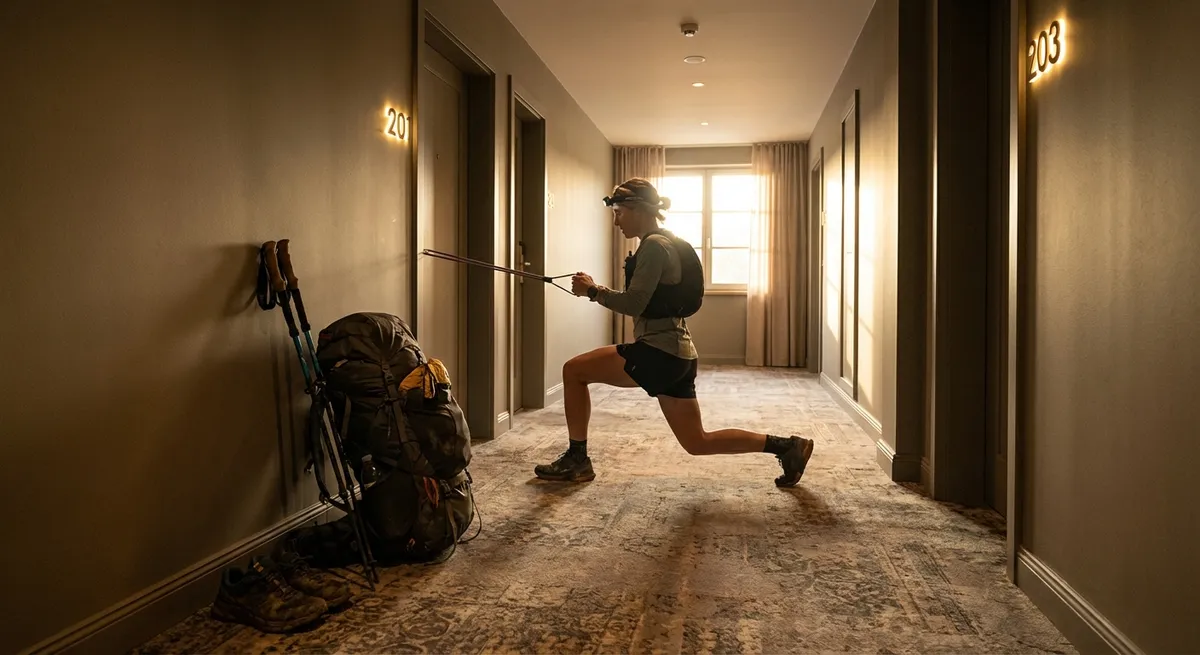
- A long resistance band: Loop around hotel door frames (carefully), chairs, or your own body for rows, presses, and assisted pull variations.
- Jump rope (if noise and ceiling height cooperate): High-output conditioning tool that fits in your palm.
- Lightweight travel mat or foldable mat: Optional, but helpful if you’re squeamish about the carpet or doing core work daily.
With just bands and your body weight, you can cover push, pull, hinge, squat, and carry patterns. That keeps your strength, posture, and joint health from slowly eroding while you’re living out of a backpack.
Tip 3: Use the Hotel Itself as Your Endurance Playground
The building you’re sleeping in doubles as a vertical training field. Even if the “fitness center” is a sad treadmill facing a blank wall, the rest of the property is usually fair game.
Ways to turn the hotel into a conditioning tool:
- Stair sprints or power climbs: Walk 2–3 floors to warm up, then power up 3–5 floors at a strong pace, walk down, repeat 4–6 times.
- Hallway intervals: Quiet shuffle runs or brisk walks down the corridor and back (especially early morning or late at night).
- Loaded carries: Grab your backpack or suitcase and walk laps around your floor for 5–10 minutes, switching hands to stay balanced.
- Pool sessions (if available): Easy laps, walking in the shallow end, or simple intervals like 30 seconds swim / 30 seconds rest.
Stay respectful: keep noise low, avoid peak guest traffic, and skip anything that involves slamming feet or dropping weight on the floor. You’re here to explore, not get a noise complaint.
Tip 4: Anchor Your Day With a “Movement Bookend” Ritual
Travel shreds routines. Your calendar gets weird, your meals get erratic, and your sleep dances around your flights. The antidote: bookend your day with short, non-negotiable movement rituals—morning and night.
Morning bookend (5–10 minutes):
- 1–2 minutes of easy breathing: in through the nose, out through the mouth.
- 8–10 slow cat-cow or spine rolls to unlock your back after the hotel bed.
- 10–15 bodyweight squats + 10–15 wall push-ups or incline push-ups on the desk.
- Brief doorway chest stretch and hip flexor stretch.
Evening bookend (5–10 minutes):
- 1–2 minutes of nasal breathing to downshift your nervous system.
- Light stretching for hamstrings, hip flexors, and upper back.
- Optional: 60–90 seconds of a low plank or side plank to finish the day “switched on” but calm.
These bookends are your anchor points—no matter the city, time zone, or level of chaos, you hit these. Over weeks and months, they quietly protect joint health, posture, and mental clarity.
Tip 5: Sync Movement With Your Travel Days, Not Against Them
Travel days can feel like write-offs: security lines, cramped seats, bad food. Instead of trying to cram a “perfect workout” into those days, let your training flex around your itinerary.
Strategize like this:
- Night-before flights: Do something strength-focused—hotel circuit with bands, stair climbing, or loaded suitcase carries. Your body will handle the next day’s sitting better.
- Morning of travel: Move lightly—mobility, easy walk, and a few squats or lunges to wake up the hips and spine. Think “priming,” not crushing.
- Layovers: Walk the terminal deliberately. Skip the moving walkways. Use a quiet gate area for calf raises, hip circles, and gentle stretching.
- Arrival days: Aim for a short, low-friction session within a few hours of checking in—5–15 minutes of light movement to shake off stiffness and help reset your internal clock.
Your mindset shift: training is part of your travel system, not some separate thing you’ll “get back to” once you’re home. Your body is the one piece of gear you can’t replace mid-trip—treat it like essential equipment, not an afterthought.
Conclusion
Your hotel room doesn’t need to be a downgrade from your home gym; it’s a temporary basecamp on a bigger expedition. With a simple jet lag circuit, a pocket-sized strength kit, a willingness to use stairwells and hallways, and small movement rituals bookending your day, you can keep your strength, stamina, and sanity intact while the scenery keeps changing.
Your flights, meetings, and adventures will always be unpredictable. Your commitment to move—even for 10 focused minutes in a strange room—doesn’t have to be. Pack light, adapt fast, and let every check-in be a fresh chance to train.
Sources
- [American Council on Exercise – Benefits of Bodyweight Training](https://www.acefitness.org/resources/everyone/blog/7639/benefits-of-body-weight-training/) – Overview of why simple, equipment-free workouts are effective for strength and fitness
- [CDC – Physical Activity Guidelines for Adults](https://www.cdc.gov/physicalactivity/basics/adults/index.htm) – Government recommendations on weekly activity levels and types of movement
- [Harvard Health Publishing – The Truth About Exercise and Sleep](https://www.health.harvard.edu/newsletter_article/exercise-and-sleep) – Explains how movement can help regulate sleep, useful for jet lag and travel fatigue
- [Mayo Clinic – Benefits of Resistance Bands](https://www.mayoclinic.org/healthy-lifestyle/fitness/expert-answers/resistance-bands/faq-20057984) – Details why resistance bands are an effective, portable training option
- [Cleveland Clinic – Why Movement Breaks Matter When You Sit a Lot](https://health.clevelandclinic.org/how-often-should-you-get-up-from-your-desk) – Discusses the health impact of prolonged sitting and the value of frequent movement, relevant on flights and travel days
Key Takeaway
The most important thing to remember from this article is that this information can change how you think about Hotel Fitness.