If your “home base” changes every week, your body shouldn’t pay the price for your passport stamps. Hotel life can wreck routines—odd check-in times, mystery minibars, lobby cocktails—but it can also be a training playground if you know how to use it. This guide is for travelers and digital nomads who want more from a hotel than clean sheets and coffee: you want stronger legs, a calmer nervous system, and lungs that can handle sprinting for that last boarding call.
Below are five travel‑proof fitness tactics that don’t care if your hotel gym is elite, outdated, or nonexistent. Pack light, move smart, and treat every stopover like a new training zone.
Scout the Terrain: Turning Any Hotel Into a Training Map
Before you ever hit “start” on your timer, map the terrain like you’re planning a micro‑expedition.
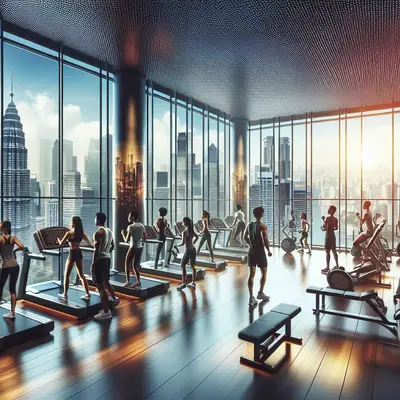
As soon as you arrive, take a 10–15 minute “recon walk” of the property. Look for long hallways for walking lunges, stairwells for hill‑climb substitutes, railings or sturdy desks for incline push‑ups, and open corners for stretching. If there’s a gym, note what you actually have: adjustable dumbbells, cable stack, treadmill, or just a dusty multi‑station.
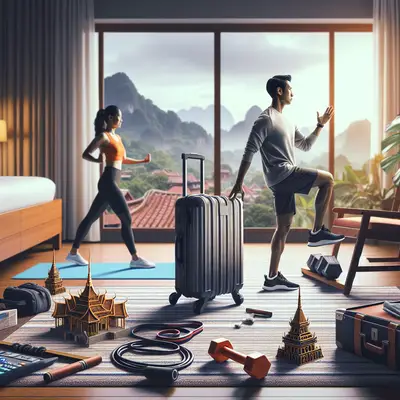
Next, check your room: solid door for band work, a heavy chair for step‑ups and triceps dips, enough floor space for a yoga mat or towel. Open the curtains—natural light helps your circadian rhythm reset after travel, which makes training and sleep easier.
Finally, set a “movement checkpoint” in your day: maybe every time you pass the stairwell you climb two flights, or before every shower you do five minutes of mobility. These micro-rules turn an anonymous hotel into a living obstacle course instead of just a place you crash between Zoom calls and train rides.
Tip 1: Build a 15‑Minute “Jet Lag Circuit” You Can Run Anywhere
Long travel days drain willpower. A pre-planned, short circuit takes the decision-making out of the equation and keeps your fitness progressing between cities.
Create one go‑to bodyweight circuit you can run in your room with zero setup:
- 40 seconds squats → 20 seconds rest
- 40 seconds push‑ups (incline on desk if needed) → 20 seconds rest
- 40 seconds reverse lunges → 20 seconds rest
- 40 seconds glute bridge on the floor or bed edge → 20 seconds rest
- 40 seconds dead bug or plank → 20 seconds rest
Repeat this 2–3 times depending on energy and time.
Set a non-negotiable rule: on any travel day you don’t touch a gym, you still run this circuit at some point—post-check-in, before a shower, or after your last call. Because it’s timed rather than rep-based, it automatically adjusts to your energy level; you just keep moving. Over time you can progress by adding a round, slowing every rep for more control, or cutting rest to 10–15 seconds.
Consistency beats hero workouts. This kind of “default circuit” keeps your joints, muscles, and brain primed even when your sleep, meals, and time zones are chaos.
Tip 2: Turn Stairs and Hallways Into Your Cardio Lab
Treadmills come and go; stairs are almost guaranteed.
Pick a stairwell that feels safe and well-lit. After a 3–5 minute easy warm‑up (marching in place and gentle hip circles), build a simple interval:
- Walk up 2–4 flights at a brisk pace
- Walk down slowly, using the descent as your recovery
- Repeat for 10–15 minutes
To progress, you can add a “power round” every third trip: climb faster, take slightly larger steps, or add 10–15 seconds of hallway marching at the top before heading down. If stairs are too intense or your knees complain, turn hallways into an interval track:
- 30–45 seconds brisk walk or light jog down the hall
- 30–45 seconds easy walk back
- Repeat for 10–20 minutes
If you carry a small resistance band, you can add hallway side steps, monster walks, or banded walks between doors. This strategy doubles as jet lag therapy: light to moderate cardio early in the local day helps shift your internal clock and improve nighttime sleep quality.
Tip 3: Pack a “Pocket Gym” That Weighs Less Than a Hoodie
You don’t need a suitcase full of iron to train like you mean it. A minimalist, hotel‑proof kit can disappear into your backpack and still give you full‑body resistance work.
Consider packing:
- A pair of light and medium loop resistance bands (for glutes, shoulders, and hips)
- One long resistance band with handles or a loop (for rows, presses, and pulldowns using a door anchor or sturdy hinge)
- A compact jump rope (for high‑intensity cardio in parking lots or quiet outdoor corners)
This setup lets you mimic most gym patterns: banded rows off the door for your upper back, presses and overhead presses for shoulders and chest, banded RDLs and squats for legs. Use higher reps (12–20 per set) and slower tempos to get a solid strength and hypertrophy stimulus from lighter loads.
If you can, choose a “travel rule”: for every full week of continuous travel, hit at least two “band-only” sessions plus your regular bodyweight work. That way, when you find a well-equipped gym again, your connective tissue is ready and you haven’t lost your pulling strength—one of the first things to vanish when all you do is push‑ups and planks.
Tip 4: Sync Training With Time Zones Instead of Fighting Them
Roaming across time zones wrecks the usual morning/evening workout dichotomy. Instead of clinging to your home schedule, anchor your training to the local clock to speed adaptation.
Use this framework:
- Landed in the morning or midday? Aim for a light-to-moderate session within 4–6 hours of arrival: walking intervals, bodyweight circuit, or light bands. Exposure to daylight and moderate movement helps shift your internal clock toward the new zone.
- Landed in the late afternoon or night? Keep it gentle: 5–10 minutes of stretching, mobility, and breathwork in your room. Hard training too close to local bedtime can make it tougher to fall asleep.
- Staying somewhere for more than 3–4 days? Pick a local “anchor hour” (e.g., 7 a.m. or 5 p.m.) and commit to moving at that time daily—whether it’s a full workout, a stair session, or a mobility flow. Your body learns: “At this hour, we move.”
Push heavy or intense sessions to days you’re a bit better rested—usually day two or three after arrival. On brutal jet lag days, trade intensity for frequency: two or three 5-minute micro-sessions spread across the day rather than one long grind. That keeps blood sugar and mood steadier without hammering an already stressed system.
Tip 5: Use Micro‑Workouts to Survive Call Stacks and Red‑Eye Chaos
Digital nomad days often look like: sit, call, sit, email, sit, collapse. Instead of fighting for one huge workout, thread movement through your work blocks.
Options that play nice with hotel life:
- Desk breaks: Every 60–90 minutes, stand up and do one set of 8–15 squats, 8–15 incline push‑ups on the desk or dresser, and a 30–45 second plank. It’s not heroic, but eight of these in a day add up.
- Coffee timer rule: While your coffee brews or the kettle boils, do calf raises, shoulder circles, and gentle hip mobility.
- Call warm‑up: For audio‑only calls, stand and pace the room or hallway. If it’s a long sync, alternate between walking and light stretching.
- Pre‑shower ritual: Before every shower, hit a 4–5 minute routine: hip hinges, lunges, wall slides, and light band pull‑aparts if you have them.
These “fragments” stack volume without feeling like you’re sacrificing working time or leisure. They also fight the worst enemy of the traveling body: long, uninterrupted sitting that tightens your hips, flattens your glutes, and drains mental energy.
Conclusion
Hotels don’t have to be excuses for lost progress; they can be test labs for how adaptable and creative your training really is. When you scout your environment, carry a tiny pocket gym, align your workouts with the local day, and lean on micro‑sessions, you turn even the most generic chain hotel into an adventure base for your nervous system, lungs, and muscles.
Your body doesn’t care about your loyalty program status or how “nice” the gym is. It responds to tension, movement, and consistency. Next check‑in, don’t just grab the room key—claim the stairwell, the hallway, and the four walls as your temporary training ground. Then take that stronger, more resilient body with you to the next border crossing.
Sources
- [Centers for Disease Control and Prevention – Physical Activity Basics](https://www.cdc.gov/physicalactivity/basics/index.htm) - Overview of recommended activity levels and health benefits of regular movement
- [World Health Organization – Physical Activity Fact Sheet](https://www.who.int/news-room/fact-sheets/detail/physical-activity) - Global guidelines on exercise intensity, duration, and sedentary behavior
- [Harvard Health Publishing – The Importance of Stretching](https://www.health.harvard.edu/staying-healthy/the-importance-of-stretching) - Evidence-based look at flexibility, mobility, and simple routines that fit into travel days
- [Johns Hopkins Medicine – Jet Lag: What It Is and How to Beat It](https://www.hopkinsmedicine.org/health/wellness-and-prevention/jet-lag-what-it-is-and-how-to-beat-it) - Explains how time zone shifts affect sleep and how movement and light help reset your clock
- [American Council on Exercise – Benefits of Short Exercise Bouts](https://www.acefitness.org/resources/pros/expert-articles/5535/what-are-the-fitness-benefits-of-exercising-in-short-bouts-throughout-the-day/) - Discusses how brief, frequent bouts of activity can add up to meaningful fitness gains
Key Takeaway
The most important thing to remember from this article is that this information can change how you think about Hotel Fitness.