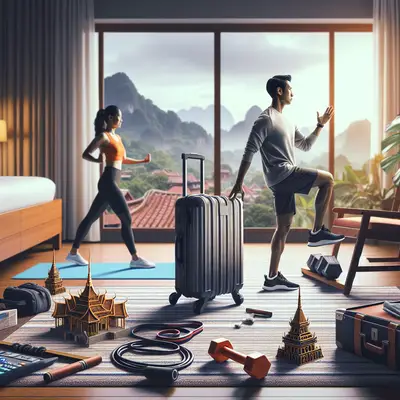
The moment your hotel door clicks shut, you’ve entered more than a temporary room—you’ve walked into a portable training basecamp. Whether you’re hopping time zones as a digital nomad or stacking back-to-back client meetings, your hotel room can either drain your energy or quietly upgrade your fitness. You don’t need a fancy gym, and you definitely don’t need to pack a suitcase full of equipment. You need a strategy, a bit of creativity, and a willingness to treat each stay like a mini expedition.
This isn’t about chasing perfection. It’s about building a travel-proof routine that survives cramped rooms, jet lag, and unpredictable schedules. These hotel-friendly tactics are designed to slip between calls, flights, and late check-ins—using gear that actually earns space in your bag and movements that keep you strong, mobile, and ready for the next adventure.
Tip 1: Claim Territory – Build a “Training Zone” in Minutes
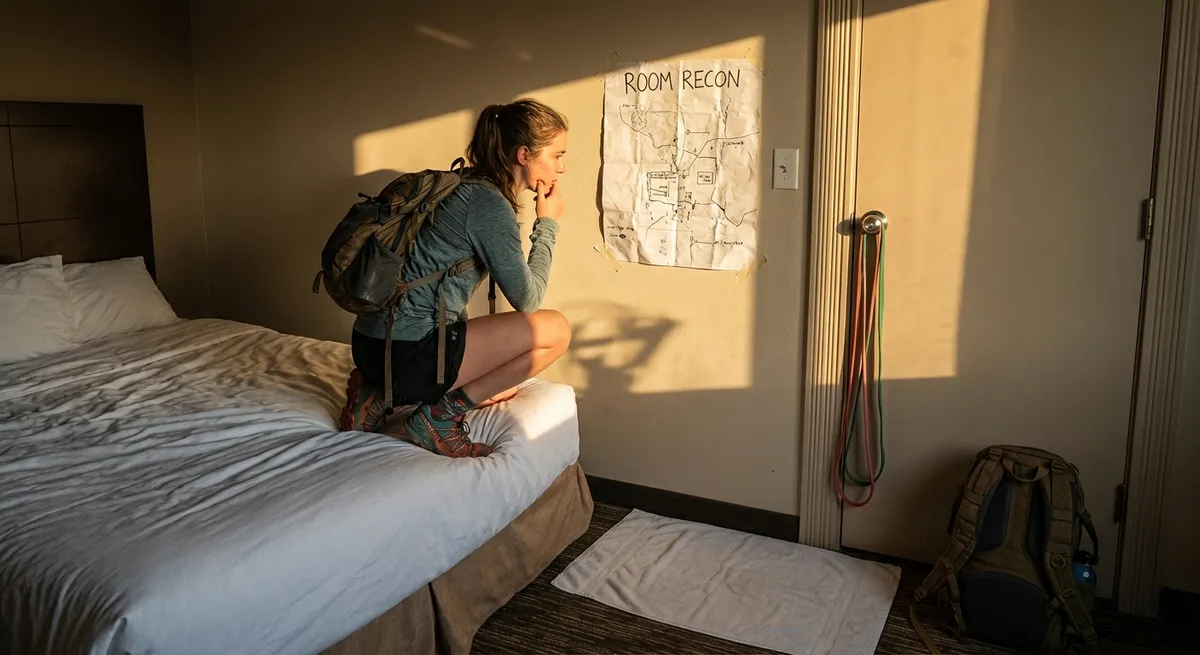
Before you even open your laptop, scout your room like you’re setting up camp. Slide the coffee table to the side, stack the desk chair near the wall, and clear a rectangle of floor space big enough to lie down in. This becomes your non-negotiable training zone for the duration of your stay. Lay out a travel towel or compact foldable mat to mark it visually—your brain responds better when your workout “lives” in a dedicated space. Keep any portable gear (like bands or a jump rope) in that same spot so you see it every time you walk past. This tiny ritual turns “maybe I’ll work out later” into “this is where I train.” Treat the training zone as off-limits to clutter: no food trays, no luggage overflow, no laundry pile. By the second night, your body will start to recognize that spot as the place where you move, sweat, and reset from travel.
Tip 2: Build a No-Excuse Hotel Circuit Using Only Furniture
Your room is hiding a full-body workout in plain sight—you just have to use the furniture like tools, not decor. A sturdy chair becomes your station for Bulgarian split squats, incline push-ups, or triceps dips. The edge of the bed is perfect for hip thrusts, glute bridges, and core work. A wall transforms into your isometric strength partner for wall sits and elevated feet push-ups. String these movements together into a simple circuit: lower body (squats, lunges, bridges), upper body (push-ups on bed or floor, chair dips, inverted rows if you can anchor under a desk), then core (planks, dead bugs, suitcase crunches). Aim for 20–30 minutes total, rotating through movements with almost no rest so you don’t have time to overthink or grab your phone. If the room is tiny, focus on movements that don’t require stepping or jumping: static lunges, slow squats, tempo push-ups, and long tension planks. Your goal isn’t to impress anyone; it’s to walk out of that room stronger than you walked in.
Tip 3: Pack “Compression Gear” for Strength – Lightweight, Heavy Impact
You don’t need metal plates to get strong on the road—you need resistance that compresses small and works hard. A set of long resistance bands or a pair of light mini bands can turn a bland room into a strength lab. Loop a band around the bathroom door hinge (using a towel barrier to protect the door) for rows, presses, and pull-aparts. Use mini bands around your legs for glute activation, lateral walks, and squats that actually challenge you. The key is to think in “strength waves”: one wave focused on pulling (rows, band pull-aparts), one on pushing (overhead presses, push-ups), and one on bracing (anti-rotation holds, banded marches, single-leg balance with band tension). Because bands are so portable, you can also take them to the hotel stairwell or rooftop for hybrid sessions—climb stairs, then hit a round of band exercises at the top before heading back down. When you’re packing, treat bands like non-negotiable gear: same priority as your charger, passport, or laptop.
Tip 4: Train Around Jet Lag With Micro-Sessions, Not Willpower
Hotel fitness fails usually aren’t about motivation—they’re about timing. Long-haul flights, late check-ins, and morning calls wreck any plan that relies on a single “perfect” workout window. Instead, split your training into micro-sessions you can drop into any time you have 5–10 minutes. Morning: a dynamic wake-up—hip circles, shoulder rolls, cat-cows, and a short bodyweight circuit to flush stiffness from the flight. Midday: a brisk stairwell climb or power walk around the block plus a quick set of push-ups and squats. Night: a low-intensity mobility flow on the floor to calm your nervous system and offset chair time. The adventure here is in consistency, not duration—your body responds better to three short, predictable hits of movement than one epic session that only happens “when you’re not too tired.” Treat movement like hydration: steady sips throughout the day instead of one desperate chug.
Tip 5: Turn “Dead Time” Into Movement Missions
Travel is filled with dead zones—waiting for laundry, watching uploads buffer, or sitting on hold with reception. Instead of doom-scrolling, turn these gaps into mini “missions” you can complete in your room without changing clothes. Need five minutes while your coffee brews? That’s one round of squats, wall push-ups, and side planks. Uploading a massive file? Alternate between standing calf raises, single-leg balance drills, and gentle hip hinges while you wait. Before a video call, do 60 seconds of fast marching in place, arm circles, and neck mobility to show up looser and more focused. You’re not chasing sweat here; you’re building an identity: “I’m the traveler who moves whenever the world stops.” Over a week-long trip, these small missions stack up into real training volume, better circulation, and fewer aches when you finally land back home—or on your next continent.
Conclusion
Every hotel stay can either break your routines or harden them. When you treat your room like a temporary basecamp instead of a box to collapse in, fitness stops being “one more thing to fit in” and becomes part of how you travel. Clear your training zone, turn furniture into tools, pack resistance that actually pulls its weight, and stitch movement into the gaps of your day. Your passport may be full of random check-in stamps, but your body doesn’t have to feel random at all—it can feel trained, ready, and steady, no matter where you drop your bags next.
Key Takeaway
The most important thing to remember from this article is that this information can change how you think about Hotel Fitness.