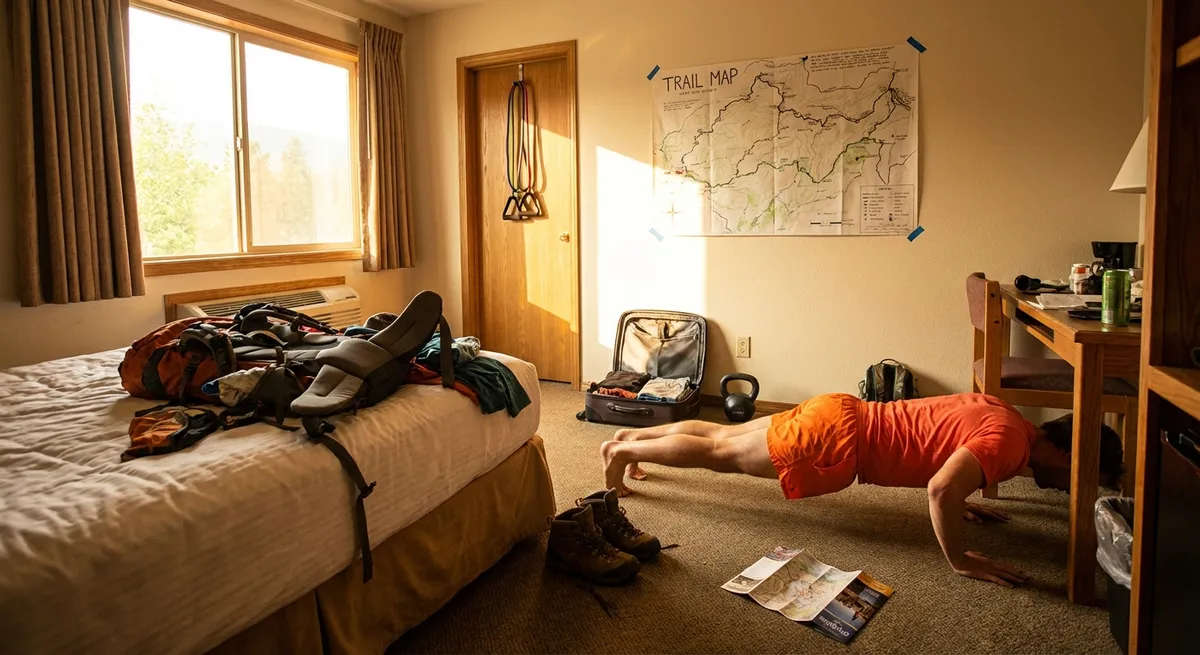
You don’t need a fancy hotel gym—or any gym—to stay strong on the road. Whether you’re hopping between client meetings, chasing sunsets as a digital nomad, or crashing for one night before the next flight, your hotel can double as a legit training basecamp. The key is thinking like an adventurer: use what you’ve got, move with intent, and make every stay a chance to come back stronger than you arrived.
This guide gives you five practical, portable fitness tactics built for travelers who live out of backpacks and carry-ons. No complicated routines. No bulky gear. Just smart, adaptable strategies that fit into any room, any schedule, any country.
Build a “Zero-Equipment” Hotel Room Circuit
First, assume the worst: no gym, no pool, no usable stairs, and a chair that looks like it might collapse if you blink at it. You can still build a full-body session with nothing but gravity and floor space.
Pick 4–6 movements and turn them into a simple circuit you can repeat 3–5 times:
- Lower body: Squats, reverse lunges, split squats using the bed edge, hip bridges, single-leg Romanian deadlifts (balance-focused)
- Upper body: Push-ups (hands on desk, feet on bed, narrow, wide), incline push-ups off the windowsill, chair dips if the chair is solid
- Core: Planks (front and side), dead bugs, hollow holds, slow mountain climbers
- Cardio bursts: Fast high knees in place, shadowboxing, squat jumps, lateral shuffles if there’s room
Set a timer for 20 minutes and cycle through: 40 seconds work, 20 seconds rest. That keeps the session tight, efficient, and travel-schedule friendly.
Key tactics:
- Use tempo (slow lowering, explosive pushing) to make light or bodyweight work harder.
- Focus on single-leg and unilateral work to build balance after long travel days that wreck posture.
- Keep rest short—your heart rate becomes your built-in “cardio machine.”
Turn the Hotel Into a Multi-Zone Training Map
Instead of thinking “I’m stuck in this room,” treat the whole property as your training playground. Scout the hotel like you would a new trail:
- Stairwells: Instant hill sprints. Walk up a few floors as a warm-up, then power up one to three flights, walk down to recover.
- Hallways: Great for walking lunges, suitcase carries (if you have a pack or bag), or brisk walking intervals between room and elevator.
- Outdoor areas or parking lots: Use them for short runs, shuttle sprints, or walking workouts between light poles or marked spots.
- Walls and doorframes: Perfect for isometric holds like wall sits, or static calf stretches after flights.
- Strength zone: Your room (squats, push-ups, core).
- Power/cardio zone: Stairs, hallways, or the parking lot.
- Mobility zone: Quiet corner of your room or balcony (if you have one) for stretching and breathwork.
Build a “zones” mindset:
By mapping out these training zones when you check in, you remove decision fatigue later—and you’re less likely to skip your session when you’re tired from travel.
Pack a Micro Kit That Multiplies Your Options
You don’t need a traveling gym; you need one or two small tools that radically expand what your body can do. Think “fits in a laptop compartment, weighs almost nothing.”
Clutch travel-friendly options:
- Mini loop bands: Great for glute activation, hip stability, shoulder work, and making squats, bridges, and push-ups harder.
- Light to medium long resistance band: Use for rows, banded deadlifts, face pulls, presses, and assisted pull-ups if you find a sturdy bar.
- Jump rope (if you can use it without hitting the ceiling): Ultra-efficient for cardio when you have time but no space to run.
- Suspension trainer (optional upgrade): Still travel-sized, and turns any solid door into a full-body training station with rows, pistols, presses, and core work.
- Banded squats
- Banded good mornings or deadlifts
- Door-anchored rows with a long band or suspension trainer
- Overhead band presses or push-ups
- Plank variations with banded shoulder taps
Sample micro-kit workout:
When in doubt, think: “Can I double resistance or range of motion with a band?” Almost always, yes.
Sync Workouts With Your Travel Rhythm, Not the Clock
On the road, perfect schedules are a myth. Instead of trying to force a strict routine, build rhythms that flex around departures, check-ins, and client calls.
Use these simple rules:
- Anchor Day One: After you arrive and settle, do a 15–20 minute movement burst (mobility + light strength) to reset your body from travel.
- Go “10-Minute Minimum”: On brutal days, your only rule is to move for 10 minutes—mobility, brisk hallway walk, push-up ladder, or band circuit. Often you’ll go longer once you start.
- Match intensity to jet lag:
- Heavy jet lag or poor sleep: stick to light mobility, walking, and easy strength.
- Well-rested: push harder with circuits, intervals, or stair sprints.
- Pair with existing habits:
- Before morning emails: a quick 10–15 minute bodyweight flow.
- After your last meeting: a stairwell or parking lot cardio hit.
You’re not trying to run a “perfect program” on the move; you’re trying to keep your strength and capacity alive until you’re back in a more stable location. Consistency beats complexity every time.
Make Recovery a Non-Negotiable Part of Your Hotel Routine
Travel beats up your body: cramped seats, weird pillows, late nights, and new time zones. Training hard without recovery is just another stressor. So bake recovery into your hotel rituals.
Practical recovery tactics:
- Hydration first thing on check-in: A full bottle of water before you even open your laptop helps counter dehydration from flights.
- Quick mobility reset:
- 30–60 seconds each for hips, hamstrings, chest, and upper back.
- Use the bed, chair, or wall to support stretches.
- Use towels as tools:
- Towel hamstring stretches.
- Towel-assisted shoulder and chest openers after backpack or suitcase lugging.
- Light evening walk: Even a 5–10 minute loop around the block or lobby area helps circulation, digestion, and sleep.
- Sleep guardrails:
- Keep the room cool and dark.
- Avoid heavy screens for 20–30 minutes before bed if possible.
- If your schedule’s chaotic, aim for total weekly sleep hours, not perfect bedtimes.
Think of recovery as your travel armor: it keeps you training-ready even when your environment is unpredictable.
Conclusion
Every hotel room can be a basecamp, not a setback. When you travel with a plan—bodyweight circuits, mapped-out hotel zones, a tiny but powerful gear kit, flexible workout rhythms, and built-in recovery—you stop “trying to survive the trip” and start using every stop to sharpen your strength.
You don’t need ideal conditions. You need a decision: wherever you land, you’ll move with purpose. The adventure doesn’t pause when you close the hotel door; it just changes rooms.
Sources
- [American Council on Exercise (ACE) – Travel Workouts and Tips](https://www.acefitness.org/resources/everyone/blog/7636/no-excuses-4-quick-travel-workouts/) - Practical ideas for no-equipment and hotel-friendly workouts
- [Mayo Clinic – Fitness: Exercise for a Healthy Heart](https://www.mayoclinic.org/healthy-lifestyle/fitness/in-depth/exercise/art-20045506) - Explains why consistent movement (even short sessions) supports cardiovascular health
- [Harvard Health – The Importance of Stretching](https://www.health.harvard.edu/staying-healthy/the-importance-of-stretching) - Covers benefits of mobility and stretching, especially after long periods of sitting
- [Sleep Foundation – How Travel Affects Sleep](https://www.sleepfoundation.org/travel-and-sleep) - Details how travel disrupts sleep and what to do about it
- [CDC – Physical Activity Basics](https://www.cdc.gov/physicalactivity/basics/index.htm) - Outlines recommended activity levels and the benefits of regular movement
Key Takeaway
The most important thing to remember from this article is that this information can change how you think about Hotel Fitness.