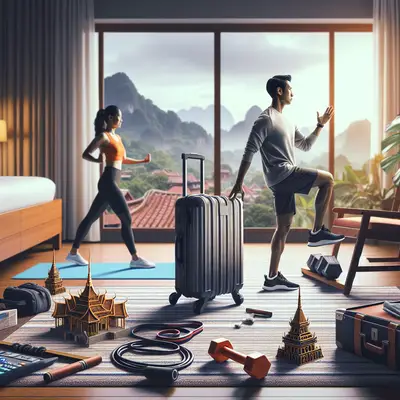
Hotel doors close; adventure shouldn’t. Whether you’re bouncing between client calls, red-eye flights, and border crossings, your body is the one piece of gear you can’t afford to let go offline. The good news: you don’t need a fancy gym, a perfect schedule, or a checked-bag full of equipment to stay mission-capable on the road. You just need a plan that fits in your carry-on and a mindset that treats every room like a temporary basecamp.
This guide gives you five travel-tested fitness tactics built for hotel floors, tight hallways, and unpredictable itineraries—ideal for travelers, remote workers, and digital nomads living out of a backpack.
Build a “Room-Ready” Ritual the Moment You Drop Your Bag
Before you open your laptop or raid the minibar, claim the room as your training ground. That mental reset is the difference between staying sharp and slowly turning into carry-on cargo.
Start by doing a 5-minute scan: where’s the clearest patch of floor, the sturdiest chair, the space by the bed you can use for mobility work? Crack a window if possible, adjust the thermostat, and turn on lighting that wakes you up instead of lulling you back toward the pillow.
Then run a simple “arrival circuit” every time you check in:
- 10 bodyweight squats
- 10 elevated push-ups (hands on desk or bed)
- 20 marching steps in place (knees high, arms pumping)
- 10 slow hip hinges (hands to thighs, hinge at the hips, wake up hamstrings)
You’re not trying to max out here—you’re telling your nervous system, “We move in this space.” That ritual anchors you to something consistent in the middle of unfamiliar cities and irregular time zones, which research shows can help protect sleep quality and overall health during travel.
Turn Furniture into Gear: Smart Hotel Room Hacks
You might not have dumbbells, but hotel rooms are full of underused “equipment.” With a little creativity (and safety awareness), you can build a solid session from what’s already there.
Use these practical conversions:
- Desk or dresser → Push-up and incline bench station
- Incline push-ups (hands on edge) for shoulders and chest
- Decline push-ups (feet on bed, hands on floor) if you’re more advanced
- Sturdy chair → Leg and core platform
- Bulgarian split squats (rear foot on chair)
- Triceps dips (hands on seat, feet on floor)
- Seated leg lifts for lower abs and hip flexors
- Bed edge → Mobility and stretching hub
- Hip flexor stretches with one knee on bed, front foot on floor
- Hamstring stretch sitting on edge, one leg extended
Test every surface for stability before putting full weight on it—no wheels, no wobble, no sliding on slick tile. Aim to work in slow, controlled reps; this not only keeps you safer, it makes light or improvised resistance more effective.
A sample full-body “furniture session”:
- 3 rounds:
- 12 incline push-ups on desk
- 10 Bulgarian split squats per leg using chair
- 12 triceps dips on chair
- 20-second hollow-body hold on the floor or bed
Minimal noise, minimal space, and done in under 15 minutes.
Pack a Micro-Kit: Gear That Earns Its Luggage Space
When your backpack real estate is tight, every item has to earn its keep. A tiny fitness micro-kit can multiply your options without tipping the airline scale.
Consider carrying:
- Mini-loop resistance bands – size of a wallet, huge payoff for hips, glutes, and shoulders; perfect for pre-flight activation or quick hotel circuits.
- A light long band with handles or loops – attaches to a door (using a proper anchor) for rows, presses, and pulldowns.
- A compact jump rope – fast conditioning tool that works in parking lots, courtyards, or even tall-ceiling hotel corridors.
- A lacrosse or massage ball – small but powerful for releasing tight calves, glutes, and upper back from long travel days.
A carry-on-friendly micro-kit workout:
- 30 seconds banded lateral walks (mini band around ankles or knees)
- 12 band rows (long band anchored in door, pull toward chest)
- 30 seconds jump rope or simulated rope hops
- 10-15 band-resisted squats
- 30 seconds plank
Repeat 3–4 times. You’ve hit strength, stability, and conditioning with less gear than a toiletry bag.
Use Time Zones as Training Windows, Not Excuses
Your schedule might be chaos: sunrise flights, midnight check-ins, and calls scattered across continents. Instead of waiting for the “perfect” window, work with the fragments you do have.
Think in movement blocks, not 60-minute sessions:
- 5-minute resets between calls: choose one move (squats, push-ups, lunges, or wall sits) and perform sets during every 10–15-minute gap.
- 10-minute “bookends” for your day: a short strength circuit within 30 minutes of waking, and a mobility or stretching block within 60 minutes of heading to bed.
- Travel-day rule: every time you reach a new location (gate, station, hotel), do 1–2 minutes of movement—calf raises, shoulder rolls, walking lunges, or wall push-ups.
You can also align intensity with jet lag:
- When you’re tired or in a new time zone, favor low-impact mobility and lighter strength work.
- When your energy spikes, use that window for a higher-intensity circuit (short intervals, faster reps, or more challenging variations).
This approach protects consistency, which is far more important on the road than hitting perfect training volumes. A body that moves a little every day will out-perform a body that trains hard once and then goes dark for a week.
Make Recovery a Non-Negotiable Part of Your Hotel Strategy
Adventure is easier when your joints aren’t complaining and your brain isn’t fogged from red-eye fatigue. Recovery isn’t a luxury add-on—it’s the maintenance schedule that keeps your “vehicle” running.
Key hotel-friendly recovery tactics:
- Hydration discipline: travel, dry cabin air, and caffeine drain you. Aim to drink water regularly from landing to bedtime; keep a bottle in sight on the desk.
- “Floor time” before bed: 5–10 minutes of light stretching—calves, hip flexors, hamstrings, chest, and upper back—signals your nervous system to downshift.
- Screen taper: shift from laptop/phone to a book, notebook, or audio 20–30 minutes before sleep when possible; this supports your circadian rhythm disrupted by travel.
- Dark, cool, quiet room: use blackout curtains, lower the thermostat if you can, and consider earplugs or a white-noise app to blunt city or hallway noise.
If you’re short on time, prioritize this simple nightly reset:
- 1 minute deep breathing (inhale for 4 counts, exhale for 6–8)
- 1 minute calf stretch against the wall
- 1 minute hip flexor stretch each side
- 1 minute chest opener (hands behind back or against the wall)
- 1 minute easy spinal twists lying on the bed
You’ll wake up moving better—and more willing to tackle another day of flights, calls, and concrete.
Conclusion
Hotel rooms can be energy drains or launch pads. When you treat each one as a temporary stronghold—scanning the space, repurposing furniture, unpacking a tiny gear kit, using scattered minutes, and honoring recovery—you stay ready for whatever the map throws at you.
You don’t need perfection, you just need repetition: short, consistent sessions that keep strength, mobility, and stamina online. The itinerary may never settle, but your training can still be the steady thread that runs through every check-in.
Sources
- [American Council on Exercise – Travel-Friendly Workouts](https://www.acefitness.org/resources/everyone/blog/7443/travel-workouts-you-can-do-anywhere/) - Practical ideas and guidelines for exercising with minimal equipment while traveling
- [Harvard Health – Benefits of Strength Training](https://www.health.harvard.edu/staying-healthy/strength-training-builds-more-than-muscles) - Overview of why maintaining strength matters for long-term health and function
- [CDC – Physical Activity Basics](https://www.cdc.gov/physicalactivity/basics/index.htm) - Evidence-based recommendations on how much activity adults need, useful for setting realistic road goals
- [National Sleep Foundation – Sleep and Travel](https://www.thensf.org/how-to-sleep-better-when-traveling/) - Research-backed strategies for improving sleep quality when crossing time zones and staying in hotels
- [Mayo Clinic – Stretching: Focus on Flexibility](https://www.mayoclinic.org/healthy-lifestyle/fitness/in-depth/stretching/art-20047931) - Guidance on effective stretching routines to support mobility and recovery
Key Takeaway
The most important thing to remember from this article is that this information can change how you think about Hotel Fitness.