You can chase sunsets, border crossings, and Wi‑Fi signals without sacrificing strength. The trick isn’t finding a “perfect” routine—it’s building trail-tough habits that survive delayed flights, bad hotel gyms, and 2 a.m. check-ins. This isn’t about six-pack selfies; it’s about keeping your body mission-ready so you can hike the extra ridge, sprint for the last train, or work a 12‑hour laptop marathon without folding.
These five travel-ready fitness tactics are built for digital nomads, long-haul travelers, and anyone whose “gym” is whatever floor space they can find.
Build a “No-Excuse 15” Workout You Can Do Anywhere
Your most powerful travel workout is the one that fits between boarding calls and client calls. Design a 15-minute, zero-equipment circuit you repeat in every city until it’s automatic—no decision fatigue, no scrolling for “hotel workout ideas.”
Example “No-Excuse 15” circuit:
- 40 seconds bodyweight squats, 20 seconds rest
- 40 seconds push-ups (standard, incline on bed, or knees), 20 seconds rest
- 40 seconds hip hinges/good mornings (for hamstrings + back), 20 seconds rest
- 40 seconds reverse lunges, 20 seconds rest
- 40 seconds plank or dead bug, 20 seconds rest
Do 3 rounds. That’s it.
Pick 4–6 movements that hit:
- Lower body (squats, lunges, step-ups on a curb or low wall)
- Upper push (push-ups against a desk, bed, or wall)
- Upper pull (doorframe isometrics or resistance band rows if you carry one)
- Core (planks, side planks, dead bugs, suitcase carry with backpack)
Run this routine:
- First thing in the morning on travel days (before chaos hits)
- After long sits (trains, buses, work marathons)
- Anytime jet lag wakes you at odd hours—movement beats doom-scrolling
Once “No-Excuse 15” is a ritual, your body knows: new city, same standard.
Turn Transit Time into Mobility Training
Travel beats you up the same way bad office posture does—rounded shoulders, stiff hips, cranked neck. Instead of just surviving flights and bus rides, use them as built-in mobility sessions so you hit the ground ready to move.
On planes, trains, or buses:
- Ankle pumps & circles: Keep blood moving and reduce stiffness.
- Seated glute stretch: Cross one ankle over opposite knee, gently hinge forward.
- Thoracic rotations: Sit tall, hands on shoulders, rotate gently left/right.
- Neck resets: Slow nods and side bends—no aggressive cranking.
At layovers or roadside stops:
- Walk laps instead of sitting at the gate.
- Find a quiet corner for 5 minutes of hip flexor stretches and hamstring hangs.
- Do 10–15 calf raises on a step or curb to wake up your lower legs.
Before bed in a new place:
- Spend 5–10 minutes on your hips, chest, and spine:
- Hip flexor stretch (half-kneeling lunge)
- Chest opener against a doorframe
- Child’s pose or lying twist for your back
This micro-mobility habit reduces next-day soreness, improves sleep, and makes your next trail, urban exploration, or coworking day feel less like damage control.
Pack One Tiny Item that Multiplies Your Options
Ultra-minimalist is cool—until you realize a 100-gram item could turn every room into a full gym. Instead of dragging dumbbells, travel with one “multiplier” you’ll actually use.
Solid options:
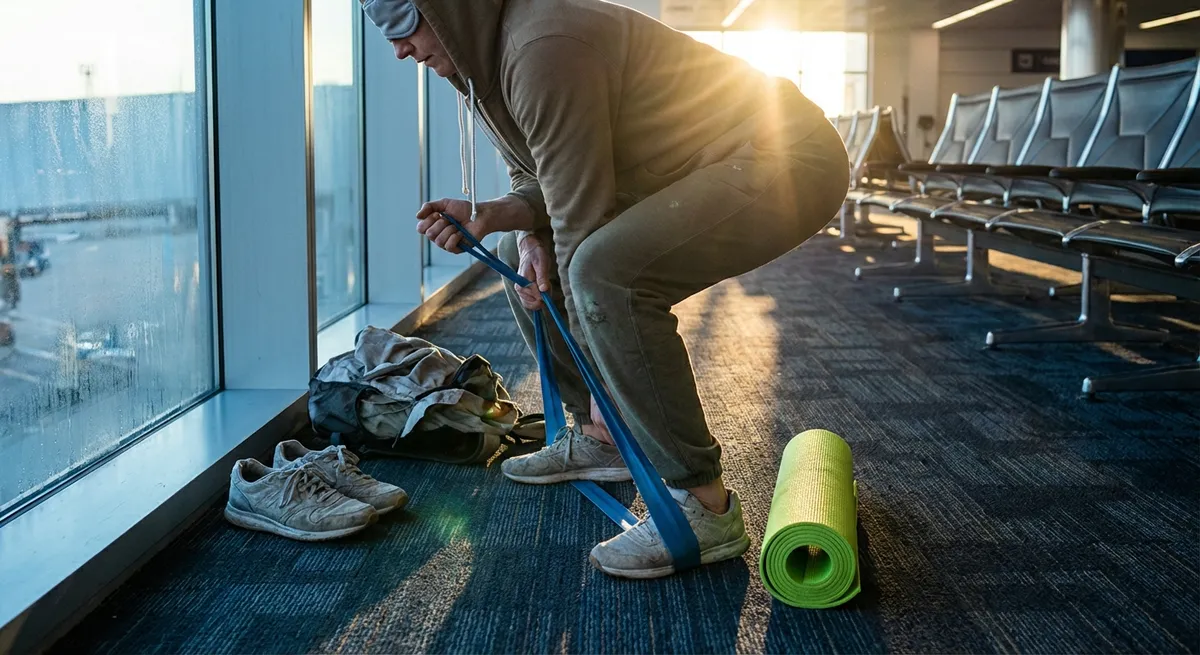
- Mini resistance band or long loop band:
- Rows using a door, bedframe, or railing (finally: pulling work)
- Glute bridges with band around knees
- Lateral walks to wake up hips before long walks or hikes
- Light jump rope:
- High-intensity cardio in tiny spaces
- Warmup tool that fits in a pocket
- Gymnastic rings or a lightweight suspension trainer (if you’re committed):
- Hang from a tree, stairwell, or sturdy beam for rows, push-ups, dips, and even assisted pull-ups
Whichever you pick, pre-commit how you’ll use it:
- “Every work break: 1 set of 15 band rows.”
- “Three times a week: 10 minutes of jump rope.”
One piece of gear, clearly defined. No “maybe I’ll try it” clutter in your pack.
Anchor Your Training to Landmarks, Not Schedules
Time zones wreck routines; landmarks don’t move. Instead of “I’ll train at 7 a.m.,” link your workouts to repeatable daily triggers that follow you from country to country.
Examples of anchor habits:
- After my first coffee, I do my ‘No-Excuse 15.’
- As soon as I check into a new place, I do a 5-minute movement check-in.
- Before my first work block, I walk 10–20 minutes outside.
- After closing my laptop at night, I do 5 minutes of stretching.
Why this works on the road:
- Your schedule might be chaos, but you’ll always drink coffee, check in, start work, and shut down.
- Anchoring to these universal moments kills the “I’ll do it later” excuse that multiplies with jet lag and shifting calendars.
- Once those anchors are automatic, it feels strange not to move.
You can still chase big training days when you land somewhere stable. But your anchor habits are what keep your base level of strength, mobility, and energy steady in the in-between.
Train for the Adventures You Actually Want
Travel workouts hit different when they’re tied to real missions, not abstract fitness goals. Instead of “I should exercise,” think: “What do I want my body to do on this trip?”
Examples:
- Planning a multi-day trek or lots of city walking?
- Emphasize: step-ups on stairs, loaded carries with your backpack, single-leg work, calf and hip strength.
- Expecting heavy luggage hauls and overhead bins?
- Emphasize: hip hinges (Romanian deadlift pattern), front-loaded squats with your pack, overhead presses with a water jug or bag.
- Adventure activities (surf, climb, ski, dive)?
- Emphasize: core anti-rotation (pallof presses with a band, side planks), shoulder stability (band pull-aparts, Y/T/W raises), balance drills (single-leg stands, slow lunges).
Use whatever’s around you:
- Backpack stuffed with clothes = sandbag for squats, presses, carries.
- Water bottles = light dumbbells for shoulder work and curls.
- Stairs = step-ups, stair sprints, calf raises.
- Park benches = incline push-ups, Bulgarian split squats, tricep dips (controlled and pain-free only).
When training mirrors your adventures, workouts stop feeling like a chore and start feeling like pre-mission prep.
Conclusion
You don’t need a perfect gym to stay strong on the road. You need a simple, repeatable system that survives border crossings, bad Wi‑Fi, and sleepless layovers:
- One go-to “No-Excuse 15” you can do anywhere.
- Mobility built into transit and bedtime instead of added on top.
- A tiny piece of gear that unlocks real resistance.
- Rituals anchored to daily landmarks, not fickle clocks.
- Training that prepares you for the next summit, side street, or surf break.
Keep your kit light, your standards consistent, and your body ready—because the world doesn’t slow down for you to find the perfect gym.
Sources
- [Centers for Disease Control and Prevention – Physical Activity Basics](https://www.cdc.gov/physicalactivity/basics/index.htm) - Overview of evidence-based physical activity recommendations for adults
- [American College of Sports Medicine – ACSM’s Guidelines for Exercise Testing and Prescription](https://www.acsm.org/education-resources/books/acsms-guidelines-for-exercise-testing-and-prescription) - Widely used reference for safe and effective exercise programming
- [Harvard Health Publishing – The Importance of Stretching](https://www.health.harvard.edu/staying-healthy/the-importance-of-stretching) - Details on why mobility and stretching matter, especially for people who sit or travel a lot
- [Mayo Clinic – Aerobic Exercise: How to Warm Up and Cool Down](https://www.mayoclinic.org/healthy-lifestyle/fitness/in-depth/exercise/art-20045517) - Practical guidance on integrating warm-ups and cool-downs into short workouts
- [World Health Organization – Physical Activity](https://www.who.int/news-room/fact-sheets/detail/physical-activity) - Global health recommendations and benefits of regular physical activity
Key Takeaway
The most important thing to remember from this article is that this information can change how you think about Travel Workouts.