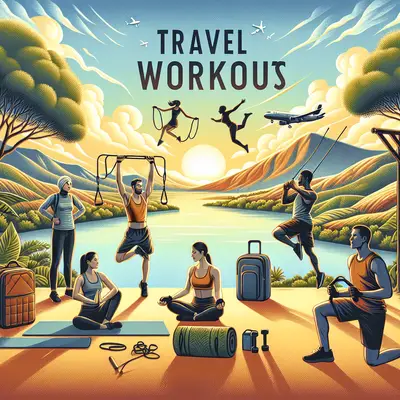
Your itinerary shouldn’t decide your fitness level. Whether you’re catching red-eyes, bouncing between coworking spaces, or chasing sunsets in new time zones, your body is your only guaranteed piece of “equipment.” This guide is about turning layovers into labs, hotel rooms into training grounds, and chaotic travel days into chances to sharpen your edge instead of losing it.
Build a Minimalist “Always-On” Travel Routine
Travel breaks patterns—that’s the point. But your body thrives on rhythm, not randomness. Instead of chasing perfect workouts, anchor yourself with a minimalist routine that you can run almost anywhere in 15–20 minutes.
Pick 4–5 moves that cover your whole body and cycle them on most days, regardless of where you are. For example: squats or lunges, push variations (walls, counters, floors), a hinge or glute move (hip thrusts, single-leg deadlifts), a core drill (planks, dead bugs), and a dose of movement that elevates your heart rate (fast stair climbs, jump rope, shadow boxing). Keep the structure consistent, even if the scenery changes.
Think of this as your “travel operating system”: simple, repeatable, and resilient to missed flights, late check-ins, and surprise meetings. When life gets chaotic, you don’t negotiate; you just hit the protocol. On smoother days, feel free to extend it, explore a local gym, or tack on a run through a new neighborhood—but your base routine is what keeps you adventure-ready.
Tip 1: Turn Transit Time into Micro-Workouts
Airports, train stations, and bus terminals are usually where fitness goes to die. They’re also full of stairs, long corridors, and quiet corners—prime real estate for sneaky movement if you know how to use it.
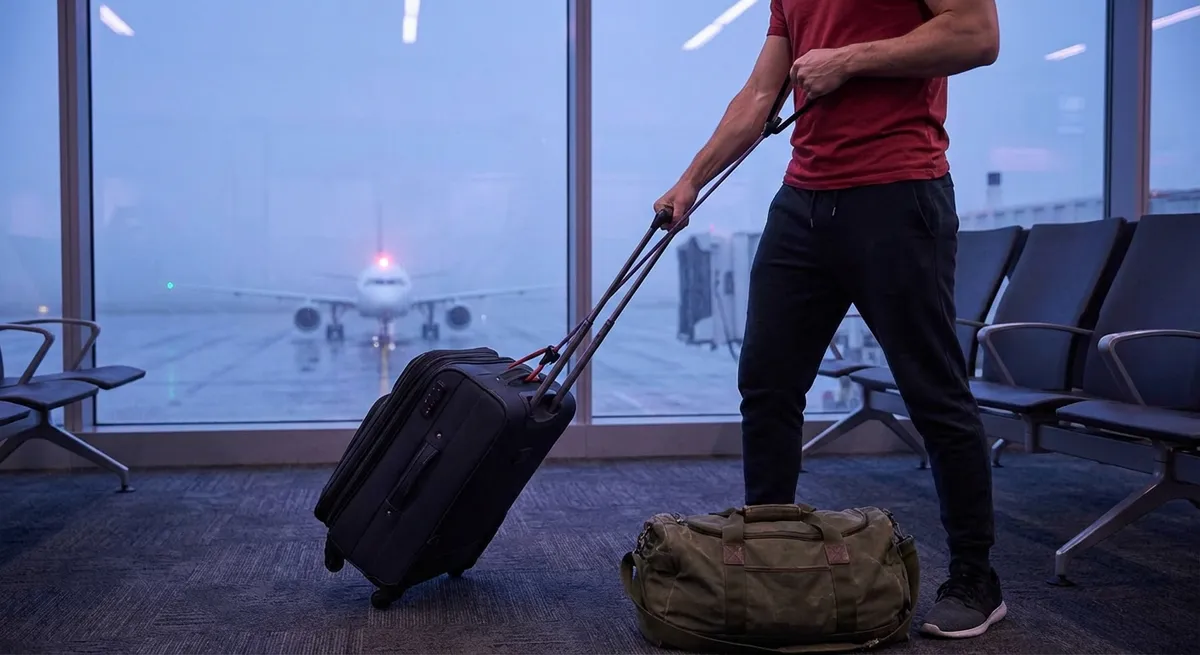
Waiting at the gate? Pace the terminal instead of sitting. Walk brisk laps with your carry-on, adding 3–5 bouts of 60–90 seconds of faster walking or light jogging if the space allows. Use stairs instead of escalators, doubling back for extra flights when you’ve got time. If there’s a less crowded corner, hit a quick circuit of wall push-ups, bodyweight squats, and standing calf raises for 5–10 minutes.
On long flights, set a reminder to stand up every 60–90 minutes. Walk the aisle, do ankle circles, calf raises, and gentle hip hinges near the galley. It’s not about burning massive calories; it’s about keeping blood flowing, joints from stiffening, and your nervous system from slipping into “hibernation mode” before you even land.
Tip 2: Use Your Pack as a Portable Weight Room
You’re already hauling a bag—make it earn its keep. Your backpack or carry-on can become a simple, brutal tool if you load and handle it correctly. Toss in a water bottle or two, a laptop, chargers, and a book, and you’ve got a makeshift weight that’s tailor-made for strength work on the road.
Grab your pack by the top handle for one-arm suitcase carries down a hallway or balcony, focusing on staying tall and bracing your core. Hug the pack to your chest for goblet squats, split squats, or slow step-ups onto a stable surface. Hold it by the side or bottom for bent-over rows and Romanian deadlift variations in a hotel room.
If you’re sharing space or staying in hostels, choose low-impact moves that don’t involve jumping or loud impacts. Controlled tempo is your ally: 3–4 seconds down, 1–2 seconds up transforms light loads into serious work. You’re not trying to max out; you’re trying to maintain strength, joint integrity, and confidence in your body while everything around you is in flux.
Tip 3: Master a “No-Equipment, No-Excuses” Strength Session
When you strip away the gear, you find out what actually matters: angles, tension, and intent. A smart bodyweight session can hit every major muscle group and leave you smoked—in a good way—without needing more than a few square feet of floor.
Here’s a flexible template you can adapt in any room or outdoor spot:
- Push: Incline push-ups on a desk or bed, floor push-ups, or decline push-ups with feet elevated
- Pull / Upper Back: Towel isometrics (looped around a sturdy object and pulled against), reverse “snow angels” lying on your stomach, or prone Y-T-W raises for shoulder and upper-back endurance
- Squat / Lunge: Air squats, split squats, reverse lunges, or Cossack squats for mobility and strength
- Hinge / Glutes: Single-leg hip thrusts on the bed, glute bridges, or good-morning hinges with hands on hips
- Core / Anti-Rotation: Planks, side planks, dead bugs, and suitcase carries with your bag for real-world trunk strength
Run 3–4 rounds, 8–15 controlled reps per move (or 20–40 seconds per hold), with 30–60 seconds rest between exercises. If you’re short on time, do one “AMRAP” round: set a 6–8 minute timer and cycle through your chosen moves without overthinking it. The goal isn’t perfection—it’s consistency and intensity you can sustain, even on heavy travel days.
Tip 4: Sync Workouts with Local Rhythm, Not Jet Lag
Your body clock is already under attack from time zones, street noise, and unfamiliar beds. Instead of forcing a rigid “5 a.m. workout rule,” let your training help you adapt—to the light, the schedule, and the pace of the place you’re visiting.
On arrival days, aim for a short movement session timed with local daylight. A brisk 20–30 minute walk or jog outdoors, paired with a 10–15 minute bodyweight circuit, can help anchor your circadian rhythm and combat that groggy, time-warp feeling. Prioritize training when the sun’s up, especially in those first two days.
As you settle in, match your workouts to your work and exploration blocks. Early coworking start? Train right after you log off, using movement as the clean break between “screen mode” and “explore mode.” Night-owl city with late dinners? Slide your session earlier in the day so you’re not doing burpees at midnight when your nervous system wants to wind down. Flexibility is the superpower here—your routine should support the adventure, not strangle it.
Tip 5: Treat Recovery Like Gear You Can’t Afford to Lose
Travel stress stacks up fast: cramped seats, new foods, random sleep, and constant micro-decisions. Training on top of that is powerful—but only if your recovery game keeps pace. Think of sleep, hydration, and mobility as your non-negotiable “invisible workouts.”
Protect your sleep first. Darken the room as much as possible, use an eye mask and earplugs if needed, and aim for consistent sleep and wake times once you land. Hydrate aggressively, especially on travel days—start drinking water long before you’re thirsty, and balance caffeine and alcohol so they don’t ambush your sleep or spike your heart rate at the wrong time.
Sneak in micro-mobility: ankle circles in lines, neck rolls between calls, hip flexor stretches before bed, and 5–10 minutes of gentle stretching or breathwork at night to downshift your nervous system. Recovery doesn’t have to look like a spa day; it just needs to be deliberate. The better you recover, the more your workouts feel like rocket fuel instead of another form of jet lag.
Conclusion
Being on the move doesn’t have to mean being out of shape. When you stop relying on perfect conditions and start using what the road gives you—stairs, packs, quiet corners, sunrise streets—you turn every stop on the map into a training ground. Anchor yourself with a simple routine, repurpose what you’re already carrying, align your training with local rhythms, and guard your recovery like your passport.
Adventure will always try to knock you off your game. The goal isn’t to cling to a rigid plan—it’s to stay strong, mobile, and mission-ready no matter what the itinerary throws at you. Your body is the one piece of gear that never goes in checked luggage; train it like it’s your most important travel companion.
Sources
- [Centers for Disease Control and Prevention – Physical Activity Basics](https://www.cdc.gov/physicalactivity/basics/index.htm) - Overview of recommended activity levels and health benefits, useful for framing travel workouts
- [American Council on Exercise – Bodyweight Training Benefits](https://www.acefitness.org/resources/pros/expert-articles/5512/why-bodyweight-training-is-so-effective/) - Explains why minimal-equipment, bodyweight workouts are effective for strength and conditioning
- [Harvard Health Publishing – The importance of stretching](https://www.health.harvard.edu/staying-healthy/the-importance-of-stretching) - Details on flexibility, mobility, and recovery strategies that support frequent travelers
- [National Sleep Foundation – Sleep and Travel](https://www.thensf.org/how-to-sleep-better-when-traveling/) - Practical guidance on minimizing jet lag and protecting sleep while on the road
- [Mayo Clinic – Exercise and Stress Relief](https://www.mayoclinic.org/healthy-lifestyle/stress-management/in-depth/exercise-and-stress/art-20044469) - Explores how consistent movement helps manage stress, highly relevant to travel fatigue and busy itineraries
Key Takeaway
The most important thing to remember from this article is that this information can change how you think about Travel Workouts.