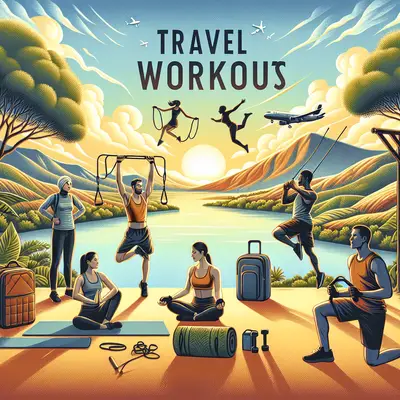
You don’t need a home gym, a perfect schedule, or checked luggage full of gadgets to stay strong on the road. Whether you’re chasing sunsets between coworking spaces or hopping red-eyes to your next project, your body can be your most reliable piece of gear. This isn’t about squeezing in “a quick burn” for the sake of it—this is about building a travel-proof engine that can carry you up volcano trails, through 14‑hour bus rides, and into whatever wild detour shows up next.
Build a “Non-Negotiable 10” Ritual
When your days swing between time zones and transit, long workouts are the first thing to evaporate. A tiny, non-negotiable ritual is how you sneak consistency into chaos.
Pick a simple, repeatable 10-minute block that you can do almost anywhere, no warm-up, no thinking. For example: 3 rounds of 10 squats, 10 push-ups (on a wall, desk, or floor), 10 reverse lunges per leg, and a 30-second plank. That’s it. If motivation is low, you still do the 10. If energy is high, you can stack more rounds.
Make this ritual happen at a fixed trigger—right after you brush your teeth, after your morning coffee, or when you close your laptop. The point isn’t intensity; it’s identity. You’re the person who moves every day, even when your bed is a sleeper bus and your “gym” is an airport gate. Over time, this baseline keeps your joints awake, your strength from eroding, and your mind anchored in something you control.
Turn Transit Into Your Secret Mobility Lab
Travel beats your body up in sneaky ways: tight hips from long flights, stiff upper backs from laptop hunching, swollen ankles from hours of sitting. Instead of accepting that as the cost of adventure, treat transit as mandatory maintenance time.
On planes, trains, and buses, set a quiet timer on your phone for every 30–60 minutes. When it buzzes, run through a short mobility sequence: ankle circles, seated figure‑4 hip stretch, gentle neck rotations, shoulder rolls, and a seated twist. In the aisle or terminal, add standing calf raises and quad stretches while you check your gate or boarding group.
If you’re working in cafés or coworking spaces all day, rotate between sitting, standing (use a high counter or bar), and occasionally working from a lunge or kneeling position if the space allows. These micro-adjustments keep your hips, back, and shoulders from locking into “travel statue” mode. Your reward: climbing temple steps or chasing sunrise buses without feeling like you’ve aged 20 years overnight.
Pack One Piece of Gear That Multiplies Your Options
You don’t need a suitcase of equipment—but one smart tool can turn almost any room into a functional training space. Aim for something light, packable, and versatile.
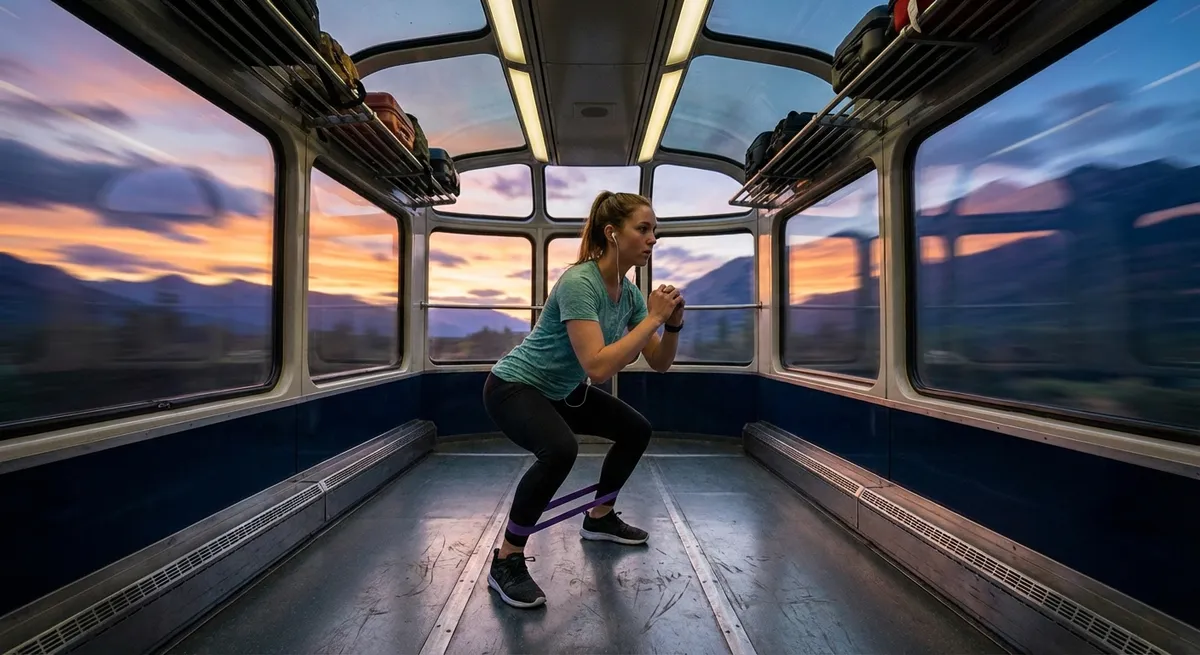
A long resistance band or a pair of mini loop bands can cover rows, presses, hip work, and shoulder stability drills. A lightweight suspension trainer or DIY version with strong straps and carabiners can anchor to hotel doors, sturdy beams, or playground structures, unlocking rows, assisted single-leg squats, and core work. Even a simple jump rope gives you a powerful conditioning tool that fits in a pocket.
Use this gear to fill the gaps bodyweight alone can’t fully hit—especially pulling movements (rows, face pulls) to balance out all the pushing and hunching you do while traveling and typing. Think of your gear as a “strength lens” you can bolt onto any environment: hostel courtyard, rooftop terrace, quiet park, even the corner of a budget hotel room.
Train for the Adventures You Actually Want
Random workouts keep you busy. Intentional workouts keep you ready. If your travel dreams involve mountain switchbacks, surf sessions, long city wanders, or back-to-back sightseeing days, let that shape your training.
For hiking-heavy trips, focus on leg strength (squats, split squats, step-ups on benches or stairs), single-leg balance, and core stability so you can handle uneven trails and heavy daypacks. For surf or water adventures, double down on shoulder health (band pull‑aparts, Y‑T‑W raises, scapular push-ups) and rotational core work (dead bugs, side planks, slow mountain climbers). City explorers benefit from basic endurance: brisk walking “commutes” instead of rideshares, fast stair climbs instead of elevators, and short intervals of jump rope or shadow boxing.
Twice a week, make one session “adventure strength” (slow, controlled strength-focused work) and one session “adventure endurance” (faster-paced, higher-heart-rate intervals). Even 20 focused minutes can make the difference between surviving your trip and having energy left to say yes when someone invites you on a last-minute sunrise mission.
Use the World as Your Training Playground
The best travel workouts are the ones that don’t look like workouts at all. Let the environment do half the programming for you.
Spot stairs? Turn them into low‑impact hill sprints, step-ups, or stair climbs with intervals: 30–45 seconds hard effort, matched with an easy walk down. Find a sturdy bench or low wall for elevated push-ups, triceps dips, split squats, and box step-ups. Beach or soft grass nearby? Barefoot walks, short runs, or balance drills challenge your feet and ankles in ways a treadmill never will.
If you’re in a cramped city with no obvious open space, get creative indoors: isometric wall sits, suitcase or backpack loaded squats and carries, towel rows looped around a door handle, and tempo push-ups (3 seconds down, 1 up) can bring serious challenge without noisy jumps or heavy weights. The key is to stop waiting for a perfect setup and instead ask: “What can this place do for my body today?”
Conclusion
Travel will always try to throw your routine off-balance—that’s part of the thrill. But strength, mobility, and stamina don’t have to be casualties of your next border crossing or deadline. Anchor yourself with a tiny daily ritual, move often in transit, carry one versatile piece of gear, train with your next adventure in mind, and treat each new location as a playground instead of an excuse.
Your body becomes the one piece of equipment that’s always checked in, never lost, and ready for whatever path, alleyway, or ridgeline you chase next.
Sources
- [American College of Sports Medicine – Physical Activity Guidelines](https://www.acsm.org/educate/health-and-fitness-framework/physical-activity-guidelines) – Overview of evidence-based recommendations for weekly activity and strength work
- [Centers for Disease Control and Prevention – Benefits of Physical Activity](https://www.cdc.gov/physicalactivity/basics/pa-health/index.htm) – Summarizes how regular movement supports health, energy, and long-term function
- [Harvard Health Publishing – The Importance of Stretching](https://www.health.harvard.edu/staying-healthy/the-importance-of-stretching) – Explains why mobility and stretching matter, especially when sitting for long periods
- [Mayo Clinic – Aerobic Exercise: How to Warm Up and Cool Down](https://www.mayoclinic.org/healthy-lifestyle/fitness/in-depth/exercise/art-20045517) – Practical guidance for safely ramping up and down intensity during short travel workouts
Key Takeaway
The most important thing to remember from this article is that this information can change how you think about Travel Workouts.