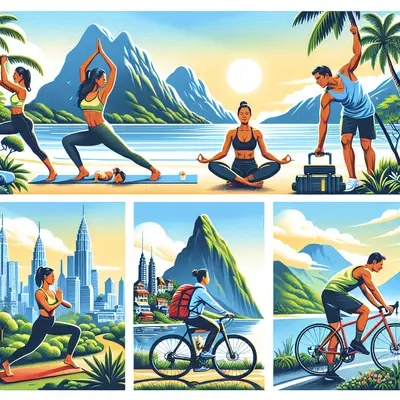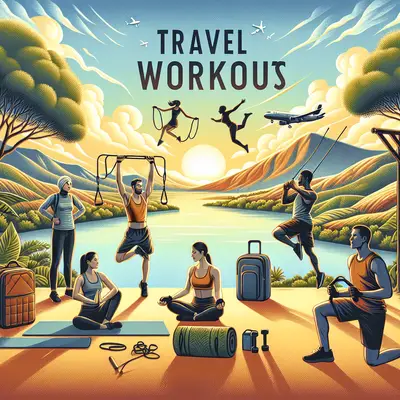
Your boarding pass doesn’t have to stamp out your strength. Whether you’re chasing Wi-Fi in a mountain town, stacking time zones, or hopping overnight buses, your body can stay just as mission-ready as your passport. Travel doesn’t have to be a detour from training—it can be the terrain that makes you stronger, more adaptable, and more resilient.
This isn’t about perfection. It’s about portable tactics: smart, compact moves that fit between flights, calls, and border crossings. Below are five field-tested fitness tips built for travelers and digital nomads who want to move well, carry light, and stay ready for whatever the map throws at them.
Build a “Movement Minimum” for Any Day, Any Country
You won’t always have time or space for a full workout—but you can have a non‑negotiable “movement minimum” that follows you from hostel bunk to airport gate.
A movement minimum is a tiny, repeatable protocol you can knock out in 5–10 minutes without equipment. Think of it as your physical baseline: if nothing else happens today, this does. It keeps your joints awake, your muscles honest, and your mind anchored.
A reliable template:
- 10 slow bodyweight squats
- 10 push-ups (elevated on a bed, sink, or wall if needed)
- 10 hip hinges or good mornings (hands on hips, soft knees, hinging forward)
- 10 reverse lunges (total)
- 30 seconds of plank
Run through this 1–3 times, depending on your energy and schedule. The goal isn’t exhaustion—it’s consistency. This “floor” of daily movement improves circulation after long sits, maintains basic strength, and keeps travel stiffness from becoming travel pain.
Once this minimum is automatic, you can scale up on days with more time, or scale down to a single round on brutal transit days and still stay in the game.
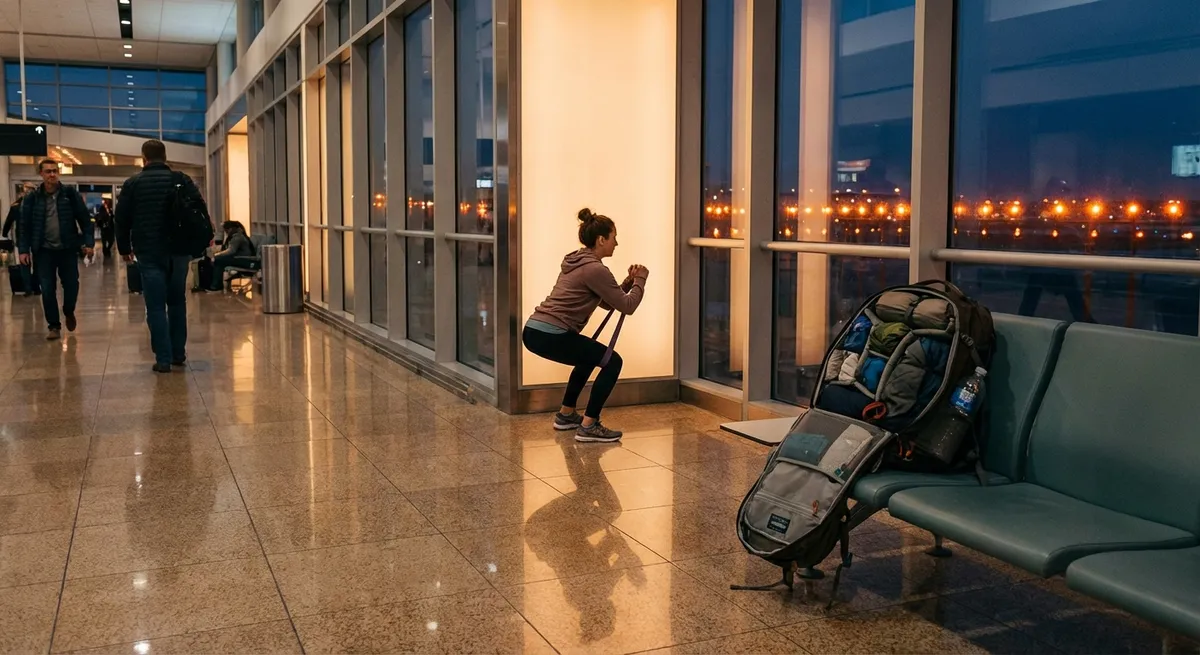
Turn Transit and Layovers Into “Hidden Training Time”
Travel days look inactive, but they’re secretly loaded with micro‑opportunities to move. Instead of seeing flights and bus rides as dead zones, treat them as modular training blocks you can weave together.
Before boarding or during layovers, cycle through:
- Stair intervals: Skip the escalator when safe. Walk or lightly jog stairs for 5–10 minutes. Great for leg strength and heart rate.
- Carry practice: Use your backpack or duffel as a loaded carry. Walk slow laps around your gate area with your core braced and shoulders pulled down. Alternate one-hand suitcase carries if you’ve got a rolling bag.
- Mobility circuits: Ankle circles, gentle hip circles, neck rotations, and shoulder rolls every hour. This supports circulation and combats stiffness from prolonged sitting.
On planes or trains:
- Seated calf raises and ankle pumps for blood flow
- Gentle seated twists (rotate from your ribs, not just your shoulders)
- Periodic aisle walks when allowed
None of this will feel like a traditional gym session—but stack these “stealth reps” on top of your movement minimum, and your travel day becomes more active than most office days back home.
Use Your Pack as a Portable Weight Room
Your luggage is more than a gear hauler—it’s a compact, adjustable weight set that’s already paid for.
A solid backpack or small duffel can stand in for dumbbells or kettlebells in cramped rooms, parks, or rooftops. Start light and focus on control and body position before loading up.
Try these pack‑based moves:
- Loaded squats or split squats: Hug your pack to your chest like a sandbag, or wear it on your back.
- Bent-over rows: Hinge at the hips, neutral spine, row the pack toward your ribs.
- Suitcase deadlifts: With the pack or suitcase on the ground beside you, hinge and lift it straight up while keeping your shoulders level.
- Overhead press (if your shoulders are healthy): Press a lightly loaded pack overhead, standing tall and bracing your core.
Adjust intensity by adding or removing items: clothes, water bottles, books, or tech. This keeps your “gym” adaptable whether you’re ultralight backpacking or rolling heavy between client sites.
Always check your surroundings—no overhead pressing under a low ceiling fan—and avoid throwing or dropping your bag, especially with fragile gear inside.
Anchor Your Week With Three Pillar Sessions
Travel wrecks routines, but it doesn’t have to wreck structure. Instead of clinging to a fixed weekly schedule that falls apart with every delayed flight, anchor your training around three “pillar sessions” that can float with your itinerary:
Lower-Body Strength + Balance Session
- Squats or split squats (bodyweight or pack-loaded) - Hip hinges (good mornings, single-leg deadlifts without weight) - Calf raises and single-leg balance work (stand on one foot, add eyes-closed to progress)
Upper-Body Push/Pull Session
- Push-ups (floor, incline, or wall) - Rows (using your pack, a sturdy table edge, or TRX-style straps if you carry them) - Shoulder stability (plank variations, scapular push-ups, Y-T-W arm patterns on the floor)
Conditioning + Core Session
- Short circuits of step-ups (stairs/curb), fast walking, or brisk stair climbs - Core work: planks, side planks, dead bugs, suitcase carries with your bag - Optional short shuttle walks or jogs in a park, along a beach, or in a quiet street
Instead of tying these to specific days (like “Monday/Wednesday/Friday”), run them in order whenever you have 20–30 minutes. If you only manage two sessions this week, pick up with the next one when life settles. This flexible framework keeps you progressing without crumbling when your calendar shifts.
Stack Movement With Existing Habits to Make It Stick
The biggest travel enemy isn’t lack of equipment—it’s decision fatigue. New cities mean new logistics: where to eat, where to sleep, where to work. If you force your workouts to be “just one more decision,” they’ll lose.
The workaround: habit stacking—attaching your movement to something you’re already doing every single day, no matter the country.
Examples that work well on the road:
- After morning coffee or tea: 1–3 rounds of your movement minimum before you open your laptop.
- After every long work block: 5–10 minutes of mobility or a mini set of squats, push-ups, and hip hinges. Use timers or app reminders.
- Before your evening shower: Quick core and mobility circuit—plank, side plank, glute bridge, and a few stretches.
- When you check into a new stay: Drop your bags, map the room, then do a fast scan: where can I do push-ups, rows, and squats here? Do one test set of each.
By wiring movement into routines you already have, training becomes part of your travel rhythm instead of a separate, fragile “gym time” that collapses with every new city.
Conclusion
You don’t need a metal rack or a familiar postal code to train like you mean it. You need a plan that travels as well as you do: small, repeatable anchors, gear that doubles as equipment, and an eye for movement opportunities in places most people only sit and scroll.
Treat every new city as terrain to move through, not just scenery to photograph. Stay curious, stay adaptable, and let your training be as portable as your passport. The map will keep changing—your capacity to handle it can keep getting stronger.
Sources
- [American College of Sports Medicine – Staying Active While Traveling](https://www.acsm.org/docs/default-source/files-for-resource-library/staying-active-while-traveling.pdf) - Practical strategies and guidelines for maintaining physical activity during trips
- [CDC – Physical Activity Basics](https://www.cdc.gov/physicalactivity/basics/index.htm) - Evidence-based recommendations for weekly activity and why consistency matters
- [Harvard Health – The Importance of Stretching](https://www.health.harvard.edu/staying-healthy/the-importance-of-stretching) - Explains how mobility and stretching support joint health and reduce stiffness from sitting and travel
- [Mayo Clinic – How to Sit Less and Move More](https://www.mayoclinic.org/healthy-lifestyle/adult-health/in-depth/sitting-problem/art-20205927) - Research-backed advice on breaking up sedentary time with movement
- [NHS – Strength and Flex Exercise Plan](https://www.nhs.uk/live-well/exercise/strength-and-flex-exercise-plan/) - Simple, equipment-free routines that align well with portable, bodyweight-focused training
Key Takeaway
The most important thing to remember from this article is that this information can change how you think about Travel Workouts.