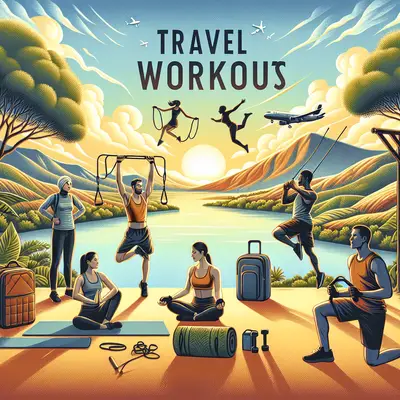
Travel shifts your sense of time, place, and sometimes sanity—but your body still craves movement. Whether you’re chasing visas, red‑eye flights, or the best coffee in a new city, staying strong on the move doesn’t need a full gym or perfect schedule. It just needs a portable plan, a bit of creativity, and a willingness to treat every layover, lobby, and guesthouse as your training ground.
This isn’t about “keeping up” with a home routine. It’s about building a travel‑proof body that lets you hike the longer trail, sprint for the closing gate, and shoulder your pack without your back complaining.
Build a “Minimum Viable Workout” You Can Run Anywhere
When you’re crossing time zones and swapping beds every few nights, consistency beats perfection. A “minimum viable workout” (MVW) is a short, no‑equipment routine that you commit to doing almost every day—no matter how chaotic the itinerary.
Design your MVW to hit three pillars: push, pull, and legs, plus a little core. For example: push‑ups, towel rows (looped around a sturdy door), split squats, and a plank variation. Keep it simple enough that you can start without thinking: 2–3 rounds, 8–15 reps, under 20 minutes. This becomes your anchor when the local gym is closed, the park is sketchy, or the schedule explodes.
The psychological win is huge. Studies show that even short, moderate workouts improve mood and reduce perceived stress, which matters when travel throws curveballs. Protect your MVW like you protect your passport—this is your baseline, and anything extra you do (hikes, swims, city walks) is a bonus, not a requirement.
Use Your Environment Like an Obstacle Course
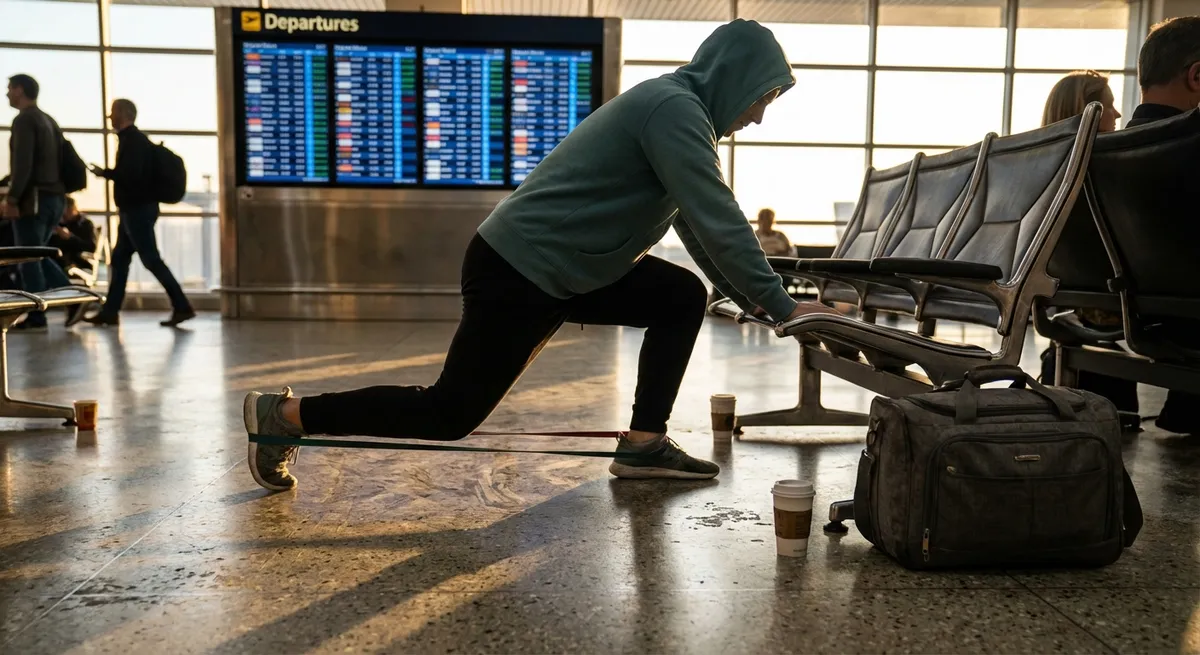
Your surroundings on the road are a playground if you know how to look. Airport benches become elevated push‑up stations. A low wall at a viewpoint becomes your step‑up platform. Stairwells turn into no‑nonsense leg and cardio zones.
Think in patterns, not equipment. Need a pull movement? Find a sturdy railing, tree branch, or playground bar for bodyweight rows or hangs. Need cardio? Use a staircase and sprint/walk intervals for 5–10 minutes. Benches and curbs are perfect for single‑leg squats, dips, and calf raises. In a hotel room, a heavy backpack becomes a weight for goblet squats and overhead presses.
Exploring on foot is also free conditioning. Turn “I’ll just check out that neighborhood” into a purposeful power walk: long strides, brisk pace, backpack on. Research shows walking, especially at a faster pace, improves cardiovascular and metabolic health—even in short bursts. Treat each city or town like a new route on your personal movement map.
Travel‑Ready Tip #1: Create a Bodyweight Strength Template
For travelers and digital nomads, strength work needs to be modular and fast. Use a simple template you can plug exercises into, with no more than 4–5 moves:
- Lower body: squats, split squats, reverse lunges, hip hinges (good mornings or single‑leg deadlifts with a backpack)
- Upper push: push‑ups (floor, incline on bed/bench, decline with feet elevated), pike push‑ups for shoulders
- Upper pull: towel rows in a door, table rows, resistance band rows if you carry one
- Core: side planks, dead bugs, hollow holds, crawl patterns (bear crawl in a small space)
- Finisher: a short 5‑minute burner like squats + push‑ups EMOM (every minute on the minute)
Pick one of each and run: 3 sets, 8–15 reps per move, 2–3 times a week. Progress by changing angles (harder push‑up variations), slowing the eccentric (lowering) phase, or adding a backpack load. This keeps your muscles challenged without needing a squat rack or dumbbells.
Travel‑Ready Tip #2: Pack a One‑Liter Fitness Kit
You don’t need a portable gym—just a tiny toolkit that fits in a corner of your carry‑on. Think of it as your “one‑liter fitness kit”:
- A light to medium resistance band with handles or loops (for rows, presses, pull‑aparts)
- A mini loop band (great for hip work, glute activation, and shoulder warm‑ups)
- A compact jump rope (for high‑intensity cardio when running outside is unsafe or impractical)
- A massage ball or lacrosse ball (for releasing tight hips, back, and feet after long flights)
With this set, you can turn any room, rooftop, or hostel courtyard into a micro‑gym. Resistance bands are proven to build strength and muscle similarly to free weights when used with sufficient effort, and they’re practically weightless in your bag. The jump rope covers your “heart punching out of your chest” needs in about 5–10 tight, focused minutes.
Travel‑Ready Tip #3: Anchor Training to Daily Rituals
Travel wrecks schedules, but rituals survive. Anchor your workouts to habits that happen no matter where you are. For example:
- Post‑wake‑up: 5–10 minutes of mobility and activation before you touch your phone or laptop.
- Post‑work deep focus block: 15–20 minutes of strength before you allow yourself to check messages or social media.
- Pre‑dinner: Quick circuit before you go hunting for food in a new place.
Habit stacking works well on the road: “After I make coffee, I do my 10‑minute movement block.” Short and predictable beats long and hypothetical. You’ll also sleep better—moderate daily activity improves sleep quality, which is gold when you’re bouncing between beds and time zones.
Travel‑Ready Tip #4: Turn Transit and Waiting Time Into Mobility Sessions
Long-haul flights, overnight buses, and train marathons turn your hips and spine into concrete. Instead of passively suffering, treat these stretches as mobility windows. During layovers or rest stops, walk laps instead of sitting, then add simple movement snacks:
- Standing calf raises while you wait in line
- Hip circles and gentle leg swings in a quiet corner
- Neck and shoulder rolls while seated
- Ankle circles and foot pumps to reduce stiffness and support circulation
Sitting for long periods is strongly associated with health risks, but breaking it up with light activity helps. Even 2–3 minutes of movement every 30–60 minutes on travel days reduces that “my body hates me” feeling when you finally reach your destination. When you get to your room, spend 5–10 minutes on hip flexor stretches, thoracic spine rotations, and hamstring work before collapsing into bed.
Travel‑Ready Tip #5: Use Intensity, Not Duration, When Time Is Brutal
Some days on the road will be chaos: immigration lines, client calls, late check‑ins. On those days, chasing a 45‑minute workout is fantasy. Instead, use intensity in small, sharp doses.
High‑intensity interval training (HIIT) or even moderate intervals can be brutally effective in 8–15 minutes, and research backs its benefits for cardiovascular health and fitness. Think of “micro‑sessions”:
- 30 seconds hard, 30–60 seconds easy, repeated 8–12 times with:
- Fast stair climbs
- Jump rope
- Burpees + squats
- Shadow boxing with fast footwork
Stay honest with your effort: you should finish feeling worked but not wrecked. If you’re sleep‑deprived, jet‑lagged, or under‑fed, drop the intensity and do low‑impact intervals like brisk walking laps or slow stair climbs. The goal on these days is “keep the engine warm,” not set personal records.
Conclusion
A strong travel body isn’t built in pristine gyms with perfect lighting; it’s forged in hotel hallways, airport corners, hostel courtyards, and tiny apartments with sketchy flooring. The key is flexibility: a simple bodyweight template, a tiny gear kit, movement woven into your transit days, and micro‑bursts of effort when time is tight.
You’re not trying to freeze your “home routine” in place—you’re upgrading it for the road. Treat every new city as both a destination and a training ground, and your body will be just as ready for the next border crossing as your passport.
Sources
- [Harvard Health Publishing – The Importance of Exercise](https://www.health.harvard.edu/exercise-and-fitness) - Overview of why consistent physical activity matters for health, mood, and energy—critical for frequent travelers.
- [Mayo Clinic – Interval Training: Fitness with a Flare](https://www.mayoclinic.org/healthy-lifestyle/fitness/in-depth/interval-training/art-20044588) - Explains how interval training works and why it’s effective when time is limited.
- [American Council on Exercise – Resistance Band Training](https://www.acefitness.org/resources/everyone/blog/7486/why-you-should-use-resistance-bands-in-your-workouts/) - Details the benefits and versatility of resistance bands for strength on the go.
- [Centers for Disease Control and Prevention – Physical Activity Basics](https://www.cdc.gov/physicalactivity/basics/index.htm) - Evidence-based guidelines for weekly activity levels and health outcomes.
- [World Health Organization – Physical Activity Fact Sheet](https://www.who.int/news-room/fact-sheets/detail/physical-activity) - Global recommendations and research on the impact of regular movement on overall health.
Key Takeaway
The most important thing to remember from this article is that this information can change how you think about Travel Workouts.