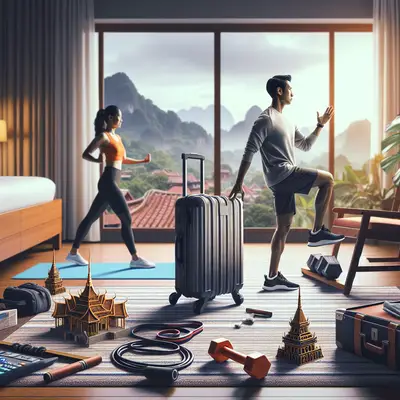
Your passport has more stamps than your kettlebell has scuffs, your life runs on boarding times and booking confirmations, and yet your body still needs consistent work. Hotel walls change, time zones blur, and “I’ll train when I’m home again” becomes a lie that stretches for months.
This is your antidote: an on-the-road approach to hotel fitness that doesn’t depend on lucking into a miracle gym. These tactics are built for digital nomads and frequent flyers who want to move like athletes, not passengers.
Build a Minimalist “Always-Ready” Kit
The strongest advantage you can carry isn’t a full gym—it’s a tiny kit that kills excuses.
Pack gear that disappears into your luggage but multiplies your training options: a light mini-band, a long resistance band with handles, and a short loop band cover basically every major movement pattern. Slip in a jump rope for conditioning and a lacrosse ball (or tennis ball) for mobility and tight-spot self-massage. This all fits in a packing cube smaller than your toiletry bag.
Stash this kit where it’s impossible to ignore (front of your backpack or top of your carry-on). When you check into a room, put it in plain sight near the desk or TV, not buried in a closet. Think of it as your “field kit” for strength, not random gear. Your rule: if the Wi‑Fi connects, the kit comes out. No hotel gym? No problem—you already brought one.
Tip 1: Anchor Your Day With a 15-Minute “Arrival Circuit”
Long travel days wreck structure. Reclaim it the moment you hit the room.
Before you dive into email, room service, or scrolling, run a short “arrival circuit” to reset your body and wake your brain:
- 2 minutes: slow standing hip circles and arm circles
- 8 minutes: rotating strength block
- 30 seconds: bodyweight squats
- 30 seconds: incline push-ups on the desk or bed edge
- 30 seconds: band rows locked around a door hinge or heavy table leg
- 30 seconds: dead bug core holds on the floor
- Rest 1 minute and repeat 2–3 times
- 5 minutes: calf raises on a stair or ledge, plus a long hip flexor stretch
This short hit fights stiffness from flights, resets posture from laptop hunching, and gives you a psychological win: your first action in a new city is movement, not passivity. It also helps regulate circadian rhythm by waking muscles and improving blood flow, especially when paired with some daylight at the window.
Tip 2: Turn Your Hotel Room Into a Three-Zone Training Ground
You don’t need square footage; you need zones with a purpose.
Zone 1: Strength Corner
Use the heaviest, most stable thing in the room—a desk, bed frame, or heavy chair. This becomes your station for:
- Incline or decline push-ups
- Bulgarian split squats with your back foot elevated
- Chair dips (only if the chair is rock-solid and doesn’t roll)
Zone 2: Mobility Strip
Clear a narrow strip by the bed or along the wall where you can lie down. This is your mat space for:
- Glute bridges and hip thrusts
- Planks and side planks
- Hamstring stretches, adductor stretches, and thoracic spine rotations
Zone 3: Cardio Lane
Find the longest line in the room or hallway outside your door. This is your path for:
- High-knee marches or skips in place
- Shadow boxing
- Jump rope (if the ceiling is high enough and neighbors won’t hate you)
By assigning zones, you remove decision fatigue. You’re not thinking, “What should I do?” You’re thinking, “Which zone am I using today?” That’s the difference between training on the road and just doing random hotel burpees when guilt hits.
Tip 3: Program for Chaos, Not Perfection
Travel days destroy beautifully structured programs. Stop pretending your road life will bend around a four-day split and train for chaos instead.
Use a flexible template: push, pull, legs, core, and conditioning. Your rule: on any given day, hit at least three of those five categories using whatever you’ve got.
Example “chaos-friendly” session:
- Push: Incline push-ups on the desk (3 sets)
- Pull: Resistance band rows hooked through the bathroom door (3 sets)
- Legs: Split squats or walking lunges down the corridor (3 sets)
- Core: Side planks and dead bugs (2–3 rounds)
- Conditioning (optional): 6–8 rounds of 20 seconds fast jump rope, 40 seconds easy
If you’re wiped from travel, shorten sets or reduce rounds—but never break the chain. A small session keeps the habit alive. When you get an unexpectedly great gym one day, push harder, but don’t depend on that as the norm. Your standard plan should expect bad lighting, mediocre space, and no equipment, and still work.
Tip 4: Use Time-Zones to Your Advantage, Not as an Excuse
Crossing time zones messes with energy, appetite, and motivation—but it also gives you a strategic edge if you plan for it.
On early-arrival days, commit to a light-to-moderate workout within 2–3 hours of local sunrise, even if your body thinks it’s 2 a.m. The combination of movement and daylight exposure helps anchor your circadian rhythm and reduce jet lag. Keep it simple: brisk walk outside plus a short band circuit in the room.
On late-arrival nights, aim for shorter, calming sessions: more mobility, slow tempo, and controlled breathing. Think:
- Long hip flexor and hamstring stretches
- Slow deep squats holding onto the desk for balance
- Cat-cow spine movements and gentle thoracic rotations
- 3–5 minutes of nasal breathing in a lying or seated position
Your mission isn’t to hit PRs across time zones—it’s to keep your body feeling like an ally instead of an anchor. When your sleep schedule is shaky, prioritize consistent low-to-moderate movement and exposure to daylight over heroic workouts.
Tip 5: Create a “No-Excuse” Bodyweight Template
Hotel gym closed. Gear left at last Airbnb. Red-eye flight turned your brain to oatmeal. You still have this: a no-excuse hotel-room template that needs nothing but floor space.
Use this structure and fill in with variations that work for your space:
Lower Body:
- Squats, reverse lunges, or split squats - For more challenge: pause 2 seconds at the bottom or do tempo reps (3 seconds down, 1 second up)
Upper Push:
- Push-ups at whatever incline you need (wall, desk, bed, floor) - Narrow-hand variation for triceps, wider stance for more chest
Upper Pull (Improvised):
- Towel rows over a sturdy door (towel draped over the top, hands pulling down) - Isometric pulls: loop a towel around a fixed object and pull hard without movement
Core:
- Dead bugs, plank variations, or slow mountain climbers - Suitcase carry imitation: stand tall with a backpack in one hand and hold tight while walking in place
Finisher:
- 5–10 minutes of non-impact cardio: shadow boxing, brisk in-place marching, or low-impact lateral steps
Cycle through 3–4 rounds, 8–15 reps per exercise depending on difficulty. When in doubt, go slower and tighter rather than faster and sloppier. This template is your safety net—if your day collapses, you still have a plan that fits inside any room, in any city.
Conclusion
A hotel room can be a layover, or it can be a training outpost.
When you travel with a tiny kit, a chaos-ready plan, and a few simple rules—arrival circuits, multi-zone rooms, and no-excuse bodyweight templates—you stop being dependent on lucky gyms or perfect schedules. Your body becomes something you carry with intent, not something dragged along for the ride.
The itinerary will always be uncertain. Your training doesn’t have to be. Wherever you land tonight, you’ve got everything you need to move like you’re on tour with a purpose, not just passing through.
Sources
- [Centers for Disease Control and Prevention – Physical Activity Basics](https://www.cdc.gov/physicalactivity/basics/index.htm) - Overview of recommended activity levels and benefits of consistent movement
- [American Heart Association – Staying Active While Traveling](https://www.heart.org/en/healthy-living/fitness/getting-active/staying-active-while-traveling) - Practical tips and health considerations for maintaining activity on the road
- [Harvard Health Publishing – The Importance of Stretching](https://www.health.harvard.edu/staying-healthy/the-importance-of-stretching) - Evidence-based guidance on mobility and flexibility, useful for post-travel routines
- [Sleep Foundation – How Exercise Affects Sleep](https://www.sleepfoundation.org/physical-activity/how-exercise-impacts-sleep) - Explains how timing and intensity of exercise influence sleep and jet lag adjustment
- [Mayo Clinic – Fitness Basics: Starting a Fitness Program](https://www.mayoclinic.org/healthy-lifestyle/fitness/in-depth/fitness/art-20048269) - Foundational principles for building sustainable exercise habits, adaptable to travel life
Key Takeaway
The most important thing to remember from this article is that this information can change how you think about Hotel Fitness.