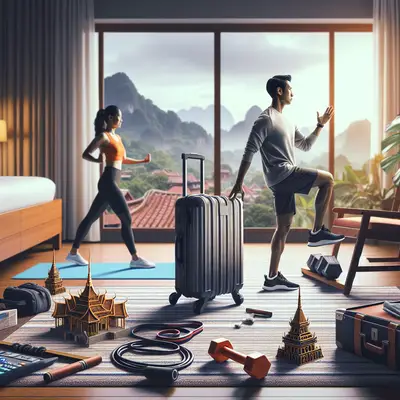
You don’t need a home gym or a month-long retreat to stay in expedition shape. If you’ve got a key card, a carry-on, and a willingness to sweat between time zones, your hotel can become a training outpost—whether you’re on a red-eye business sprint or a long-haul nomad loop.
This isn’t about “fitting in a quick workout.” This is about staying trail-ready, hike-capable, surf-curious, and mountain-strong using the most overlooked gym in travel: the hotel itself.
Scout Your Terrain: Recon the Hotel Like an Athlete, Not a Guest
Before you unpack, treat your hotel like a new training zone you’re mapping for an expedition.
Walk the property once with a “movement” mindset. Look for:
- Stairwells for strength and conditioning bursts
- Long hallways for walking lunges, farmer’s carries (with your bags), or brisk pacing calls
- Solid walls or doorframes for isometric holds and mobility drills
- Outdoor spaces: loading zones, courtyards, rooftop decks, or nearby parks
- Furniture that won’t slide: sturdy chairs, the bed frame, or a low windowsill for dips and step-ups
This recon lap does two things: it locks in a mental map for quick, no-excuse workouts, and it shifts your brain from “jet-lagged guest” to “athlete on assignment.” Once you’ve scouted the terrain, you can plug in short, intentional movement breaks throughout the day—no need to negotiate with yourself about “finding a gym.”
Tip 1: Build a 10-Minute “Arrival Reset” You Can Do in Any Room
Travel days wreck posture, circulation, and energy. Your first move in the room shouldn’t be Wi-Fi, it should be a reset.
Try this simple 10-minute arrival sequence:
- Doorway chest opener – Stand in the bathroom or main doorframe, forearms on the frame, step through gently for 30–45 seconds.
- Bed-edge squat-to-stand – Sit on the edge of the bed, stand up without using your hands, sit back down slowly. 12–15 reps.
- Suitcase deadlifts – Use your heaviest bag. Hinge at the hips, keep your back neutral, lift the bag to standing, lower with control. 10–12 reps.
- Wall plank hold – Hands on the wall at shoulder height, walk your feet back until your body forms a straight line. Hold 30–45 seconds.
- Foot and calf reset – Barefoot ankle circles, calf raises off the edge of the bathroom step or a thick towel. 15–20 reps each side.
This isn’t full training—this is you telling your nervous system, “We’ve arrived, we’re in control, and this body is mission-critical.” It also primes you for better sleep and easier decision-making when it comes to food, work, and movement over the next 24 hours.
Tip 2: Turn Your Luggage Into a Makeshift Strength Rack
If it has a handle, weight, and a zipper, it’s training gear.
With a bit of creativity, your carry-on and backpack can cover most strength patterns:
- Suitcase rows – One hand on the bed for support, other hand on the suitcase handle. Row it toward your hip; keep your spine neutral.
- Backpack front squats – Hug a loaded backpack to your chest and sit into a squat, pushing knees out and keeping heels down.
- Single-leg Romanian deadlifts – Hold a duffel or backpack in both hands, hinge at the hips on one leg, extend the other leg behind you. Great for hamstrings and balance.
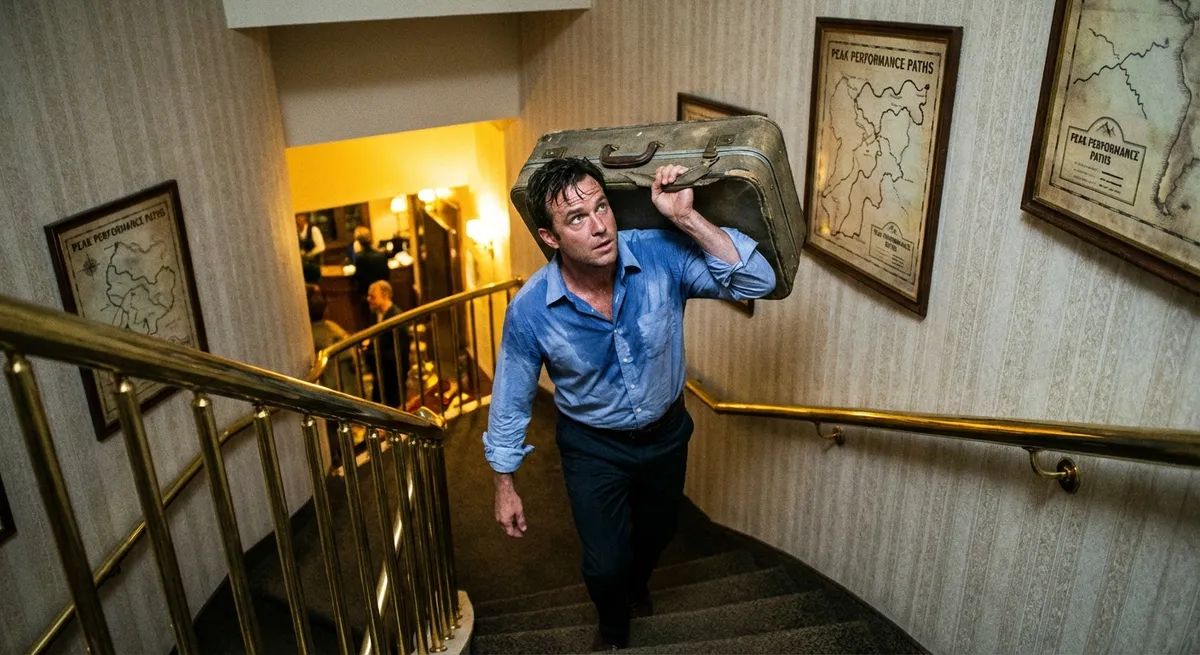
- Suitcase carries – Walk the hallway or pace your room holding one suitcase at your side. This trains your grip, core, and anti-tilt strength.
Pack with intent: heavier items (books, chargers, shoes, water bottle) go in a “training bag” you’re willing to use as a weight. If the hotel gym is packed or tiny, you’re covered. If there is no gym at all, you still have a portable strength base built into your luggage.
Tip 3: Use the Hotel Schedule as Your Training Framework
Instead of fighting your travel schedule, hitch your fitness to it.
Anchor movement to things that already must happen:
- Post-check-in circuit – Do your 10-minute arrival reset immediately after you get your key.
- Coffee walk – Never drink your first coffee sitting down. Grab it to-go and circle the block or walk the hotel corridors for 10–15 minutes.
- Pre-shower “micro-session” – Before every shower, commit to a short bodyweight routine (push-ups, split squats, glute bridges, planks). No shower without movement.
- Call-and-pace rule – Any audio-only meeting or family call becomes a walking meeting down the halls or around the lobby.
By attaching training to non-negotiable events (wake-up, check-in, coffee, calls), you ditch the need for motivation and willpower. The trip’s rhythm becomes your training partner instead of your enemy.
Tip 4: Design a Go-To “No-Jump, No-Noise” Hotel Room Workout
Thin walls and sensitive neighbors should never be the reason you skip a session. Build a quiet, low-impact sequence you can do at 5 a.m. or midnight without upsetting anyone.
Example full-body, no-jump flow (3–5 rounds, 20–30 seconds rest as needed):
- Slow tempo squats – 10–15 reps, 3 seconds down, 1 second pause, 1 second up
- Incline push-ups – Hands on the desk or bed frame, 8–12 reps
- Reverse lunges – Step back instead of forward to save your knees and space, 8–10 reps per leg
- Isometric suitcase hold – Hold a loaded backpack at chest height or a suitcase at your side, 20–30 seconds
- Dead bug or hollow hold on the floor – 20–30 seconds, controlled breathing
- Wall sit – Back against the wall, thighs parallel to the floor if possible, 30–45 seconds
Move deliberately, breathe quietly, and focus on form. This kind of “silent training” builds joint control, strength endurance, and mental discipline—useful on mountain switchbacks, in surf lineups, or carrying gear up a steep hostel stairwell.
Tip 5: Treat Every City Like an Outdoor Gym Extension
The hotel is your base camp, but the real playground is outside. Use your room to warm up, then take your adventure conditioning into the streets.
A simple “city exploration conditioning” template:
- Warm-up in the room – 5 minutes of mobility: arm circles, hip circles, cat-cows, bodyweight squats.
- Pick a landmark – A park, river path, old town square, or viewpoint 10–20 minutes away on foot.
- Walk or jog there – Comfortable pace; focus on posture and breathing.
- Mini-station session – At the park or open area: step-ups on a bench, incline push-ups, walking lunges, side shuffles, short stair repeats if available.
- Return at a slower pace – Use the walk back as a cool-down and route scout for future runs or walks.
This approach turns “I should work out” into “I’m going to scout the city like an athlete.” You collect steps, sights, and local intel at the same time—and your hotel remains a reliable launchpad instead of a confinement box.
Conclusion
Every hotel stay can move you closer to your next summit, surf break, or trail instead of dragging you away from it.
You don’t need perfect conditions. You need a mindset: treat the lobby like base camp, your luggage like a barbell, the hallways like lanes, and the city like a training ground. Anchor short bouts of movement to your travel routine, move quietly when you must, and explore aggressively when you can.
Travel doesn’t have to be a break from your fitness. It can be the proving ground that keeps you permanently adventure-ready—no matter where you drop your bag tonight.
Sources
- [American Council on Exercise: Hotel Room Workout Ideas](https://www.acefitness.org/resources/everyone/blog/7203/no-gym-no-problem-do-this-hotel-room-workout-while-you-travel/) - Practical examples of effective exercises you can safely do in a hotel room
- [Mayo Clinic: Strength Training Fundamentals](https://www.mayoclinic.org/healthy-lifestyle/fitness/in-depth/strength-training/art-20046670) - Overview of safe strength-training principles that apply to using luggage and bodyweight as resistance
- [Harvard T.H. Chan School of Public Health: Benefits of Walking](https://www.hsph.harvard.edu/nutritionsource/walking/) - Evidence-based health and fitness benefits of walking, useful for “coffee walks” and city exploration sessions
- [CDC: Physical Activity Basics](https://www.cdc.gov/physicalactivity/basics/index.htm) - Guidelines on recommended activity levels and how short bouts of movement contribute to overall fitness
Key Takeaway
The most important thing to remember from this article is that this information can change how you think about Hotel Fitness.