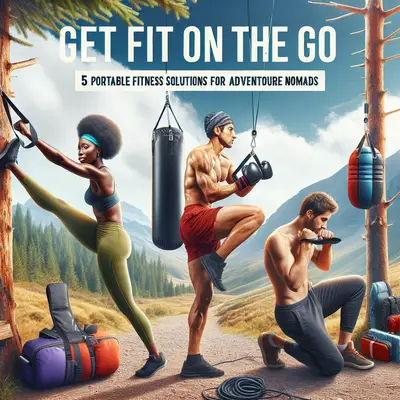
Airports, sleeper trains, rooftop terraces, parking-lot pull-up bars—if you live on the move, these are your training grounds. You don’t need a full rack and bumper plates to stay strong; you need a smart, portable kit and a plan that survives red-eye flights, hostel bunks, and timezone chaos.
This is your field guide to building a “micro-gym” that fits in your bag—and using it to stay dangerous, durable, and ready for whatever the road throws at you.
Building Your Packable Power Kit
Your portable equipment needs to pass three tests: light enough to carry, tough enough to abuse, and versatile enough to hit full-body strength. Think “maximum function per cubic inch.”
A strong starting kit:
- Long resistance band (heavy) – For rows, presses, deadlift patterns, face pulls, and assisted pull-ups. Loops around trees, railings, bed frames, and door hinges.
- Mini loop bands – For hip activation, glute work, shoulder stability, and warm-ups in tiny spaces.
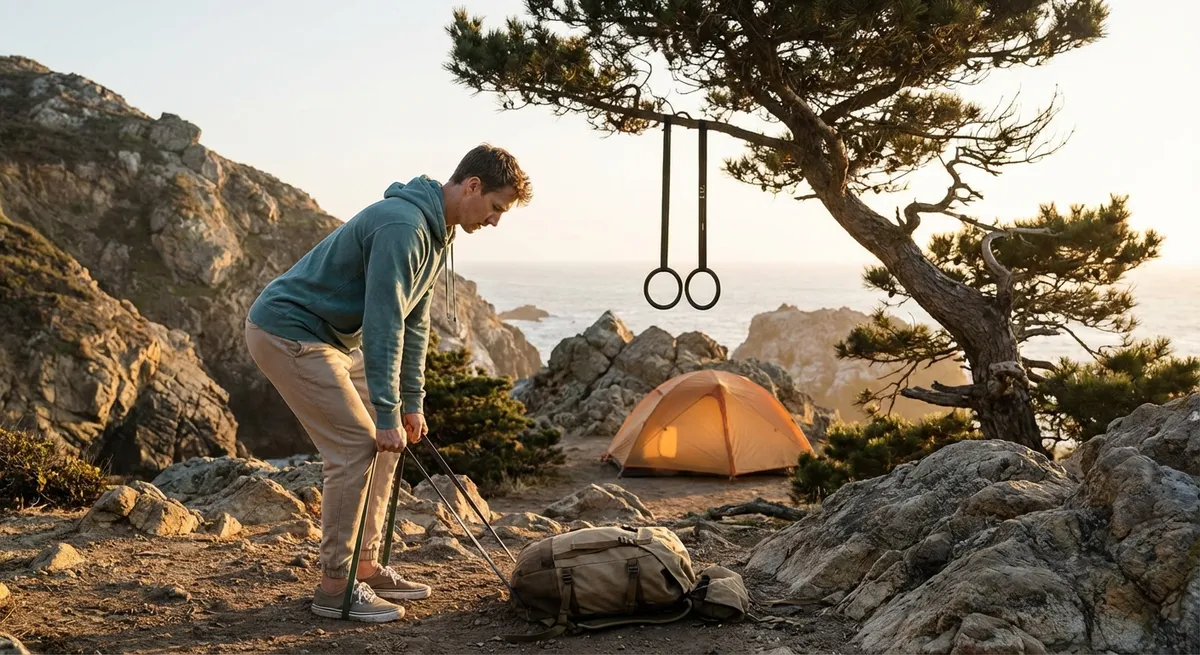
- Lightweight suspension trainer – A TRX-style system or gymnastic rings for rows, push-ups, core work, and single-leg patterns. Clips to doors, beams, or playground bars.
- Jump rope – Packs small, turns any parking lot into a conditioning arena.
- Compact massage ball or lacrosse ball – For quick tissue work after long flights and cramped bus rides.
Choose gear built from durable materials—thick rubber bands, strong stitching on straps, and solid metal carabiners. Pack it all into a mesh pouch or packing cube so it lives as one unit. When the kit is always together, “no time” becomes a weaker excuse.
Smart Packing: Gear That Survives Security and Layovers
Travel beats up both you and your equipment. Pack with security checks, tight connections, and surprise hikes between terminals in mind.
Keep metal to a minimum to avoid extra screening; fabric straps and rubber bands fly under the radar almost everywhere. Place your kit near the top of your bag so you can yank it out on a long layover and train beside a quiet gate or outside a terminal.
Use layers of clothing as padding—wrap bands and a jump rope in a hoodie or packing cube with soft items to protect them and keep them from tangling. If you’re swapping between carry-on and checked luggage, set a hard rule: one band and one mini loop stay in your personal item so your training never gets lost with your suitcase.
Finally, accept that some hotel rooms and hostels will be sketchy places for anchor points. When in doubt, skip door-frame anchors and move outdoors to a tree, lamp post, or playground bar. Your gear should never depend on a single environment to be useful.
5 Trail-Proof Fitness Tips for Travelers and Nomads
1. Anchor Your Day With a “Non-Negotiable 10”
Travel wrecks routines. Counter that with a hard rule: 10 minutes of movement every day, no negotiations.
Use your portable gear for micro-sessions:
- 3 rounds: band rows, band squats, push-ups, and dead bugs
- Or 5 minutes of jump rope + 5 minutes of band work
Timebox it. Set a timer, drop your bag, and move before you check email, scroll, or collapse. Ten minutes keeps your body “online” until you can attack a longer session—and it maintains the habit groove that prevents multi-week backslides.
2. Program for Unstable Schedules, Not Perfect Weeks
Forget the classic “Mon: Chest, Tue: Back…” split. On the road, sleep, time zones, and meetings will blow that apart. Instead, program simple, travel-proof templates:
- Day A – Push & Hinge
Band or strap rows, push-ups or band presses, band Romanian deadlifts, core
- Day B – Squat & Pull
Split squats, lateral band walks, band rows or face pulls, planks or hollow holds
Rotate A and B based on whenever you get a chance to train, not specific weekdays. If you hit three sessions this week, great. If you only get one solid day, you’re still moving the needle without losing the thread of your training plan.
3. Use Your Environment as Bonus Equipment
Your portable kit is the backbone; the world is the upgrade pack. Train your eye to spot “hidden gym assets” everywhere you land.
- Benches and curbs – Perfect for elevated push-ups, step-ups, Bulgarian split squats, and dips.
- Railings, beams, and playground structures – Anchor points for suspension trainers or bands, and for pull-ups or inverted rows.
- Stairs and steep streets – Natural intervals for hill sprints, loaded carries (with your bag), and calf work.
Combine these with your travel gear and you get sessions that feel more like urban obstacle courses than boring hotel workouts.
4. Let Bands Replace Heavy Iron—If You Use Them Right
Bands aren’t a downgrade; they’re a portable form of variable resistance. Use them intentionally and they become a serious strength tool, not a consolation prize.
Focus on:
- Slow, controlled eccentrics (3–4 seconds on the way down).
- High tension at lockout by stepping further from the anchor or doubling the band.
- Progression via thicker bands, more reps, or tougher mechanics (e.g., from two-leg to single-leg movements).
For example, a heavy band deadlift with a slow negative and a hard glute squeeze at the top can keep your posterior chain strong enough that returning to barbells isn’t a shock—it’s a reunion.
5. Train Jet Lag Away With Movement “Bookends”
Instead of just suffering through time-zone shifts, use short sessions as physiological reset buttons.
When you land:
- Arrival circuit (10–15 minutes)
Light band pull-aparts, hip circles with mini bands, bodyweight squats, easy rows, and a few rounds of controlled breathing.
Before you sleep:
- Decompression set (5–8 minutes)
Light band stretches (hamstrings, chest), deep squats holding a doorframe or bedframe, gentle spinal rotations, and nasal breathing in a low squat or lying on your back.
These tiny routines, powered by your portable kit, help regulate your circadian rhythm, undo the stiffness of long flights, and make your first local workout feel less like starting from zero.
Sample Micro-Gym Sessions You Can Run Anywhere
You’ve got the gear. Now turn it into go-to sessions you can hit in a hostel corner, park, or quiet airport hallway.
Strength Session (Approx. 20 Minutes)
Perform 3–4 rounds, rest 45–60 seconds between sets:
- Band/resistance row – 10–15 reps
- Push-up (hands on floor, bed, or bench) – 8–12 reps
- Band deadlift or hip hinge – 10–15 reps
- Split squat (bodyweight or band-resisted) – 8–10 reps each leg
- Plank with band row or standard plank – 20–30 seconds
Conditioning Session (Approx. 15 Minutes)
Set a timer and cycle through:
- 40 seconds jump rope / 20 seconds rest
- 40 seconds band thruster (squat to press) / 20 seconds rest
- 40 seconds mountain climbers / 20 seconds rest
- 40 seconds band good morning / 20 seconds rest
Repeat 3–4 times. Adjust work/rest ratios to your current conditioning and the altitude, heat, or elevation of wherever you are.
Conclusion
Your passport only takes you places; your portable “micro-gym” lets you show up ready. A couple of bands, a strap, and a jump rope can turn parking lots into training camps, balconies into strength labs, and layovers into performance upgrades instead of energy drains.
Travel doesn’t have to be the death of your progress. Pack smart, train opportunistically, and let every new city double as a fresh gym—no membership required.
Sources
- [American Council on Exercise – Resistance Band Training Benefits](https://www.acefitness.org/resources/pros/expert-articles/5519/5-benefits-of-adding-resistance-bands-to-your-workout/) - Overview of why bands are effective for strength and joint-friendly training
- [Mayo Clinic – Exercise: How to Get Started](https://www.mayoclinic.org/healthy-lifestyle/fitness/in-depth/fitness/art-20048269) - Guidance on structuring simple, sustainable exercise routines
- [CDC – Physical Activity Guidelines for Adults](https://www.cdc.gov/physicalactivity/basics/adults/index.htm) - Evidence-based recommendations for weekly activity and intensity
- [Harvard Health – Strength Training: Get Stronger, Leaner, and Healthier](https://www.health.harvard.edu/staying-healthy/strength-training-builds-more-than-muscles) - Explains the broad health benefits of strength work, even with minimal equipment
- [Cleveland Clinic – How Exercise Helps With Jet Lag](https://health.clevelandclinic.org/how-to-deal-with-jet-lag/) - Discusses how strategic movement and timing can reduce jet lag effects
Key Takeaway
The most important thing to remember from this article is that this information can change how you think about Portable Equipment.