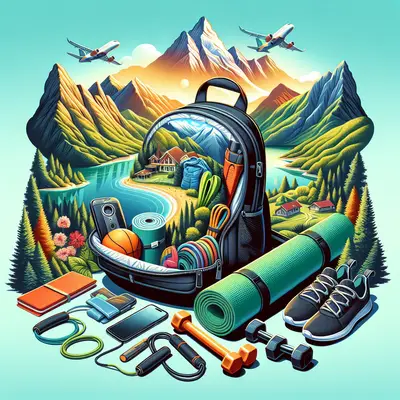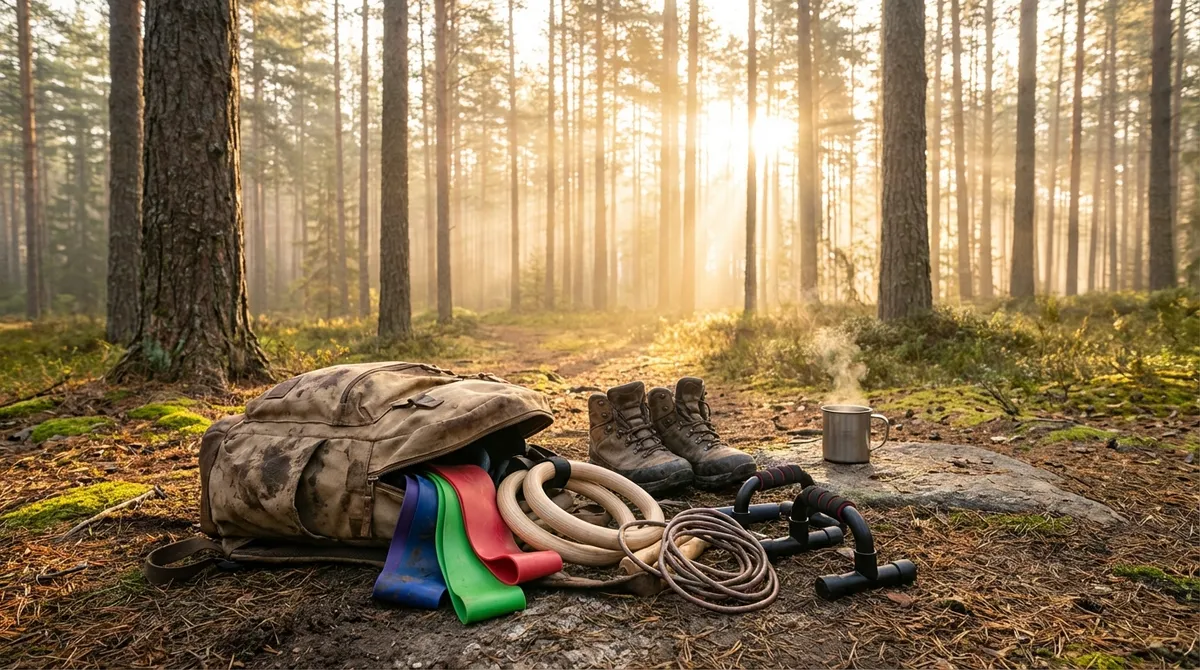
Your backpack isn’t just a way to haul your laptop and a change of clothes—it can be your entire gym if you pack it right. For travelers and digital nomads, portable equipment is the difference between “I’ll start training when I get home” and staying strong while border‑hopping and time zone–chasing. Let’s turn your everyday carry into a micro-gym that fits under an airplane seat and works in cramped hotel rooms, beaches, and bus stations.
The Core of a Travel-Ready Micro-Gym
Portable gear has one job: deliver maximum training options with minimum bulk and weight. Instead of chasing every gadget on Instagram, you want a tight, multi-use setup that survives baggage handlers, hostel floors, and surprise layovers.
Think of your micro-gym as a modular system. Each item should check at least two boxes: strength, mobility, conditioning, or recovery. Resistance bands double as strength tools and mobility aids. A compact suspension trainer handles strength and core. A massage ball rolls out tight calves after a red-eye and works as a grip tool. When gear has multiple uses, you can keep your kit light, fast, and travel-proof.
The goal isn’t to recreate a full commercial gym—it’s to maintain (and sometimes build) strength, power, and mobility with tools that fit into a laptop compartment. With the right pieces, you can handle pull, push, hinge, squat, carry, and rotate anywhere on the planet.
Essential Portable Equipment for Life on the Move
Before diving into training tips, dial in a core setup that covers your bases without overloading your pack. Here’s a battle-tested portable arsenal that works for minimalist travelers:
- Long resistance band (medium tension): Ideal for rows, presses, deadlift variations, assisted pull-ups, and mobility work. Packs flat, weighs almost nothing.
- Mini-loop bands: Great for glute activation, hip stability, shoulder warm-ups, and light rehab. They turn tiny hotel spaces into effective lower-body labs.
- Suspension trainer or gymnastics rings: Anchor to doors, trees, or beams for rows, presses, core work, and single-leg training. They replace most machines and half the dumbbells you’d normally use.
- Lightweight jump rope: Packs small, fantastic for conditioning and coordination when running outside isn’t safe or practical.
- Massage or lacrosse ball: For self-massage, trigger point work, plantar fascia relief after sightseeing, and as a grip-strength tool.
Optional extras if you have room:
- Collapsible travel foam roller or a short, dense roller for long trips.
- Compact ab wheel (two-piece varieties pack flatter) if you love core-focused challenges.
- Lightweight sandbag or fillable weight bag you can load with local materials (sand, rice, gravel) once you arrive.
Every piece you add should earn its space by offering multiple exercises and surviving rough travel. Favor durability and simplicity over fancy designs.
Five Adventure-Ready Fitness Tips for Travelers and Nomads
These five tips are built around portable gear and unpredictable schedules. Mix and match according to your itinerary and energy.
1. Anchor Your Day With a 15-Minute “Arrival Circuit”
Travel wrecks routines. Instead of waiting to feel “settled,” create a simple ritual you can do in any room the moment you drop your bag.
Grab your band or suspension trainer and run a 15-minute circuit:
- Band or suspension rows – 10–15 reps
- Push-ups (hands on floor, bed, or desk) – 8–15 reps
- Split squats or lunges – 8–12 reps per leg
- Band good mornings or hip hinge – 10–15 reps
- Front plank or hollow hold – 20–40 seconds
Cycle through for as many quality rounds as you can in 15 minutes. Keep rest short, form tight, and intensity moderate.
Why it works:
- Resets your body after long travel.
- Reconnects you to basic movement patterns.
- Signals to your brain: “New place, same training standard.”
Make this non-negotiable on travel days, like brushing your teeth.
2. Use Your Backpack as a Loadable Tool
If you’ve got a bag, you’ve got a weight. Your backpack can fill in for dumbbells and kettlebells when you’re away from a gym.
How to turn your pack into a training weapon:
- Load it smart: Put dense items (books, water bottles, electronics) close to your back; add clothes to stabilize the load so it doesn’t slam around.
- Backpack goblet squats: Hug the pack to your chest; squat with full control.
- Backpack Romanian deadlifts: Hold by the top handle like a heavy briefcase or hug to your chest for a front-loaded hinge.
- Backpack rows: Hinge at the hips and row the pack toward your ribs.
- Backpack carries: Farmer carries (one side), suitcase carries (one hand), or backpack carries (strapped on for stairs and hill climbs).
Start with 10–20 kg (22–44 lb) if you’re experienced; lighter if you’re new. The uneven, shifting load trains stabilizers in ways fixed machines never will.
3. Cycle Strength, Mobility, and Conditioning by Destination
Instead of trying to do everything every day, let your environment decide your training emphasis:
- Urban, tight hotel rooms, limited privacy:
Focus on strength and core with bands and a suspension trainer—rows, presses, squats, single-leg work, planks, and anti-rotation work.
- Coastal or open outdoor spaces:
Emphasize conditioning—jump rope intervals, band sprints (band around waist), shuttle runs, and bodyweight circuits on sand or grass.
- Long travel days / jet lag / cramped flights:
Go all-in on mobility and recovery—band-assisted stretches, hip openers, thoracic spine rotations, calf and hamstring work, and soft tissue release with your massage ball.
Think of your training as a rotating tripod: if one leg (strength, mobility, conditioning) must be weaker on a given day, make sure one of the others is strong. This keeps you progressing while respecting your energy and environment.
4. Train With “Time Boxes,” Not Perfect Schedules
Travel blows up normal routines: delayed flights, early checkouts, surprise tours. Waiting for a perfect 60-minute window is how training dies on the road.
Use time boxes tied to daily anchors:
- Wake-up box (5–10 minutes):
Mini-loop band glute bridges, shoulder band pull-aparts, cat-cow, deep squats, and a short plank. This is your “system reboot.”
- Midday box (10–20 minutes):
A band-and-bodyweight circuit: row, push, lunge, hinge, core. Treat this like a movement snack between work blocks.
- Pre-dinner box (5–15 minutes):
Jump rope intervals (if space) or brisk stair climbs; finish with a few stretches to unwind from screen time.
By thinking in bite-sized time boxes, you eliminate the “all or nothing” trap. Even on chaotic days, you can hit one or two boxes and keep your momentum.
5. Program “Jet Lag Proof” Minimalist Workouts
After long-haul flights or overnight buses, your nervous system is fried—even if you’re mentally excited to explore. Heavy max-effort sessions can backfire. Instead, have pre-written minimalist sessions ready for low-energy days.
Example Jet Lag Reset (no jumping, low joint stress):
- 1A. Suspension or band-assisted squats – 12 reps
- 1B. Suspension rows or band rows – 12 reps
- 1C. Dead bug or banded Pallof press – 8–10 reps per side
3 relaxed rounds, then:
- 2A. Hip flexor stretch with side reach – 30 seconds per side
- 2B. Calf raises (bodyweight) – 15–20 reps
- 2C. Chest opener against doorframe – 30 seconds per side
If you feel better after round 3, add one more. If you feel depleted, stop. The aim is circulation, joint lubrication, and nervous system reset—not heroics.
Keep 2–3 of these minimalist templates saved on your phone so you can start moving without overthinking.
Conclusion
Portable equipment is your insurance policy against “I’ll train when life slows down.” A couple of bands, a suspension trainer, a jump rope, and a well-loaded backpack can keep you strong, mobile, and adventure-ready across borders, layovers, and visa runs.
Don’t chase perfection—chase consistency. Land, unpack a micro-gym, and carve small training windows out of unpredictable days. When your gear fits under an airplane seat but your training carries you up mountains, down alleyways, and across new cities without breaking, you’re not just traveling—you’re touring the world with a stronger, more resilient core.
Sources
- [American Council on Exercise – Resistance Bands 101](https://www.acefitness.org/resources/everyone/blog/7440/resistance-bands-101-how-to-use-them-effectively/) - Overview of effective resistance band use, benefits, and sample exercises
- [Harvard Health – The Importance of Strength Training](https://www.health.harvard.edu/staying-healthy/the-importance-of-strength-training) - Explains why maintaining strength matters for health, mobility, and longevity
- [Cleveland Clinic – Benefits of Stretching and Mobility](https://health.clevelandclinic.org/benefits-of-stretching) - Details how stretching and mobility support recovery, performance, and travel-weary bodies
- [CDC – Physical Activity Guidelines for Adults](https://www.cdc.gov/physicalactivity/basics/adults/index.htm) - Baseline recommendations for weekly activity levels and exercise structure
- [Mayo Clinic – Exercise for Stress Management](https://www.mayoclinic.org/healthy-lifestyle/stress-management/in-depth/exercise-and-stress/art-20044469) - Covers how consistent movement helps manage stress and jet lag–related fatigue
Key Takeaway
The most important thing to remember from this article is that this information can change how you think about Portable Equipment.