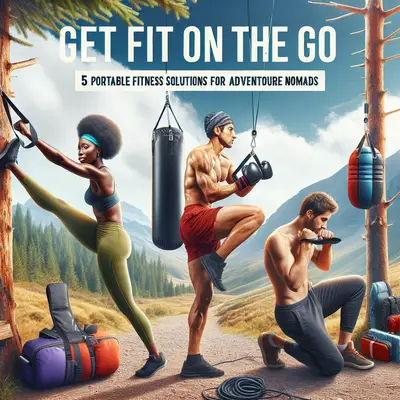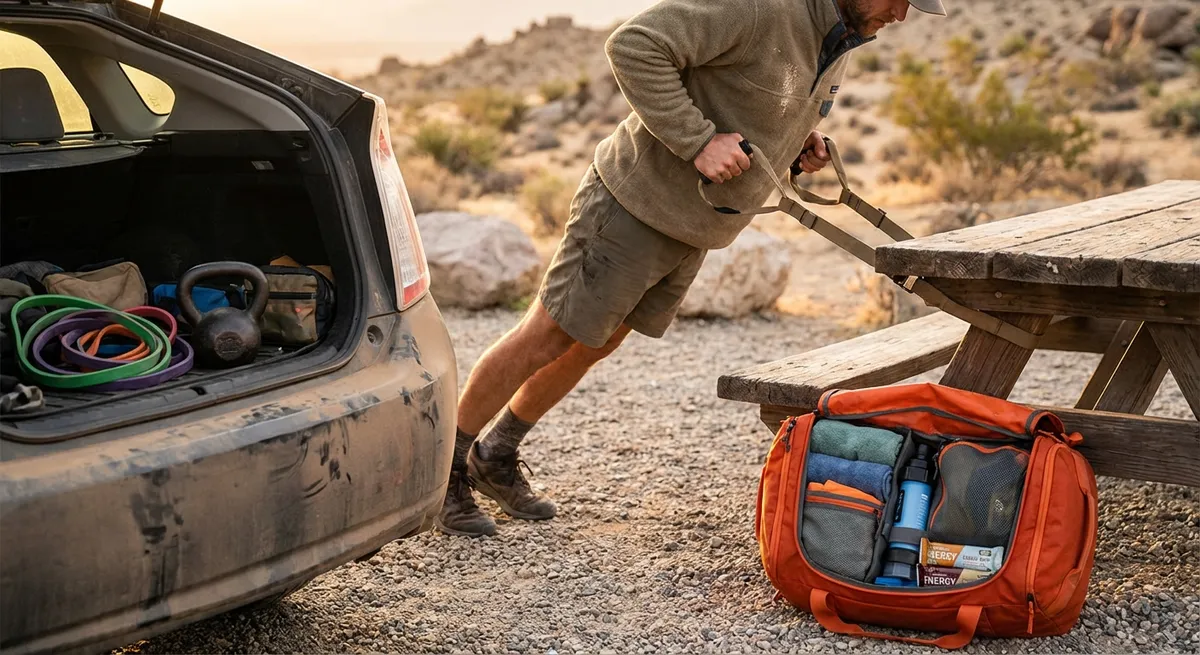
Travel doesn’t have to mean “start over when I get home.” With the right portable gear and a smart plan, your body can get stronger while your passport fills up. Think of your backpack as a mobile gym bag: every zipper you open should give you one less excuse and one more way to move.
This guide is your practical field manual for packing, using, and owning portable equipment—plus five battle-tested fitness tips for travelers and digital nomads who want more than just steps on a pedometer.
Build Your Core-On-Tour Kit: What Earns a Spot in Your Bag
Your gear has to justify every ounce of weight and every inch of space, so treat your backpack like prime real estate.
Start with mini resistance bands (loop bands). They weigh almost nothing, roll up smaller than a pair of socks, and turn any space into a strength station. You can target glutes, hips, shoulders, and core without hunting for a gym.
Next, add a long resistance band with handles or a loop. This is your “cable machine in a strap.” Anchor it around a door, railing, or sturdy post and you’ve unlocked rows, presses, pull-aparts, and assisted squats—perfect when your “gym” is a hostel hallway or balcony.
A lightweight suspension trainer (think TRX-style) is like bringing parallel bars and a pull-up station in a pouch. Clip it over a door, a tree branch, or a beam, and you’re in business for rows, push-ups, lunges, and core work at adjustable difficulty.
Don’t sleep on a travel jump rope with a tangle-free cable. It’s pure conditioning that fits in a side pocket and turns any safe patch of pavement into a conditioning zone.
Finally, consider a packable yoga or exercise mat if you know you’ll be on hard tile or rough surfaces. Some fold into squares to fit in a backpack—clutch for floor work, stretching, and core sessions in tight Airbnbs.
How to Use Any Room as a Strength Zone
Once your kit is packed, the real skill is scanning any new space like a tactical athlete.
Walk into your room and immediately identify:
- A clear floor patch big enough for a yoga mat or for you to lie flat.
- A solid door or beam for anchoring bands or a suspension trainer. Always check that it closes securely, hinges are solid, and you’re pulling toward the frame, not away from it.
- A stable surface like a bed frame, chair, or low table for step-ups, elevated push-ups, or dips—test it with bodyweight first.
- Push: band presses anchored in a doorway, suspension push-ups, floor push-ups.
- Pull: band rows around a bed frame, suspension rows, face pulls for shoulders.
- Hinge: good mornings or deadlifts with bands under your feet and over your shoulders.
- Squat/Lunge: band-resisted squats, split squats with rear foot on a bed or chair.
- Core: planks with band rows, anti-rotation holds with a band, slow mountain climbers.
From here, think “movement patterns,” not exercises:
This mindset keeps your training consistent no matter what the room looks like. Your environment changes; your movement pillars don’t.
Five Traveler Fitness Tips to Stay Strong Between Check-Ins
1. Lock in a “Non-Negotiable 15” Routine
Decide on a 15-minute baseline workout you’ll do every travel day, no matter what. It should use only what you can guarantee: yourself, a band, and a bit of floor.
Example template:
- 5 minutes: jump rope or marching/jogging in place
- 8 minutes: circuit of push-ups, band rows, squats, and planks (40 seconds work, 20 seconds rest)
- 2 minutes: hip flexor and chest stretches
You can always add more if energy and time allow, but the “Non-Negotiable 15” keeps your identity as someone who moves—even on layovers, red-eyes, and late check-ins.
2. Use Your Gear to Fight Travel Stiffness, Not Just Build Strength
Portable equipment isn’t only for “workouts.” It’s a weapon against the tight hips, cranky back, and rounded shoulders that stack up on long flights and bus rides.
Use mini bands for:
- Glute activation: lateral band walks, clamshells, bridges before a walk or run.
- Hip stability: monster walks and single-leg holds with a light band.
- Posture resets: band pull-aparts, dislocates (with a light, long band), and rows.
- Hip mobility: band-assisted hip flexor stretches after sitting long hours.
Use long bands for:
Sprinkling these throughout your day—5 minutes before heading out, 5 minutes before bed—keeps you feeling more like an athlete on the move and less like luggage on legs.
3. Program for Chaos, Not Perfection
Travel laughs at rigid plans. Build flexible workout tiers tied to time and energy instead of specific days.
- Tier A – Full Session (35–45 min): use everything—bands, suspension trainer, jump rope, mat. Hit full-body strength plus conditioning.
- Tier B – Compact Session (20–25 min): prioritize compound strength (push, pull, squat, hinge) with bands and bodyweight; short finisher (jump rope intervals or fast-paced circuit).
- Tier C – Survival Mode (10–15 min): focus on movement quality and mobility—slow strength (controlled squats/push-ups/rows) and long stretches.
Each day, you simply plug in the highest tier you can realistically hit. No guilt, no “all or nothing”—just consistent “something,” scaled to your situation.
4. Make Your Backpack Part of the Workout
If you’re already hauling a bag, make it do double-duty.
Fill your daypack or carry-on with your usual gear (laptop, water, clothes) and use it as a makeshift weight:
- Backpack goblet squats and split squats in your room.
- Backpack rows (leaning on a desk or bed).
- Marching lunges down a quiet hallway or in a park.
- Loaded carries: grab the handle and walk for time or distance in a safe area.
Your portable equipment can layer on: use a band around your knees while you squat with your pack, or row with a band anchored low and your backpack on to up the challenge.
5. Set Location-Based Triggers to Stay Consistent
Anchor your workouts to places and actions, not just vague intentions. The more automatic the cue, the less willpower required.
Examples:
- Every time you arrive at a new stay, do one full circuit with your bands after you drop your bags.
- After your morning coffee, 10 minutes of band work and core.
- Every time you find a park or open plaza, do a quick conditioning burst: 5 rounds of 30 seconds jump rope, 30 seconds rest.
Pair these triggers with your portable tools and soon your body expects to move when your environment changes. Travel stops being a disruption and becomes the signal to train.
Dialing In Safety and Recovery On the Road
Your gear makes it easier to train anywhere, but you still need to treat your body like something you want to keep for a long time.
Hydration is non-negotiable: travel often means dry airplane air, heat, or cold and a lot of walking. Dehydration can make workouts feel harder and increase injury risk. Keep a collapsible water bottle in your kit and refill at every chance.
Sleep will be messy across time zones, so use your equipment smartly: keep high-intensity sessions on the days you’re better rested and lean on band-only, lower-intensity mobility when sleep is short or broken.
Warm up even when rushed: 3–5 minutes of dynamic movement (arm circles, leg swings, light band work, easy rope) prepares joints and tissues for unfamiliar hotel-room angles and surfaces. And when something hurts in a “not normal” way, back off; you’re a long way from your usual healthcare providers.
Reset your body after long hauls with a 10–15 minute decompression block: slow band rows, hip mobility, gentle core work, and breathing. It’s not glamorous, but it’s the difference between landing somewhere new feeling wrecked and feeling ready to explore.
Conclusion
Your body doesn’t care if you’re in a five-star hotel, a shared dorm, or a roadside guesthouse. It only cares about consistent signals: pull, push, hinge, squat, carry, and move your joints through real ranges.
Portable equipment—bands, a suspension trainer, a jump rope, a packable mat—turns every new location into a training opportunity instead of an excuse. Pair that gear with a simple, adaptable plan and the five tips above, and your strength starts traveling with you instead of staying behind at your home gym.
Every border crossed, every stamp earned, every new city: another chance to prove you can build a strong, capable body anywhere.
Sources
- [American Council on Exercise – Resistance Band Workouts](https://www.acefitness.org/resources/everyone/blog/7441/how-to-use-resistance-bands-in-your-workouts/) - Practical overview of resistance band benefits, setup, and sample exercises
- [National Academy of Sports Medicine – Benefits of Resistance Bands](https://blog.nasm.org/the-benefits-of-resistance-bands) - Explains why bands are effective for strength, mobility, and joint-friendly training
- [CDC – Physical Activity Guidelines for Adults](https://www.cdc.gov/physicalactivity/basics/adults/index.htm) - Official recommendations for weekly exercise volume and intensity
- [Sleep Foundation – Jet Lag and Sleep](https://www.sleepfoundation.org/jet-lag) - Details how travel and time zones affect sleep and recovery, with actionable strategies
- [Harvard Health Publishing – The Importance of Stretching](https://www.health.harvard.edu/staying-healthy/the-importance-of-stretching) - Covers why mobility and stretching matter, especially when sitting or traveling frequently
Key Takeaway
The most important thing to remember from this article is that this information can change how you think about Portable Equipment.