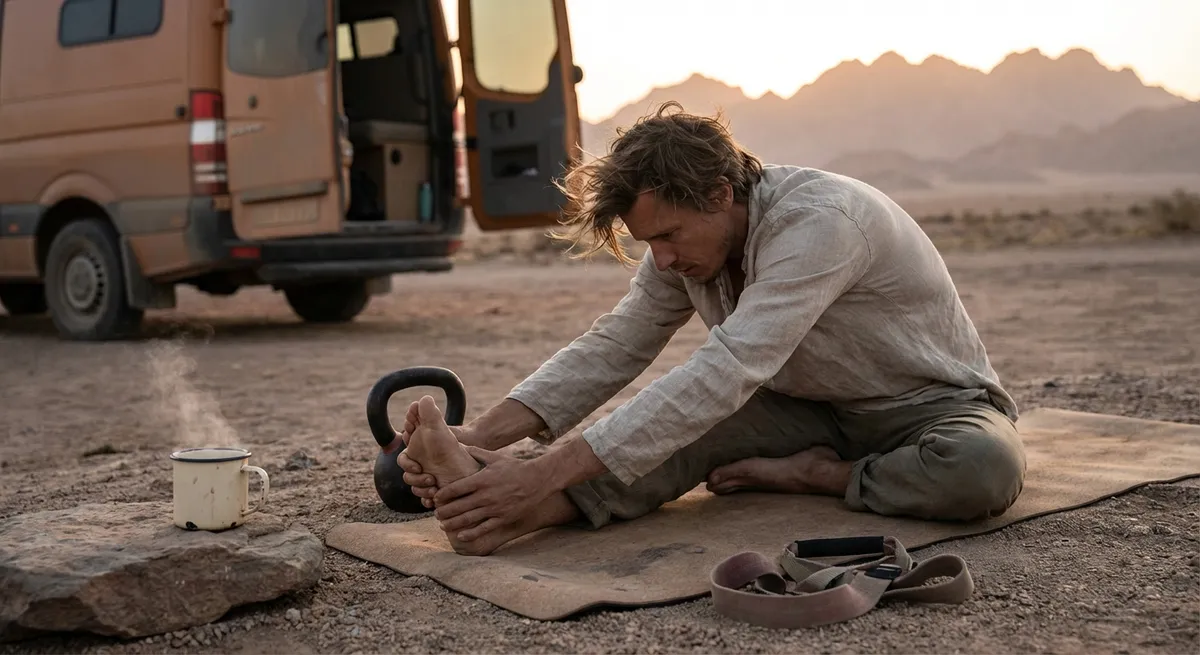
You’ve got a passport full of stamps, a backpack that smells like three countries, and a laptop that logs more miles than most people’s cars. But if your fitness keeps getting left behind at the last airport gate, your adventures are running on borrowed time. Nomad health isn’t about perfect routines or luxury gyms—it’s about staying strong, clear-headed, and adventure-ready with whatever space, gear, and time you’ve got.
This is your field manual for moving camp without losing your edge.
The Nomad Mindset: Training for the Long Journey, Not the Short Trip
Most travelers treat fitness like a mini-vacation project—something they “get back to” when they’re home. But if home keeps changing, that strategy collapses on day three of your trip.
Nomad health is about durability, not perfection. You’re training to haul your pack up hostel stairs, hike that “easy” viewpoint that’s actually a quad burner, and slam out a work deadline after a red-eye flight. Your body is gear, too—maybe the only piece you can’t replace on the road.
Reframe your fitness as mission-critical, like your passport or power adapter. You don’t need 90 minutes and a squat rack; you need reliable basics you can run anywhere: a core of simple movements, a few pieces of portable gear, and a routine that survives flight delays, weird schedules, and tiny rooms. Once you see training as part of travel—not in competition with it—you stop debating and start doing.
Stealth Workouts: Turning Any Space into Your Training Ground
Forget the excuse of “no gym.” Your environment is your equipment if you know how to see it that way.
Airport? Slow, heavy suitcase farmers carries down a quiet corridor. Long layover? Walk laps, alternate fast and slow sections, then hit 3–4 rounds of wall sits and incline push-ups on a pillar or bench. Beach? Sand makes bodyweight work harder—lunges, bear crawls, and sprints all become twice as challenging. Hotel or hostel room? That’s your personal training bunker.
A simple anywhere circuit:
- 10–15 squats (or split squats if space is tight)
- 8–12 push-ups (hands on bed or desk if needed)
- 20–30 seconds plank
- 10 hip hinges or good mornings (slow, controlled)
- 20–30 seconds fast steps in place
Cycle it for 10–20 minutes. No warm-up gear, no shirtless sunrise Instagram nonsense required. Just press play on a timer and get it done.
Five Field-Tested Fitness Tactics for Travelers and Digital Nomads
Here are five practical, portable strategies that keep you strong without hijacking your trip.
1. The “15-Minute Non-Negotiable” Rule
Instead of waiting for the perfect 60-minute block, commit to 15 minutes a day—no matter what, no matter where. That might be mobility on a travel day, strength on a work-heavy day, or conditioning when you’re feeling wired.
Example 15-minute template:
- Minute 0–3: Dynamic warm-up (arm circles, leg swings, hip circles, gentle twists)
- Minute 3–12: 30 seconds work / 30 seconds rest cycling:
- Push-up variation
- Squat or lunge
- Core move (plank, dead bug, side plank)
- Minute 12–15: Easy stretching—hips, chest, shoulders, hamstrings
You can run this in a hostel dorm without judgment if you keep it quiet and controlled. The win is consistency, not intensity.
2. Make Your Pack Double as a Weight Vest
Your backpack isn’t just a burden—it’s free resistance.
On lighter travel days, use your pack for:
- Loaded squats or split squats (pack hugged to chest)
- Bent-over backpack rows (two straps in hands, pulling to ribs)
- Overhead presses (if it’s not stuffed with glass souvenirs)
Adjust difficulty by adding or removing items. Keep the movements slow and controlled to avoid tweaking your back. This lets you sneak in resistance training even when you haven’t seen a dumbbell in weeks.
3. Choose One “Anchor” Movement Per Trip
Each trip, pick a single movement as your anchor—something you repeat often enough that it becomes a ritual. It gives your training rhythm even if your schedule is chaos.
Examples:
- Push-ups: 30–50 total every day, broken into small sets
- Lunges: 40–60 walking or stationary lunges daily
- Hangs: If you have access to a playground or pull-up bar, hang for 3–5 total minutes in short segments throughout the day
- Turkish get-up or suitcase deadlift if you carry a kettlebell or heavy bag
Your anchor is your baseline: even on brutal travel days, you do at least that. You can always stack more training on top when you have time.
4. Train for the Terrain You’re Actually On
Match your training to your environment and upcoming adventures. If you’re headed for mountains, hills, or city staircases, emphasize legs and lungs. For surf, climbing, or long laptop days, bias toward shoulders, core, and posture.
Some examples:
- Urban nomad days: Prioritize walking volume (8–12k steps), plus daily back and hip work: Y-T-W arm raises on the floor, glute bridges, hip flexor stretches.
- Mountain towns: Lots of step-ups on benches, calf raises on stairs, and longer walks/hikes at a conversational pace.
- Beach/coastal life: Barefoot sand walks for foot strength, plus ankle and calf mobility to stay injury-free.
This keeps your training purposeful, not random. You’re not just “working out”—you’re prepping for the next mission.
5. Use Micro-Sessions to Combat Laptop Lockdown
Digital nomads live and die by screen time, and your hips, neck, and shoulders are usually the first casualties. Instead of one big workout, break your movement into micro-sessions around your work blocks.
Between calls or deep work sessions:
- 60–90 seconds of movement:
- 10–15 squats
- 10 desk or wall push-ups
- 30 seconds of “world’s greatest stretch” or hip flexor stretch
- Top of every hour: stand up, shoulder rolls, neck rotations, 10 slow breaths away from the screen
- Twice a day: 3–5 minutes of focused mobility—think cat-cows, thoracic rotations, and hamstring/hip stretches
These micro-breaks keep your joints from seizing up and help your brain reset without derailing productivity.
Portable Tools That Earn Their Place in Your Pack
Your backpack space is sacred, so any gear you bring has to pull serious weight.
High-value, low-bulk options:
- Resistance bands: A light and a medium band can turn any railing, doorknob, or pole into a training station for rows, presses, pull-aparts, and hip work.
- Lightweight suspension trainer or doorway strap: Lets you hit rows and assisted single-leg work in cramped rooms.
- Compact jump rope: Perfect for quick conditioning where jumping is allowed and neighbors won’t riot.
- Lacrosse or massage ball: Tiny, tough, and ideal for digging into hips, glutes, feet, and upper back after long travel days.
If you’re ultra-minimalist, skip it all and just pack a long, sturdy resistance band. It’s the closest thing to a full gym in your pocket.
Whatever you carry, pair it with a small “playbook” of 4–6 go-to movements you can perform on autopilot. When you’re tired, jet-lagged, or overwhelmed, decision fatigue can be the thing that quietly kills your training.
Fueling and Recovering Without Ruining the Adventure
Nomad health isn’t just reps and sets—it’s what you feed yourself and how well you bounce back between legs of your journey.
A few portable rules:
- Hydration first: Travel days and flights dry you out. Make water your default and use electrolytes on long, hot, or super active days.
- Anchor meals: Try to keep at least one meal per day protein-centric and less “adventurous”—like eggs and fruit for breakfast or a simple lean protein and veggies dinner. This gives you a nutritional baseline even if the rest of the day is pure street food chaos.
- Walk off jet lag: Use movement, not just caffeine, to adjust. Light exposure and brisk walks at your target local daytime can help reset your body clock and improve sleep.
- Defend your sleep: Eye mask, earplugs, and a consistent pre-bed routine (even 5–10 minutes of stretching or breathwork) can make sketchy hostels and new time zones less brutal.
You’re not aiming for perfection; you’re aiming for “good enough to keep moving hard and long.”
Conclusion
Your home base may change every week, but your body travels with you to every border crossing, mountain pass, and random coworking space. Nomad health isn’t a luxury—it’s your travel insurance for all the stuff you actually care about doing.
You don’t need a pristine gym, a rigid routine, or a suitcase full of equipment. You need a few durable habits, some creative use of whatever space you’ve got, and a commitment to show up for at least 15 minutes—even when the jet lag, deadlines, or chaotic bus rides say otherwise.
Keep your camp moving. Keep your body sharp. The world’s a lot bigger when you’re strong enough to chase more of it.
Sources
- [Centers for Disease Control and Prevention – Physical Activity Basics](https://www.cdc.gov/physicalactivity/basics/index.htm) - Guidelines on how much movement adults need for health and longevity
- [World Health Organization – Physical Activity](https://www.who.int/news-room/fact-sheets/detail/physical-activity) - Global recommendations and benefits of regular physical activity
- [Harvard T.H. Chan School of Public Health – Benefits of Physical Activity](https://www.hsph.harvard.edu/nutritionsource/benefits-physical-activity/) - Overview of how consistent movement supports long-term health
- [Harvard Health Publishing – How to Combat Jet Lag](https://www.health.harvard.edu/diseases-and-conditions/how-to-minimize-jet-lag) - Evidence-based strategies to use movement and light to adjust to new time zones
- [Sleep Foundation – Travel and Sleep](https://www.sleepfoundation.org/travel-and-sleep) - Practical tips on protecting sleep quality during frequent travel
Key Takeaway
The most important thing to remember from this article is that this information can change how you think about Nomad Health.