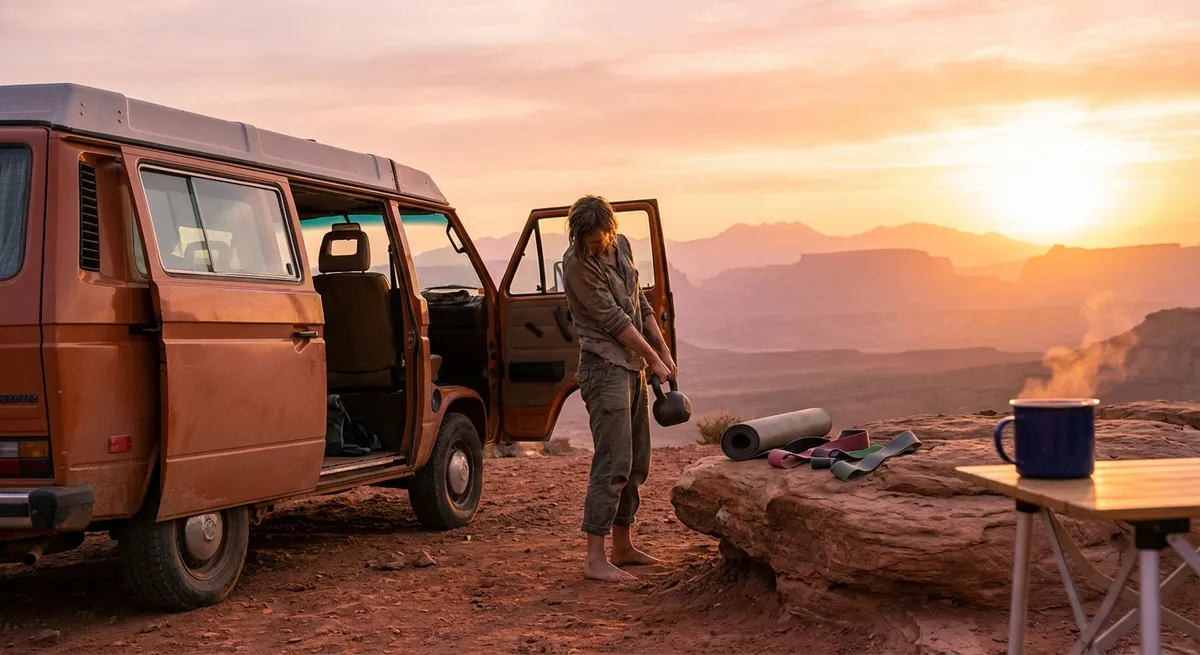
When your “home base” is a rotating cast of airports, hostels, and Airbnbs, health can feel like a side quest you’ll get to “once things calm down.” Spoiler: they rarely do. Nomad health isn’t about waiting for perfect conditions—it’s about building a sturdy, adventure-ready body that can thrive in jet lag, street food, and surprise overnight buses. This guide is your field manual: no gym contracts, no checked bags, just smart strategies and portable tactics to keep you strong while the scenery keeps changing.
Redefining Nomad Health: Training for Unpredictable Terrain
Nomad health isn’t six-pack selfies under waterfalls; it’s being able to sprint for a gate change with a pack on, carry your own gear up five flights in Lisbon, and still have energy to explore after a full day at the laptop. You’re not just “staying in shape”—you’re training for an unpredictable environment where your sleep, food, and schedule are constantly under attack.
Think of your body as expedition equipment: durable, easy to maintain, and always ready to deploy. That means prioritizing consistent, bite-sized habits over heroic, once-a-week workouts. It means picking movements that translate directly to travel life—squats for stairs, carries for luggage, hinges for backpacks, push-ups for overall strength and posture.
Instead of obsessing over “perfect programs,” focus on what survives delayed flights, weak Wi‑Fi, and tiny rental spaces. The winning formula: minimal gear, simple movement patterns, and routines you can run in 10–20 minutes without overthinking. You’re building a mobile operating system for your body, not a fragile masterpiece that only works in a pristine gym.
Tip 1: Use Movement “Checkpoints” Instead of Full Workouts
The road rarely gives you a clean 60-minute training window. Waiting for the perfect chunk of time is how weeks slip by. Instead, set movement “checkpoints” that you can hit anywhere, layered into your day like waypoints on a map.
Pick 2–3 checkpoints tied to things that always happen: waking up, mid-day break, and shutting the laptop. Each checkpoint is just 3–5 minutes: for example, 15–20 bodyweight squats, 10–15 push-ups, and a 30–45 second plank. Morning: run one round. Lunch: another. Evening: a third. You’ve now racked up serious volume without ever “going to work out.”
This approach thrives on unpredictability. Stuck in an airport? Hit a checkpoint near a quiet gate. Waiting for laundry at a hostel? Another checkpoint. Long Zoom day? Run one between calls. You’re turning idle time into micro-training, keeping joints lubricated, blood moving, and strength maintained—even when your schedule is chaos.
Tip 2: Build a 10-Minute “Any Floor, Any Country” Strength Circuit
Your emergency plan is a short, repeatable session that works on any hotel floor, hostel hallway, or rooftop terrace. No excuses, no over-planning—just press play on your own internal protocol. Here’s a simple template you can adapt anywhere:
- Squat pattern (air squats or split squats)
- Push pattern (push-ups: hands elevated on a bed if needed)
- Hinge or glute work (hip thrusts on the floor, single-leg deadlifts with a backpack)
- Core (planks, dead bugs, or slow mountain climbers)
- Optional: carry or isometric (hold your backpack suitcase-style and walk laps or do static holds)
Set a timer for 10 minutes and cycle through 6–10 reps per move at a controlled pace. No need to track every detail—your only job is to show up and move for the full 10 minutes.
The secret advantage: this circuit doubles as jet-lag medicine. After long flights or bus rides, a short strength hit wakes up your nervous system, improves circulation, and helps reset your internal clock far more effectively than just collapsing into bed immediately.
Tip 3: Turn Your Luggage Into a Traveling Weight Room
If you’re already hauling a bag, make it earn its keep. Your backpack or carry-on can stand in for dumbbells when a gym is nowhere in sight. Fill it with clothes, gear, or a water bottle and you’ve got an adjustable training tool that travels with you anyway.
Use your packed bag for loaded squats, lunges, and carries: hug it to your chest for goblet squats, grip it by the handle for suitcase deadlifts, or bear-hug it for stair climbs. Short hallway? Walk laps with the bag in one hand, then the other—instant core and grip work. Have a balcony? Perform slow, controlled rows by anchoring a sturdy strap or using the bag as a weight you pull from the floor.
This approach is especially helpful if you’re staying somewhere without safe running routes or usable outdoor space. You don’t need to risk a sketchy nighttime jog just to feel like you “worked out.” Ten to fifteen minutes of suitcase strength in your room can hit your legs, back, and arms hard enough to maintain or even build muscle over long stretches on the road.
Tip 4: Make Walking Your Default Transport (With Intent)
Travel naturally pulls you onto your feet—but intentional walking turns casual wandering into a reliable fitness pillar. When possible, treat walking like your base layer of conditioning rather than an afterthought. Aim for a rough daily step target (6–10k is realistic for many travelers) and use it to guide your choices: one metro stop earlier, stairs instead of elevators, walking meetings or calls when possible.
For days chained to the laptop, use “distance snacks”: 5–10 minute walks every 60–90 minutes. You’ll improve focus, reduce stiffness, and rack up distance without needing a full-on hike. In a new city, plan scouting walks: map out a loose loop past a market, a park, and a viewpoint. You’re exploring and training at the same time.
When you can, add a bit of load: your everyday backpack, a small grocery haul, or a light water bottle. This turns plain walking into gentle endurance-plus-strength work. Combined with short strength circuits, this foundation is usually enough to keep your cardiovascular fitness respectable even when you’re hopping between countries weekly.
Tip 5: Protect Sleep and Hydration Like Critical Gear
You can train perfectly and still feel wrecked if you’re dehydrated and underslept across time zones. For nomads, sleep and hydration are performance multipliers—and both are constantly under attack from flights, late dinners, and new environments.
Build a simple sleep ritual you can recreate anywhere: dimming screens 30–60 minutes before bed, a short stretch sequence (hips, hamstrings, chest), and maybe a few pages of a book instead of doomscrolling. Use tools that pack small but pay off big: a sleep mask, earplugs, and a lightweight scarf or buff that doubles as a blackout helper. Aim to align your sleep-wake time with local daylight as quickly as you can, especially after long-haul flights.
For hydration, assume travel days dry you out more than you think. Drink water steadily in the hours before and after flights or bus rides, and consider an electrolyte pack for long hauls or hot climates. Watch coffee and alcohol—they’re fine in moderation, but they don’t replace actual fluids. A loose rule that works on the road: water with every meal, and a small refillable bottle near your laptop or in your day pack at all times. A properly hydrated, half-rested body will outperform a sleep-deprived, caffeine-fueled one every single time, especially under travel stress.
Conclusion
Nomad health doesn’t demand a perfect gym, spotless routine, or monk-level discipline. It asks for something more practical: a handful of reliable tactics you can deploy anywhere—between checkouts, client calls, border crossings, and sunset missions. By anchoring your days with movement checkpoints, a simple floor circuit, luggage-as-weights, intentional walking, and ruthless protection of sleep and hydration, you’re quietly building a body that thrives in motion instead of barely surviving it.
You don’t need to wait until you “settle down” to feel strong again. Your training ground is already under your feet: hostel floors, quiet side streets, hotel stairwells, and the stretch of time between now and your next boarding call. Use them well, and every new stamp in your passport comes with a stronger, more capable version of you carrying it.
Sources
- [Centers for Disease Control and Prevention – Physical Activity Basics](https://www.cdc.gov/physicalactivity/basics/index.htm) – Guidelines on how much movement adults need and why short bouts still matter
- [World Health Organization – Physical Activity](https://www.who.int/news-room/fact-sheets/detail/physical-activity) – Global recommendations on physical activity and health benefits relevant to active travelers
- [Harvard Health Publishing – The Importance of Sleep](https://www.health.harvard.edu/staying-healthy/the-importance-of-sleep-and-how-to-get-more-of-it) – Explains how sleep impacts performance, recovery, and overall health
- [National Library of Medicine – Hydration and Health](https://www.ncbi.nlm.nih.gov/pmc/articles/PMC2908954/) – Research overview on why proper fluid intake is crucial, especially during travel and activity
- [American Council on Exercise – Bodyweight Training](https://www.acefitness.org/resources/pros/expert-articles/5509/the-benefits-of-body-weight-training/) – Details benefits and applications of bodyweight exercise when equipment and gyms aren’t available
Key Takeaway
The most important thing to remember from this article is that this information can change how you think about Nomad Health.