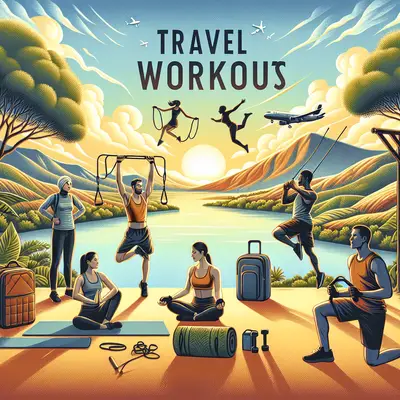
Travel rewires your sense of distance, time, and routine—but your body still craves movement. Whether you’re hopping continents as a digital nomad or stringing together weekend escape routes, your “gym” becomes whatever space your passport (or boarding pass) can reach. This guide is your field manual for turning tiny rooms, long layovers, and unfamiliar streets into a training ground that keeps you strong, clear-headed, and ready for the next jump.
Build a Minimalist “Anywhere” Movement Ritual
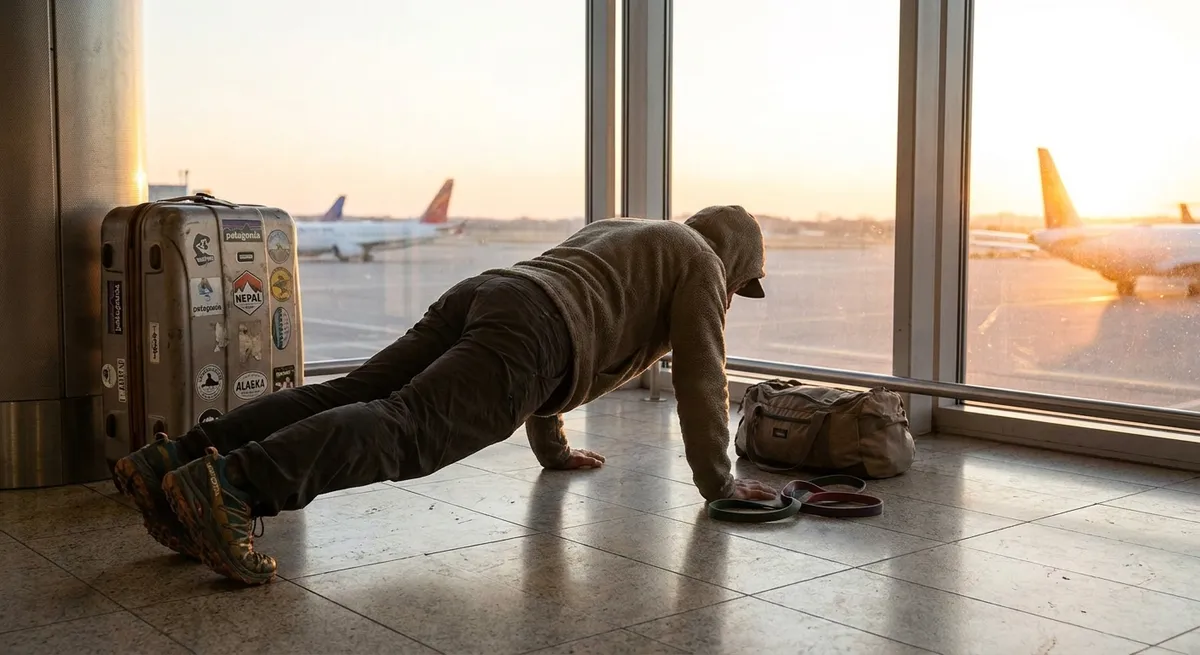
When your environment changes constantly, ritual matters more than equipment. Instead of chasing a perfect workout, aim for a repeatable movement sequence you can run in almost any setting—hotel room, guesthouse, beach, train platform, or quiet airport corner.
Pick a simple framework: push, pull, hinge, squat, and carry/brace. You don’t need all five every day, but you want to hit them across your week. For example, push-ups (push), doorway rows with a towel (pull), hip hinges or good mornings (hinge), bodyweight squats or split squats (squat), and suitcase carries with your backpack (carry/brace).
Anchor this ritual to something that always happens when you travel—waking up, brewing coffee, or returning to your room. The goal is to eliminate decision fatigue: same moves, different backdrop. Over time, your body starts to expect the sequence, making it easier to start even when you’re jet-lagged or overloaded from transit.
To keep it adventurous, occasionally swap locations instead of exercises. Do your sequence on a rooftop, by a river, on a balcony, or in a quiet plaza at sunrise. You’re not just fitting in a workout—you’re stitching movement into the landscape of your trip.
Fitness Tip #1: Commit to a 10-minute non-negotiable.
Choose 3–5 exercises and promise yourself 10 minutes per day, no matter what. Often you’ll extend it once you begin—but the rule is: 10 minutes is enough to count.
Turn Your Pack into a Portable Training Tool
Your backpack or carry-on is more than a gear hauler—it’s a traveling weight set. Smart packing and a little creativity can transform what you already carry into a serious strength session.
Load heavier items (laptop, books, water bottles, chargers) toward the back panel. This stabilizes the load and makes it safer to use as a weight. Now that pack becomes your tool for loaded squats, lunges, presses, rows, and carries. Hug it to your chest for goblet squats, hold it overhead for presses (if your shoulders are healthy), or grab one strap and use it like a suitcase for offset farmer carries down a hallway.
If you want a purposeful travel tool, a compact suspension trainer or a strong resistance band weighs almost nothing and unlocks rows, presses, hinges, and core work using door anchors, railings, or sturdy beams. When you’re in tight quarters, bands give you vertical and horizontal resistance that bodyweight alone can’t.
Always test anchor points—hotel doors, railings, tree branches—before committing your full bodyweight. Safety first: give them a strong pull and inspect for rust, loose bolts, or cracks.
Fitness Tip #2: Design a “pack workout” before you leave.
Write down a short routine using only your backpack and one simple tool (band or suspension trainer). Knowing exactly what to do removes excuses when you’re tired or overwhelmed in a new spot.
Use the City (or Nature) as Your Training Partner
Every new place is a landscape of training options hiding in plain sight. Stairs, hills, benches, bike paths, and waterfronts can all become part of your session if you’re willing to improvise.
Stairs are the nomad’s interval machine. Power up them with fast marches, jogs, or double-step climbs, then walk back down for recovery. Park benches become platforms for step-ups, Bulgarian split squats, incline or decline push-ups, and triceps dips (if your shoulders tolerate them). Wide sidewalks, promenades, and boardwalks are perfect for tempo walks, run-walk intervals, or ruck-style hikes with your pack.
When you’re in a city that feels safe and walkable, use “movement missions”: pick a landmark, café, viewpoint, or market 20–40 minutes away and walk or run to it instead of taking transit. In more nature-heavy spots, swap a traditional workout for a challenging hike, scrambling route, or coastal walk and treat it like your weekly “long session.”
Be mindful of local norms. In some places, dropping down for push-ups in a public square is totally normal; in others, subtlety and a quiet corner are better choices. Blend respect with curiosity.
Fitness Tip #3: Map a movement route on day one.
As soon as you arrive, identify a safe loop (15–45 minutes) that you can walk or run. This becomes your go-to option when your brain is fried and you can’t plan something complicated.
Train for Recovery, Not Just Intensity
Constant travel is its own kind of stressor: fragmented sleep, unfamiliar food, noise, and changing time zones all nudge your body toward overload. That means the best travel workouts don’t always feel like all-out assaults—they’re tuned to help you adapt and recover so you can keep moving.
Think of each session through three dials: intensity, duration, and complexity. On jet-lag days or after long-haul flights, keep intensity low, duration short, and complexity simple: easy walks, light mobility, gentle core work, and breathing drills. This kind of movement boosts circulation, helps with stiffness from sitting, and can improve sleep quality.
On days when you’re well-rested and not in transit, you can push one dial higher—perhaps a tougher strength circuit or a faster stair session, but still under control. The key is to view your whole travel week, not just one day. Your body doesn’t need to “PR” your hotel burpees; it needs enough stimulation to maintain strength, mobility, and stamina without burning you out.
Use your resting heart rate, mood, and joint stiffness as quick gauges. If everything feels elevated or off, shift away from high-intensity intervals and toward restorative movement—think slow flows, stretching, and mellow walks.
Fitness Tip #4: Pair hard travel days with easy training days.
Long transit, big time-zone jumps, or high-stress border crossings? Default to a light recovery session that day and save your tougher workout for when your system has caught up.
Anchor Strength to Core Travel Habits
To keep training alive across countries and time zones, tie your workouts to routines that survive every trip. You already have anchors: charging your devices, making coffee or tea, checking email, or brushing your teeth.
Pick one of those as your starting trigger. For example, no phone scrolling until you’ve done your 10-minute sequence. Or start brewing coffee and do your squats, push-ups, and hip hinges while it drips. At night, maybe you stretch for five minutes every time you plug in your laptop and phone.
Write down a simple 2–3 day rotation that you can cycle through indefinitely:
- Day A: Strength focus (push, pull, squat, hinge, core)
- Day B: Conditioning focus (stairs, brisk walk/run intervals, pack carries)
- Day C: Mobility + recovery (stretching, breathwork, easy walk)
You don’t need a perfect schedule. Just move to the next letter when you’re ready. If life gets chaotic and you miss a day (or several), restart with Day A—don’t “make up” missed work with a huge session. Consistency beats heroics.
Fitness Tip #5: Record your “wins” in a tiny log.
Use your notes app or a small notebook to jot down: location, what you did, and how you felt. It keeps you honest, makes progress visible, and becomes a surprisingly motivating travel diary of all the places you trained.
Conclusion
Travel doesn’t have to be the enemy of your fitness—it can be the ultimate proving ground for it. When you train with what you carry, use the streets and trails as your gym, and scale intensity to match your travel stress, you build a body that can actually keep up with your passport stamps.
You don’t need perfect conditions, a full weight room, or a rigid program. You need a small ritual you can run anywhere, a pack that doubles as a training tool, a willingness to treat each new place as a playground, and enough self-awareness to honor recovery when the road gets rough.
Keep your body adventure-ready, and every new destination stops being a disruption—and starts becoming just another chapter in your moving training log.
Sources
- [American Council on Exercise – Exercise & Travel](https://www.acefitness.org/resources/everyone/blog/7636/how-to-stay-fit-while-traveling/) – Practical guidance on maintaining fitness routines while traveling, with sample bodyweight strategies.
- [Harvard Health – The importance of strength training](https://www.health.harvard.edu/staying-healthy/the-importance-of-strength-training) – Overview of why strength work matters for health, especially useful when designing minimalist routines.
- [CDC – Physical Activity Guidelines for Adults](https://www.cdc.gov/physicalactivity/basics/adults/index.htm) – Evidence-based recommendations on weekly activity levels that travelers can use to benchmark their movement.
- [Sleep Foundation – Jet Lag and Sleep](https://www.sleepfoundation.org/jet-lag) – Explains how travel and time-zone shifts affect sleep and recovery, informing when to dial workouts up or down.
- [Mayo Clinic – Fitness Basics: Walking](https://www.mayoclinic.org/healthy-lifestyle/fitness/in-depth/walking/art-20046261) – Science-backed benefits of walking as a versatile, location-independent component of travel workouts.
Key Takeaway
The most important thing to remember from this article is that this information can change how you think about Travel Workouts.