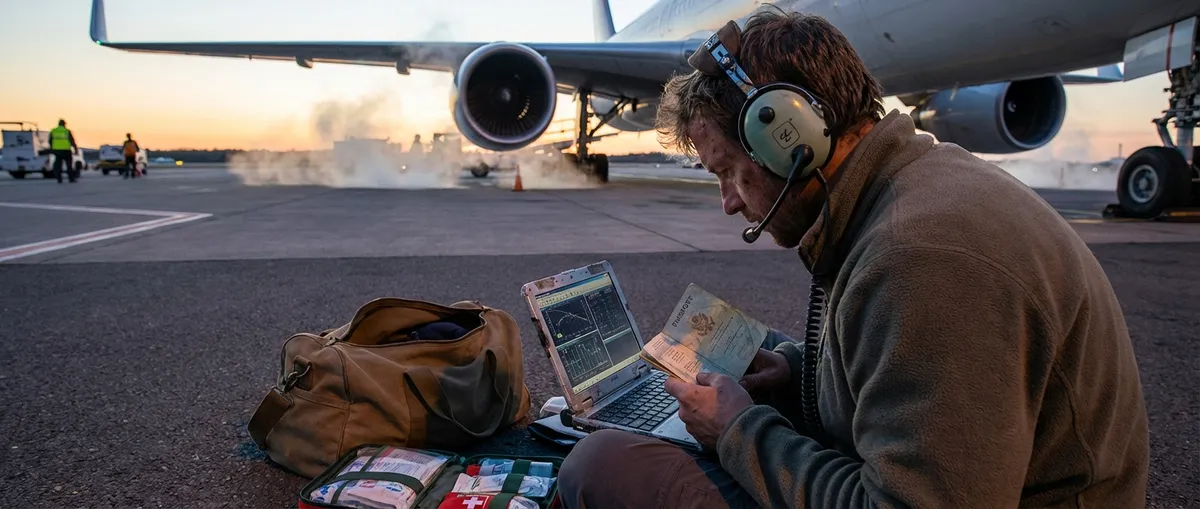
Every border crossing, every boarding call, every rattling bus ride is a stress test for your body. You’re chasing Wi‑Fi, sunsets, and client deadlines—but your energy, joints, and sleep are the real passports that decide how long you can keep this up. Nomad health isn’t spa-day self-care; it’s field maintenance for the engine that keeps you on the road. This guide gives you portable, no-excuse tactics so your body can match your itinerary—no matter how wild it gets.
Build a Daily “Anchor Ritual” That Travels Better Than Your Luggage
The most powerful nomad health hack isn’t a supplement or gadget—it’s a repeatable ritual that moves with you from hostel bunk to airport gate.
Pick a 10–15 minute anchor that you do every single day, no negotiation. It should be simple enough to do in a tiny room, on a balcony, or at the edge of a dorm bed. Think of it as your “system reboot” when time zones and transit try to scramble your circuits.
A strong anchor could be: 2 minutes of deep breathing, 5 minutes of mobility work, and 5–8 minutes of basic strength moves (like squats, pushups, and planks). Keep the sequence identical every time so your brain associates it with stability and control. Hit it on arrival at a new place, after your first coffee, or right before logging in for work. When your surroundings are chaos, this ritual becomes your portable base camp.
Travel-Ready Fuel: Eat Like You’re Prepping for an Expedition, Not a Vacation
Fast food and random pastries at 3 a.m. will eventually collect a toll in lost focus, unstable energy, and lousy sleep—exactly what wrecks nomad productivity. You don’t need perfection on the road, but you do need a default strategy.
Treat protein, hydration, and fiber as your “big three.” At airports or bus stations, prioritize foods that hit at least two of those boxes: Greek yogurt with nuts, sandwiches with real meat and veggies, or rice and beans instead of fries. Make a habit of hitting a supermarket within 24 hours of arrival to stock simple staples: canned fish, nuts, fresh fruit, carrots, hummus, and oats. These give you instant, cheap meals for days when you’re glued to the laptop or stuck somewhere remote.
Carry a collapsible water bottle and actually use it—especially on flights. Dehydration amplifies jet lag, headaches, and brain fog. Add an electrolyte packet on heavy travel days, particularly if you’re in hot, humid climates. You’re not just “grabbing something quick to eat”; you’re fueling a long-range mission.
Five Field-Tested Fitness Tactics for Nomads on the Move
You don’t need a gym membership or perfect conditions. You need tactics that work in cramped rooms, noisy hostels, and random layovers. Use these five as your all-terrain toolkit:
1. The “Doorframe Strength Test” Everywhere You Sleep
Each new stay, do a 5–10 minute check-in routine right by the door as soon as you drop your bag. This anchors the habit to arrival instead of “when I have time.”
Try:
- 3 sets of pushups (hands elevated on a bed or table if needed)
- 3 sets of squats or lunges
- 3 rounds of a 20–30 second plank or side plank
This becomes your personal readiness check—if you’re too wiped to get through it, you know to dial back caffeine, improve sleep, and clean up food for a day or two.
2. The “Carry-On Conditioning” Rule on Travel Days
Turn airports and train stations into stealth conditioning zones instead of passive waiting rooms. If it’s under 20–25 minutes away by foot and safe, walk instead of calling a ride. When you must sit for hours, set a timer every 45–60 minutes to stand, stretch, and walk a short loop.
Use these micro-moves in quiet corners:
- 10–15 slow calf raises holding your backpack
- 10 bodyweight squats
- Gentle hip circles and arm swings
It’s not a full workout—but it reduces stiffness, helps circulation, and keeps you alert when you finally need to work.
3. The “Laptop Break Circuit” for Digital Nomad Workdays
Remote work can quietly turn into 8–10 hours of sitting in cafés or at kitchen tables. Instead of searching for motivation to do a full workout, build tiny circuits into your workday.
Every 60–90 minutes, stand up and do:
- 10–15 squats
- 10 pushups against a desk or wall
- 30–45 seconds of marching in place or high knees
You’ll break up sedentary time, restore focus, and accumulate serious volume over the day—without carving out a massive training block.
4. The Elastic Arsenal: A Resistance Band That Fits in Your Passport Pouch
A single loop or tube resistance band turns any room into a micro-gym. It weighs almost nothing, fits in a small pouch, and dodges baggage fees.
Use it for:
- Rows (anchored around a sturdy table leg or pillar)
- Shoulder work (band pull-aparts, overhead presses)
- Glute activation (lateral steps, hip hinge movements)
This keeps your upper back and hips strong so hours of laptop use and long rides don’t wreck your posture and joints. When Wi‑Fi dies or a call cancels, you instantly have a training option.
5. The “Ten-Rep Promise” on Days That Go Sideways
Some days the bus breaks down, the deadline moves up, or the storm hits. On those days, commit to the “Ten-Rep Promise”: you must do one set of 10 reps of something before bed—squats, pushups, a long plank, band rows—anything.
This isn’t about fitness gains; it’s mental. It reinforces the identity of “I move every day, no matter what.” That identity keeps you from drifting into weeks of inactivity when trips get intense.
Sleep and Recovery: The Nomad’s Undercover Superpowers
Your nervous system doesn’t care that your flight was cheap if your sleep is wrecked for three nights. Travel throws bright screens, strange beds, and shifting time zones at your brain; you offset that with a few simple non-negotiables.
Pack a minimalist recovery kit: earplugs, a sleep mask, and a light scarf or hoodie you can use as a makeshift pillow or blanket. These small items can turn brutal hostels, overnight buses, and noisy city rooms into survivable sleep zones. If you can, keep your last 30 minutes before bed screen-light and caffeine-free, even on the road.
When you cross multiple time zones, start syncing to the new zone as early as possible—get daylight exposure in the morning at your destination, hydrate aggressively, and keep naps under 20–30 minutes. Think of recovery as “charging the battery” that powers all your movement, focus, and decision-making. You’re not wasting time sleeping; you’re buying yourself more capable waking hours.
Portable Mindset: Training Like a Field Operator, Not a Gym Member
Nomad health is less about perfect programs and more about adaptive thinking. You’re training to be capable anywhere, under imperfect conditions. That means judging success by consistency and creativity, not by whether you hit a specific number of sets and reps.
When you arrive in a new city, scout your “terrain” the way an athlete would: Where can you walk or run safely? Is there a park or set of stairs nearby? Does your building have a rooftop? Are there public workout stations along the waterfront? You’re not just sightseeing; you’re mapping your training environment.
Instead of asking, “Do I have a gym?” ask, “What can I use?” Stairs become cardio and leg day. A low wall becomes a pushup and step-up station. A quiet alley or hallway becomes a walking lunge path. Once you start seeing the world this way, every destination becomes part of your training, not an excuse to skip it.
Conclusion
Your passport says where you’ve been; your body says how far you can go next. Nomad health isn’t a side quest—it’s the core engine that lets you chase more borders, more projects, and more adventures without burning out. Lock in a daily anchor routine, eat like you’re fueling an expedition, move in small bursts all day, and treat sleep and recovery as tactical priorities. The world won’t slow down for you—but with the right portable habits, you won’t need it to.
Sources
- [U.S. Department of Health and Human Services – Physical Activity Guidelines](https://health.gov/paguidelines/) - Evidence-based recommendations for weekly activity levels and health benefits
- [World Health Organization – Healthy Diet](https://www.who.int/news-room/fact-sheets/detail/healthy-diet) - Science-backed principles for building balanced, travel-adaptable meals
- [Centers for Disease Control and Prevention – Travel Health](https://wwwnc.cdc.gov/travel/page/travel-health) - Official guidance on staying healthy while traveling internationally
- [Harvard T.H. Chan School of Public Health – Sleep and Health](https://www.hsph.harvard.edu/nutritionsource/sleep/) - Research on how sleep impacts performance, energy, and long-term health
- [American Council on Exercise – Benefits of Short Exercise Bouts](https://www.acefitness.org/resources/everyone/blog/7639/the-benefits-of-short-exercise-bouts/) - Explains how brief, frequent movement breaks improve fitness and wellbeing
Key Takeaway
The most important thing to remember from this article is that this information can change how you think about Nomad Health.