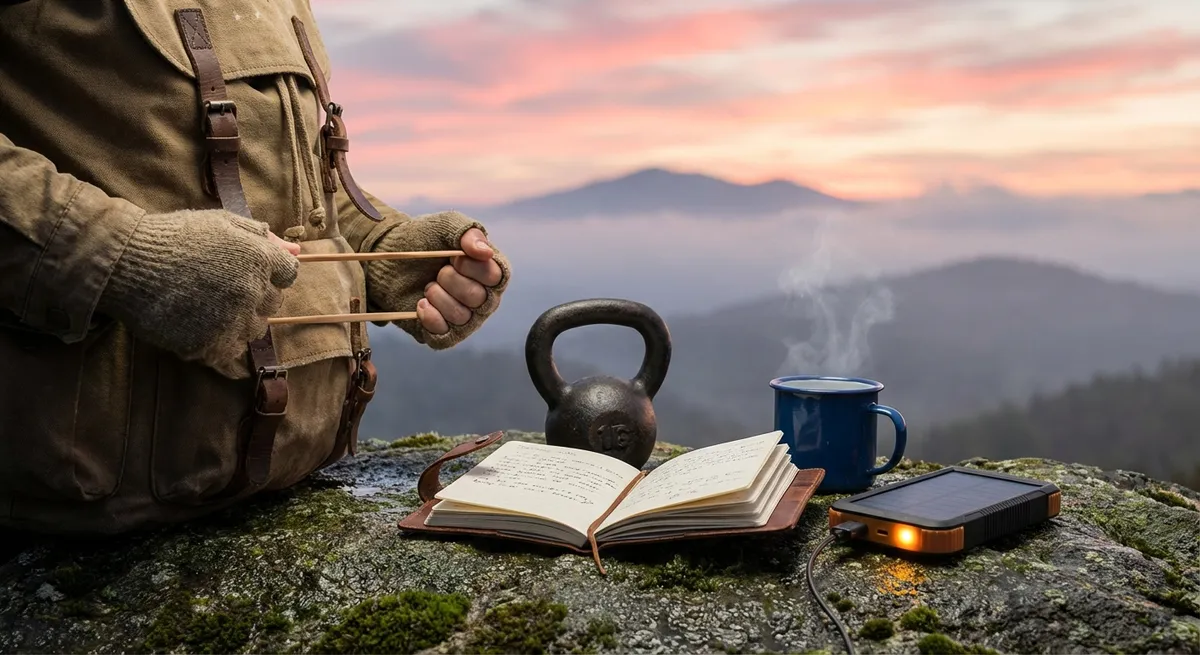
Your backpack’s the new office, your calendar’s stitched together by time zones, and “home base” is whatever Wi‑Fi network you can remember the password for. Your life moves. Your body needs to keep up.
Nomad health isn’t about chasing a perfect routine—it’s about building a portable engine that runs anywhere: bus stations, hostels, coworking rooftops, airport corners, and tiny rentals with squeaky floors. This guide breaks down how to train, recover, and stay sharp on the move, with five field-tested fitness tactics that fit in a carry-on and survive flight delays, visa runs, and last‑minute itinerary changes.
Nomad Health Is an Operating System, Not a Six-Week Program
When your location changes, so do your constraints: climate, food options, daylight, safety, noise, and your energy after long transit days. Traditional “gym‑dependent” fitness collapses under that kind of volatility. Nomad health has different rules:
- Environment-agnostic: Your plan must work in a hostel hallway, a beach park, or a tiny Airbnb with a wobbly chair.
- Equipment-light: If it doesn’t fit in your daypack or weigh less than a laptop, it’s optional, not essential.
- Schedule-flexible: Sessions need to work in 10–25 minute chunks you can stack or split around buses, client calls, and sunrise missions.
- Recovery-aware: Sleep debt, jet lag, and new foods hit hard; your system should account for that instead of pretending you’re a well-rested superhero.
- Adventure-supporting: The goal isn’t just “fit.” It’s being able to hike the extra ridge, sprint for the last train, or carry your pack up four flights when the elevator dies.
Think of your body as travel infrastructure. If your laptop is your income engine, your body is the power grid that keeps everything else online.
Tip 1 – Build a Three-Move “Anywhere Circuit” You Can Do in a Parking Lot
Nomads don’t need a 15‑exercise spreadsheet. You need a default—a simple, repeatable circuit that asks zero questions and fits almost any space. Use it on layovers, at sunrise before coworking, or at dusk when you feel sluggish and tempted to scroll.
Sample Anywhere Circuit (No Gear, 12–15 Minutes)
Cycle continuously, resting only as needed:
Push Pattern:
- Beginner: Incline push-ups (hands on bed, desk, or wall) – 8–12 reps - Intermediate: Standard push-ups – 8–15 reps - Advanced: Decline push-ups (feet elevated) – 8–12 reps
Hinge or Squat Pattern:
- Air squats or split squats – 10–15 reps per leg - If space is tight, do tempo squats: 3 seconds down, 1 second pause, stand fast.
Core + Anti-Slouch:
- Forearm plank – 20–40 seconds - Or dead bug / hollow body variations for 6–10 controlled reps per side.
Aim for 4–6 rounds. If you only have 6 minutes before a call, do 2–3 quick rounds. The point is repetition, not perfection.
Why this works for nomads:
- Uses big movement patterns (push, squat/hinge, core) that carry over to carrying luggage, climbing stairs, and hiking.
- Fits on a yoga mat, towel, or strip of floor.
- Easy to upgrade: slow the tempo, add pauses, or increase rounds when it feels too easy.
Make this circuit your “default mode.” When in doubt, run it.
Tip 2 – Deploy Micro-Sessions: Training in the Cracks of Your Day
Travel days wreck traditional workout blocks. Micro-sessions let you stay consistent even when your schedule looks like Tetris.
Instead of hunting for a perfect 45–60 minute session, cut your training into 3–5 micro-blocks of 5–10 minutes each and scatter them across your day:
- Wake-up block (5–7 min):
- Light mobility (neck, hips, ankles), 10–20 bodyweight squats, 20–40 seconds of brisk shadowboxing or marching in place.
- Purpose: clear sleep fog, reset posture, tell your nervous system, “We’re awake.”
- Work-break block (5–8 min):
- Set a timer every 60–90 minutes: 10 push-ups, 10–15 lunges per leg, 20–30 seconds of plank.
- Or pick one move and “grease the groove” all day (e.g., 5–10 push-ups every time you refill your water bottle).
- Pre-dinner block (8–10 min):
- 4 rounds: 30 seconds brisk steps or jogging in place, 30 seconds bodyweight movement (squats/lunges), 30 seconds rest.
- Purpose: circulation, appetite regulation, and stress offload.
Micro-sessions stack into real training volume without demanding a big time window or mental bandwidth. They’re especially useful on days eaten alive by coworking, transit, and unexpected “let’s grab a drink” invitations.
If you wear a smartwatch or fitness tracker, treat micro-sessions like “movement snacks” to help hit step counts and active minutes even when you’re tied to a laptop.
Tip 3 – Turn Your Carry-On Into a Minimalist Power Kit
Portable strength beats fragile strength. Your body should still feel strong after ten days of buses, cheap mattresses, and erratic sleep. A small, smart gear kit helps you maintain that edge without lugging half a gym around.
Packable gear that earns its weight:
- Long resistance band (loop or tube):
- Fits in a pocket, weighs almost nothing, replaces many cable machine movements.
- Use for rows, band pull-aparts, face pulls, biceps/triceps work, and hip work.
- Mini-loop bands (glute bands):
- Great for hip activation, knee health, and quick leg burners in small spaces.
- Compact jump rope (optional):
- High-intensity cardio in any quiet corner where you won’t decapitate a ceiling fan.
- Lightweight travel mat or microfiber towel:
- Doubles as workout space, stretch area, and airport-floor shield.
Sample “Power Kit” Session (Band + Bodyweight, 15–20 Minutes)
Cycle through:
Band rows – 12–20 reps
Push-ups – 8–15 reps
Split squats or reverse lunges – 8–12 reps per leg
Band pull-aparts or face pulls – 12–20 reps
Core finisher (dead bugs, side planks, or bicycle crunches) – 8–12 per side or 20–30 seconds
Run 3–5 rounds with 30–60 seconds rest between rounds.
This tiny kit turns almost any room, park, or rooftop into a reliable training zone. If you’re staying somewhere longer, you can always supplement with local options—a day pass at a gym, outdoor calisthenics parks, or hotel weights.
Tip 4 – Make Walking and Exploration Your Cardio Strategy
You’re already moving through new cities and landscapes—turn that curiosity into structured cardio instead of sitting in rideshares or on scooters.
Anchor habits that make movement automatic:
- 2–5 km “arrival walk” whenever you land in a new place. After checking in, drop your bag and walk a loop around your area: grocery, pharmacy, coworking, nearest park, safest routes at night.
- Default to walking for sub-20 minute distances when safety and weather allow.
- Use “walking meetings” or voice-note walks for brainstorming, catching up with family, or listening to podcasts instead of sitting in a café corner.
For conditioning, set intentional walking days:
- Choose a loop or point of interest (viewpoint, markets, coastal path).
- Aim for 8,000–12,000+ steps, depending on your baseline.
- Add terrain when possible: stairs, hills, sand, or uneven trails to keep your lower body and stabilizers honest.
If weather is brutal or the area doesn’t feel safe to roam:
- Pace stairwells (if secure) for 5–10 minute climbing bouts.
- March in place with high knees, lateral steps, and quick feet intervals in your room.
Your heart and lungs don’t care whether the view is an alpine ridge or a market alley at dusk. Sustainably raising your heart rate wins either way.
Tip 5 – Use “Recovery Checkpoints” to Stay Durable, Not Just Fit
Travel stresses your system in ways you don’t always notice: strange pillows, overnight transit, dehydration, new foods, subtle anxiety about safety or connectivity. Without a recovery plan, small aches become nagging injuries and fatigue becomes your default state.
Build recovery checkpoints into your workflow:
Daily (5–10 minutes total):
- Mobility routine:
- Neck circles, shoulder rolls, cat-cow, hip circles, ankle rolls.
- Add 30–60 seconds of couch stretch or hip flexor stretching if you sit for work.
- Posture reset:
- 1–2 minutes of band pull-aparts or wall angels if you have access to a blank wall.
- At least once per day, lie on the floor on your back, calves on a bed or chair, arms wide, for 2–3 minutes of deep breathing.
- Hydration baseline:
- Front-load water early in the day, especially after flights or long buses.
- Check your urine color: aim for pale yellow most of the time.
Weekly:
- One “maintenance” session of 15–20 minutes:
- Mix longer stretches, foam rolling (if you have a travel-sized roller or ball), and slow controlled mobility.
- Pay extra attention to hips, lower back, calves, and chest—the usual trouble spots for laptop nomads and backpack carriers.
Sleep triage when changing time zones:
- Get morning light exposure soon after waking in the new location.
- Keep the first night’s caffeine and alcohol conservative; let your system find its rhythm.
- If you can, aim for consistent wake time more than a perfect bedtime—your body anchors better to a stable “up” time.
Durable nomads treat training and recovery as a matched set. The goal is sustainable capacity, not burning through energy like a weekend warrior and spending three days recovering while your inbox mutinies.
Conclusion
Your location can change every week, but your health strategy doesn’t have to. When you:
- Rely on a simple, repeatable anywhere circuit
- Break training into micro-sessions
- Carry a minimalist power kit
- Turn exploration into built-in cardio
- And guard your recovery checkpoints
…you’re not just “staying in shape.” You’re building a portable, resilient engine that makes every border crossing, last‑minute hike, and weird overnight bus more manageable—and more fun.
Nomad health isn’t about having a perfect routine; it’s about having a reliable one that travels as well as you do. Pack these strategies next to your passport, and your body will be as ready for the next adventure as your browser tabs are.
Sources
- [Centers for Disease Control and Prevention – Physical Activity Basics](https://www.cdc.gov/physicalactivity/basics/index.htm) – Guidelines on weekly activity levels and why even short bouts of movement matter.
- [World Health Organization – Physical Activity](https://www.who.int/news-room/fact-sheets/detail/physical-activity) – Global recommendations on moderate and vigorous activity and health benefits.
- [Harvard T.H. Chan School of Public Health – The Importance of Walking](https://www.hsph.harvard.edu/nutritionsource/walking/) – Evidence on walking as accessible, effective cardio for health and longevity.
- [Sleep Foundation – Jet Lag: Symptoms, Causes, and Treatment](https://www.sleepfoundation.org/jet-lag) – Research-backed strategies for managing jet lag and sleep disruption while traveling.
- [American Council on Exercise (ACE) – Resistance Band Training 101](https://www.acefitness.org/resources/everyone/blog/7449/resistance-band-training-101/) – Practical guidance on using resistance bands effectively for strength training.
Key Takeaway
The most important thing to remember from this article is that this information can change how you think about Nomad Health.