Every border stamp, boarding call, and bus ticket is a chance to either drift further from your strength—or sharpen it. You don’t need a permanent gym membership, a checked bag full of gear, or perfect sleep to stay athletic on the move. You need smart tactics, portable tools, and a plan that survives jet lag, tiny hotel rooms, and unreliable Wi‑Fi.
This guide is built for travelers and digital nomads who want to stay strong, mobile, and capable no matter what the itinerary looks like. Think of it as your field manual for training in airports, hostels, guesthouses, and everything in between.
Build a “Minimalist Mission Kit” That Fits in Any Bag
Your first move is to assemble a pocket-sized training arsenal that turns almost any space into a functional gym. Instead of chasing perfect equipment, think: “What can give me the biggest training options for the least size and weight?”
Here’s a simple, high-impact kit:
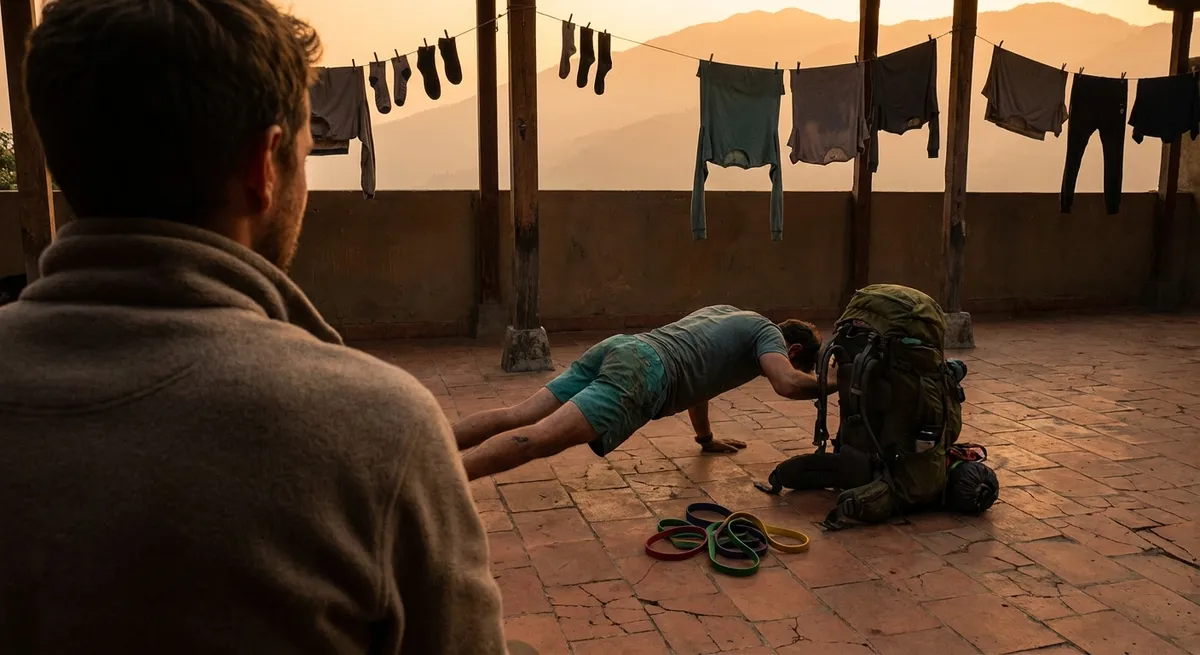
- Light and medium resistance minibands: Great for glute activation, upper back work, and shoulder stability in tiny spaces.
- One long resistance band (pull-up assist style): Anchors to doors, railings, bed frames, or trees for rows, presses, pull-aparts, and deadlift variations.
- Compact suspension trainer or strong yoga strap: Lets you do rows, fallouts, and split squats using nothing but a door or beam.
- Jump rope (if your ceilings allow it): Doubles as conditioning and warm-up; lighter than your laptop charger.
- Mobility ball or lacrosse ball: For self-massage on cramped hips, upper back, and feet after flights or long bus rides.
Pack this in a small pouch and it becomes your “deployment kit.” The rule: if it doesn’t fit in a daypack without hassle, it’s too much. This tiny load-out keeps you capable of strength, power, and mobility work even in the most cramped city studio or mountain cabin.
Use the “20-Minute Field Session” as Your Default Workout
Travel is chaos: checkouts, transit delays, late client calls, and surprise hikes. Long, perfect training blocks are rare. Instead, default to a 20-minute field session—short, dense, and repeatable in nearly any environment.
Structure it like this:
- 5 minutes – Wake-up prep
- Dynamic moves: hip circles, arm swings, leg swings, cat-cow, deep squat holds.
- Add 30–60 seconds of fast shadowboxing or marching in place to raise heart rate.
- 12 minutes – Strength and conditioning block
- Push: push-ups, elevated push-ups, banded presses
- Pull: band rows, suspension rows, towel rows through a sturdy door handle
- Legs: split squats, reverse lunges, banded good mornings, squat jumps
- Core: plank variations, dead bug, hollow holds, suitcase carry with backpacks
Pick 3–4 movements and rotate through them:
Set a timer for 12 minutes and cycle through 6–10 reps per move at a controlled pace. Travel days are about consistency, not records.
- 3 minutes – Reset
- 2–3 stretches focused on hips, hamstrings, chest, and upper back
- 4–6 slow, deep breaths through the nose to downshift your nervous system
This format is mission-ready: if you have 20 minutes and a patch of floor, you can execute. On easier days, do a single block. On days with more energy and time, run two or three blocks, changing exercises or focus (upper-body, lower-body, conditioning).
Anchor Strength to Landmarks, Not Schedules
Time zones wreck routines. Instead of thinking “I’ll train at 7 a.m.,” tie your sessions to events that always happen, regardless of the clock.
Use triggers like:
- “After I land and shower, I do a 10–20 minute session.”
- “Before I open my laptop in the morning, I move.”
- “After my last call of the day, I hit a short circuit.”
By anchoring workouts to recurring events—first coffee, last email, post-check-in—you bypass jet lag and inconsistent local schedules. Your brain knows: new city, new bed, same training trigger.
If you’re constantly in motion, consider this simple weekly rhythm:
- 3–4 days: strength-focused field sessions (bodyweight + bands)
- 2–3 days: movement + conditioning (brisk walking, stairs, jump rope, light runs, mobility)
- Daily: 5–10 minutes of mobility (hips, thoracic spine, ankles, and neck)
You’re not trying to bodybuild on the road; you’re maintaining strength, joint health, and capacity so you can jump back into heavier training when you’re home—or carry that pack up a volcano tomorrow without breaking.
Turn Transit and Lodging into Movement Opportunities
You may not control your hotel gym situation, but you usually control how you move between Point A and Point B. Instead of thinking “I can’t train because I’m traveling,” make travel part of the training plan.
Some practical tactics:
- Airports and Stations
- Walk the terminal with a loaded backpack instead of sitting at the gate.
- Use stairs instead of escalators when you’re not dragging a giant suitcase.
- Sneak in “micro-mobility”: ankle circles, calf raises, glute squeezes, seated spinal rotations while you wait.
- Hotels, Hostels, and Rentals
- Use the doorframe for isometric holds (push against frame, pull against frame).
- Turn a bed or chair into a bench for incline push-ups, Bulgarian split squats, and triceps dips (if joints tolerate them).
- A towel under your hands or feet on a smooth floor becomes a slider for hamstring curls, pikes, and plank reach-outs.
- Cities and Villages
- Treat steep streets, stairways, clock towers, or lookout points as impromptu hill or stair intervals.
- Walk or bike to coworking instead of always hailing a ride—add a little extra distance when time allows.
The mindset shift is key: transit isn’t “dead time” between your real life and your training life. For a nomad, transit IS real life—and it’s full of strength and conditioning opportunities if you’re looking for them.
Five Field-Proven Fitness Tips for Travelers and Digital Nomads
To keep this tactical, use these five core principles as your on-the-road operating system:
Prioritize Movements, Not Muscles
Focus on push, pull, hinge, squat, lunge, carry, and rotate. If you hit these patterns 3–4 times a week with decent effort, your physique and performance will stay surprisingly solid, even without barbells.
Train “Hard Enough” Instead of Chasing Perfection
Use a Rate of Perceived Exertion (RPE) scale of 1–10. Aim for sets that feel like a 7–8/10 effort, leaving 1–3 good reps in the tank. This keeps you progressing without trashing yourself before a long travel day or big sightseeing mission.
Use Your Backpack as a Mobile Weight
Load it with water bottles, books, or gear and use it for goblet squats, loaded step-ups, rows, and carries. On long trips, your carry-on becomes a portable kettlebell that’s already coming with you.
Guard Sleep and Hydration Like Priority Equipment
Performance drops fast when you’re dehydrated and underslept. On flights and bus rides, limit alcohol, sip water regularly, and try to bank sleep where you can. Strong bodies break down under chronic fatigue faster than under light equipment.
Program “Floor Time” Daily
Every day, even on brutal travel days, spend 5–10 minutes on the floor: hip openers, glute bridges, cat-cow, deep breathing, and gentle spinal twists. This small habit undoes hours of sitting and keeps your joints from stiffening into permanent airplane posture.
These aren’t just nice ideas—they’re simple rules you can run in any city, climate, or time zone. The more chaotic your travel, the more valuable these non-negotiables become.
Conclusion
You don’t have to choose between the strong version of yourself and the version that lives out of a backpack. With a small mission kit, short field sessions, event-based routines, and a willingness to treat airports, alleys, and hostels as training grounds, you can keep your edge while the scenery changes.
Strength on the road isn’t about perfect programs; it’s about portable systems, consistent intent, and a body that’s ready for whatever the next country throws at it. Pack light, move often, and let your training roam as far as your passport.
Sources
- [American Council on Exercise – Travel Workouts: Staying Fit on the Road](https://www.acefitness.org/resources/everyone/blog/7632/travel-workouts-staying-fit-on-the-road/) - Practical ideas and guidelines for maintaining fitness while traveling
- [CDC – Physical Activity Basics](https://www.cdc.gov/physicalactivity/basics/index.htm) - Evidence-based recommendations for weekly activity and intensity
- [Harvard Health – The Importance of Stretching](https://www.health.harvard.edu/staying-healthy/the-importance-of-stretching) - Overview of why mobility and stretching matter, especially for frequent sitters and travelers
- [Sleep Foundation – How Travel Affects Sleep](https://www.sleepfoundation.org/travel-and-sleep) - Explains how jet lag and irregular schedules impact recovery and performance
- [Mayo Clinic – Resistance Band Basics](https://www.mayoclinic.org/healthy-lifestyle/fitness/in-depth/exercise-bands/art-20045051) - Details on effectiveness and versatility of resistance bands for strength training
Key Takeaway
The most important thing to remember from this article is that this information can change how you think about Travel Workouts.