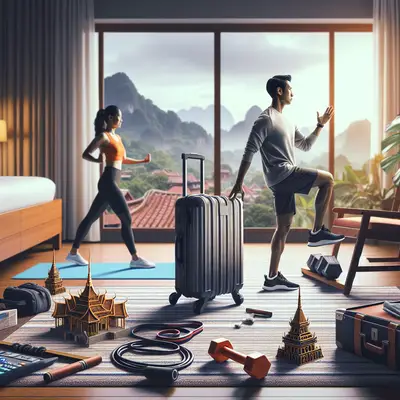
You can chase sunsets, switch cities every week, live on flight confirmations and Wi‑Fi passwords—and still feel powerful in your own skin. Hotel life doesn’t have to be a layover for your fitness; it can be your training ground. With a few portable tactics and a simple mindset shift, every room, hallway, and staircase turns into a mini basecamp for strength, stamina, and sanity.
This isn’t about perfection. It’s about building travel-proof rituals so your body keeps up with your passport.
Build a “Non-Negotiable 15” Ritual
When your home changes every few nights, routine is your anchor. Instead of promising yourself an epic workout you’ll never start, lock in a 15-minute, non-negotiable ritual you do in every hotel—no excuses, no overthinking.
Choose a simple sequence you can remember without an app or equipment, like:
- 3 minutes: mobility (neck rolls, arm circles, hip circles, cat-cow
- 8 minutes: strength (push variations, squats, hip hinges, core)
- 4 minutes: conditioning (fast-paced bodyweight circuit or stair sprints)
The goal isn’t to crush yourself; it’s to hardwire the identity of “I move, wherever I am.” Consistency beats intensity when your environment constantly shifts. That small ritual keeps your joints awake after flights, your muscles online after laptop marathons, and your brain clear enough to actually enjoy the places you’re exploring.
Tip 1 – Anchor It to a Daily Trigger:
Attach your Non-Negotiable 15 to something you already do: right after brushing your teeth, while your coffee brews, or as soon as you drop your bags on the hotel floor. Same ritual, different city.
Turn Your Room Into a Zero-Equipment Training Zone
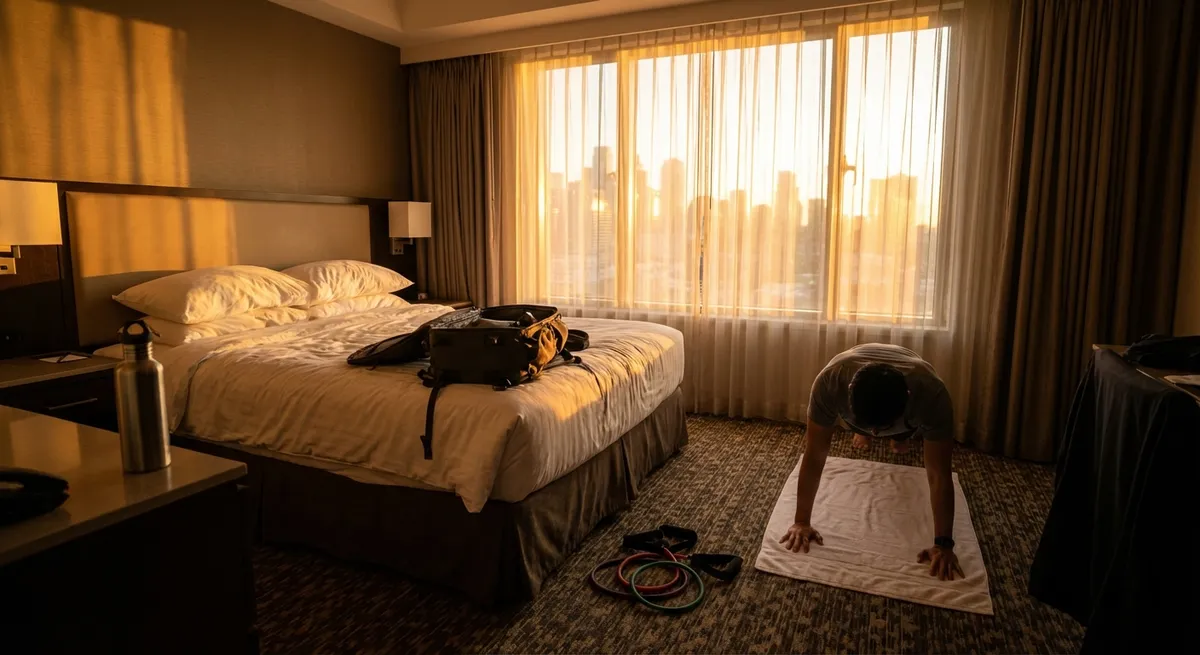
Your hotel room is more than a sleep pod—it’s a private training cave. You don’t need machines; you need leverage, angles, and creativity.
Use what’s already there:
- Bed edge for incline push-ups, hip thrusts, and Bulgarian split squats
- Sturdy desk or dresser for elevated push-ups and hands-elevated planks
- Door frame or wall for isometric holds (wall sits, wall push holds, calf raises)
- Towel as a slide tool (hamstring curls on smooth floors, sliding lunges, plank drags)
A basic full-body template you can adapt to almost any room:
- Push: incline push-ups on the desk or bed
- Pull substitute: slow tempo push-ups + long plank holds to train upper-back stability
- Legs: split squats off the bed, wall sits
- Hips: single-leg hip thrusts using the bed edge
- Core: dead bugs on the floor, side planks, slow mountain climbers
Focus on tempo (3–5 seconds lowering), paused reps, and single-leg exercises to make hotel-bodyweight work hit like a real session. The less external load you have, the more you manipulate time under tension.
Tip 2 – Use “Room Landmarks” as Cues:
Pick four movements that line up with spots in the room—desk, bed, wall, floor—and cycle them. It keeps decision fatigue low and makes every room instantly “trainable.”
Make Stairs Your Built-In Conditioning Tool
If your hotel has stairs, you have a built-in conditioning lab that never closes. Stairs challenge your heart, lungs, and legs with zero gear and almost no planning.
Start simple:
- Warm-up: walk 2–3 flights at an easy pace
- Work phase:
- Walk or jog up 1–3 flights,
- Walk down for recovery
- Repeat for 10–15 minutes
- Cooldown: slow, mindful walking + light stretching
You can modulate intensity by changing speed, skipping a step (only if safe), or increasing total time, not by turning every session into a sufferfest. When you’re crossing time zones and dealing with short sleep, moderate conditioning can be more sustainable than all-out sprints.
Stairs are also your ally on bad-weather days, late-night check-ins, or in cities where outdoor running doesn’t feel safe. Close the loop by finishing your stair session back in your room with a short mobility series—hips, calves, and upper back—to keep you from feeling like a folded pretzel at your next coworking desk.
Tip 3 – Use “Floor Numbers” as Targets:
Choose a “challenge floor.” For example: every time you come back to your room before dinner, you walk the stairs up to the 5th floor, then take the elevator the rest of the way. Micro-doses add up across a week-long stay.
Pack a Minimalist “Adventure Kit” for Strength Anywhere
You don’t need a trunk full of gear to stay strong on the road. A tiny, intentionally packed kit can turn almost any hotel into a serious training space while still fitting in your carry-on.
Consider building a minimalist travel kit with:
- One light and one medium resistance band (loop or tube)
- A long superband for rows, pulldowns, and assisted single-leg work
- A packable yoga mat or grippy towel for floor work
- Optional: a lightweight jump rope for quick conditioning bursts
With bands alone you can:
- Train your upper back with rows anchored around a door hinge (using a door anchor or wrapped around a sturdy fixture)
- Hit glutes and hips with lateral walks and banded hinges
- Add resistance to squats, push-ups, and deadlift patterns
- Keep shoulders happy with pull-aparts and face-pull variations
This kit weighs less than a pair of jeans but keeps core movement patterns—push, hinge, squat, carry (band-resisted holds), and rotation—in your weekly routine. That means when you do get access to a real gym or outdoor spot, you’re not starting from zero.
Tip 4 – Pre-Plan One “Go-To Band Circuit”:
Before you fly, write a 20-minute band circuit on your phone. When you land jet-lagged in a random city, you won’t have to program on the fly—you’ll just execute.
Design Recovery Rituals That Survive Jet Lag
Adventure is a performance sport, and your recovery is what keeps you from burning out halfway through your trip. Hotel environments often work against you: weird lighting, noisy halls, dry air, and time zone shocks. Recovery rituals keep your system stable enough to explore hard and train consistently.
Key hotel-friendly tactics:
- Light management: Get bright daylight within an hour of waking; dim your lights and screens 60–90 minutes before bed
- Hydration rule: Drink water or an electrolyte mix as soon as you enter your room; planes and AC leave you dehydrated and foggy
- Floor time: 5–10 minutes of light mobility before bed—hips, hamstrings, T-spine—signals your body you’re done “go mode” for the day
- Wind-down anchor: Choose a consistent pre-sleep pattern: warm shower, 5 deep breaths at the window, phone face-down, then into bed
Recovery doesn’t have to be a spa day. It’s about stacking small, repeatable habits so your nervous system knows what to expect, even when your view keeps changing.
Tip 5 – “Hotel Check-In Protocol”:
When you first enter your room, do the same three things every time: drop your bag, drink water, and do a 3-minute body scan + stretch. It’s a quick reset from travel mode into “I live here now—even if just for tonight.”
Conclusion
Life on the road doesn’t have to be a tradeoff between epic memories and a strong, capable body. When you treat every hotel as a temporary basecamp instead of a fitness dead zone, you stop “starting over” after every trip and start stacking strength across borders.
Your tools are simple: a Non-Negotiable 15, creative use of the room, stairwells as your built-in hill sprints, a tiny adventure kit of bands, and recovery rituals that keep you from unraveling between flights. Keep the system light, portable, and repeatable, and your body will keep showing up—in new countries, new time zones, and new stories you’d never collect from your couch.
Your passport says where you’ve been. Your rituals decide how far you can go.
Sources
- [American Council on Exercise – Exercise for Travelers](https://www.acefitness.org/resources/everyone/blog/7444/exercising-while-traveling/) – Practical guidance on maintaining exercise habits while traveling
- [Mayo Clinic – Fitness Fundamentals: Guidelines for How Much Exercise You Need](https://www.mayoclinic.org/healthy-lifestyle/fitness/in-depth/fitness/art-20048269) – Outlines evidence-based recommendations for weekly activity
- [CDC – Physical Activity Guidelines for Adults](https://www.cdc.gov/physicalactivity/basics/adults/index.htm) – Official U.S. guidelines on activity levels and health benefits
- [Harvard Health – Why Strength Training Is Key to Healthy Aging](https://www.health.harvard.edu/staying-healthy/why-strength-training-is-so-important) – Explains the importance of regular strength work, even with minimal equipment
- [Sleep Foundation – Jet Lag and Sleep](https://www.sleepfoundation.org/jet-lag) – Evidence-based strategies for managing jet lag and protecting sleep on the road
Key Takeaway
The most important thing to remember from this article is that this information can change how you think about Hotel Fitness.