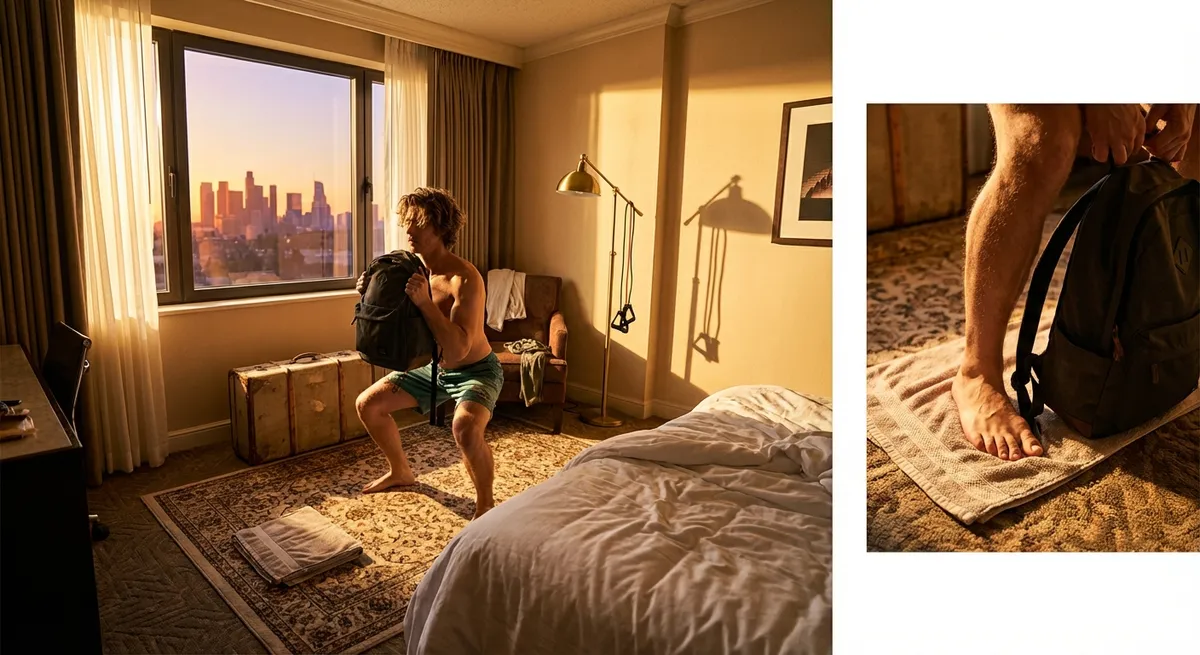
You don’t need a fancy hotel gym or a checked bag full of gear to stay strong on the road. If your life bounces between Airbnbs, long-haul flights, and hotel key cards, your body can either become travel-sore and sluggish—or road-tested and adventure-ready. This guide is about the second option. With a little strategy, you can turn any hotel room into a training base without sacrificing exploration time or overloading your luggage.
Build Your “Anywhere Strength” Mindset
If you’re waiting for the “perfect” gym to stay consistent, you’ll stay stuck. Travelers who stay fit long-term don’t rely on ideal conditions—they rely on adaptable systems.
Instead of thinking in terms of full workouts, think in “movement hits”: short, focused bursts of effort you can plug into your day between calls, check-ins, and train rides. This shift matters because travel already demands a lot from your nervous system—new time zones, disrupted sleep, different foods. Long, punishing workouts often backfire, leaving you more exhausted and less consistent.
Your new rule: treat movement like brushing your teeth. It’s not optional, it’s automatic. Even 10–15 minutes of intentional work can improve circulation, joint health, and mental clarity. Research shows that breaking movement into shorter bouts across the day can be as effective as one longer session for many health markers, including blood pressure and insulin sensitivity. That’s perfect for a schedule that never looks the same two days in a row.
Tip 1: Turn Your Hotel Room Into a Three-Zone Training Space
Before you drop your bag, scout your room like it’s a mini training map. Assign three zones:
- Zone 1 – Floor Space (Strength + Mobility):
Clear a rectangular area big enough to lie down in. This is your arena for push-ups, lunges, planks, glute bridges, and mobility flows. Use a towel as a mat if the floor looks questionable.
- Zone 2 – Stable Surface (Power + Support):
Use the bed frame, a sturdy chair, or desk for elevated push-ups, step-ups, or Bulgarian split squats. Test stability first—if it wobbles, skip it. Safety beats bravado.
- Zone 3 – Door or Wall (Isometrics + Balance):
Doors and walls are underrated tools. You can do wall sits, standing isometric pushes (like trying to “push the wall away”), calf raises while holding the door frame, and balance drills.
Once the zones are set, your workouts become plug-and-play. For example:
- 30 seconds: elevated push-ups (Zone 2)
- 30 seconds: reverse lunges (Zone 1)
- 30 seconds: wall sit (Zone 3)
- 30 seconds: rest
Run that for 4–6 rounds and you’ve earned your breakfast. No thinking, no scrolling for ideas, just hit the circuit and go explore.
Tip 2: Use Micro-Sessions to Beat Jet Lag and Desk Stiffness
Travel days and laptop marathons wreck posture and energy. Instead of one big session you keep procrastinating, use micro-sessions—5–10 minutes, 2–4 times per day.
Here’s how to deploy them:
- Morning Wake-Up:
- 10 bodyweight squats
- 10 wall push-ups or regular push-ups
- 20–30 seconds of plank
Right after you wake up (before emails), do:
Repeat 2–3 times. You’ve just pumped blood through stiff joints and told your brain, “We’re on.”
- Midday Reset (between calls or coworking sprints):
- 20 walking lunges across the room (or 10 per leg in place)
- 15–20 calf raises
- 20–30 seconds of doorframe chest stretch per side
- Pre-Dinner Decompression:
- Slow arm circles
- Cat-cow on the floor (or standing version if floors are suspect)
- Hip circles and gentle bodyweight good mornings
Set a timer every 60–90 minutes. When it goes off:
After a long sit-heavy day, hit 5–8 minutes of mobility:
Short bouts improve circulation, counter the metabolic dip from too much sitting, and help regulate your internal clock—key for adapting to new time zones. You’ll arrive at dinner much more like an explorer and less like a desk statue.
Tip 3: Pack One Ultra-Light Tool to Multiply Your Options
You don’t need a suitcase full of gear. One small item can drastically upgrade your hotel training without hogging space:
- Mini resistance band (loop band):
Weighs almost nothing and turns basic moves into serious strength work. Wrap it around your thighs for glute bridges and squats, use it for lateral band walks, or add it to push-ups by looping it around your back and hands.
- Long resistance band (pull-up assist style):
Hooks on doors (carefully), wraps around bed frames or table legs, and unlocks rows, presses, pull-aparts, and assisted single-leg work. This is the closest you’ll get to a portable cable machine.
- Jump rope (if ceilings allow):
Perfect for cardio bursts in hotel courtyards, parking garages, or quiet corners. Great if you like high-output conditioning but don’t want to hunt down a treadmill.
Pick one tool you actually enjoy using and commit to bringing it on every trip like your passport. A simple “band + bodyweight” session might look like:
- 12 band-resisted squats
- 12 band rows (anchored around a sturdy object)
- 10–15 push-ups
- 12 band pull-aparts
Repeat 3–4 rounds, resting 45–60 seconds between rounds. It’s simple, scalable, and hits the major movement patterns you need for real-world strength.
Tip 4: Anchor Your Training to Travel Rituals, Not Willpower
Consistency on the road has less to do with motivation and more to do with habits that piggyback on things you already do. Design your fitness around existing travel rituals:
- Post Check-In Rule:
After you drop your bags—but before you open your laptop—run a 5–10 minute “arrival circuit.” This signals to your body that travel mode is over and settled mode begins.
- Pre-Shower Rule:
- 30–50 total reps of a push pattern (push-ups or wall push-ups)
- 30–50 total reps of a leg pattern (squats, lunges, or split squats)
- Coffee Countdown:
- Day 1: squats
- Day 2: push-ups or wall push-ups
- Day 3: glute bridges or hip thrusts against the bed
No shower unless you’ve done:
While your kettle or hotel coffee maker runs, do a single movement:
Rotate through. The habit stays the same; the exercise changes.
By attaching movement to existing anchors—check-in, shower, coffee—you bypass decision fatigue. You don’t have to ask, “Will I work out today?” The question becomes, “What am I doing during this ritual?” That small shift keeps your training alive even on brutal travel days.
Tip 5: Train for the Adventures Outside the Hotel, Not Just the Mirror
If you’re living the traveler or digital nomad life, your “why” should be bigger than aesthetics. Training becomes much more compelling (and sustainable) when it’s tied to what you actually do on the road: hiking, city walking, climbing stairs, carrying bags, impromptu bike rentals, surf lessons, or chasing sunsets up questionable viewpoints.
Aim your hotel sessions at supporting:
- Leg endurance:
High-rep squats, lunges, step-ups onto a stable chair or low bed frame. These pay off on long walking days and stair-heavy old towns.
- Back and shoulder resilience:
Rows with a band or suitcase, pull-aparts, and banded face pulls (if you’ve got a long band). This armor helps you handle backpacks, camera gear, and laptop bags.
- Core stability:
Planks, side planks, dead bugs, and suitcase carries (literally carry your loaded suitcase in one hand and walk carefully around the room). This protects your spine on long flights and rough transport days.
- Ankles and feet:
Calf raises, single-leg balance drills (stand on one foot while brushing your teeth), and towel scrunches for your toes. Strong feet and ankles matter when you’re racking up 20,000 steps on cobblestones.
When you design your training to fuel experiences—sunrise hikes, canyon trails, citywide walking tours—your hotel workout stops feeling like a chore and starts feeling like gear prep for your next mission.
Conclusion
Hotel fitness isn’t about recreating your home gym; it’s about staying ready for whatever the road throws at you with the least friction possible. With a three-zone room setup, micro-sessions to fight jet lag and stiffness, one portable tool, habit anchors built around your travel rituals, and adventure-focused training, you can keep your body mission-ready anywhere your passport takes you.
Your room is small, your time is limited, and your schedule is chaotic—but your training doesn’t need to be. Start with one tip from this guide on your next trip, layer in the others as you go, and let your body become as nomadic—and resilient—as your itinerary.
Sources
- [Physical Activity Guidelines for Americans, 2nd Edition (HHS)](https://health.gov/sites/default/files/2019-09/Physical_Activity_Guidelines_2nd_edition.pdf) - U.S. Department of Health and Human Services overview on recommended activity levels and benefits of breaking movement into bouts
- [World Health Organization: Physical Activity Fact Sheet](https://www.who.int/news-room/fact-sheets/detail/physical-activity) - Global health guidance on physical activity and its impact on health and longevity
- [Harvard Health Publishing – The Truth About Exercise “Snacks”](https://www.health.harvard.edu/exercise-and-fitness/the-truth-about-exercise-snacks) - Explains how short, frequent bouts of movement can boost health and fitness
- [Mayo Clinic – How Sitting Affects Your Health](https://www.mayoclinic.org/healthy-lifestyle/adult-health/in-depth/sitting-too-much/art-20045383) - Details the health risks of prolonged sitting common to travel and remote work
- [American Council on Exercise – Resistance Band Training Benefits](https://www.acefitness.org/education-and-resources/lifestyle/blog/6642/7-benefits-of-resistance-band-training/) - Outlines why bands are effective, portable tools for strength training
Key Takeaway
The most important thing to remember from this article is that this information can change how you think about Hotel Fitness.