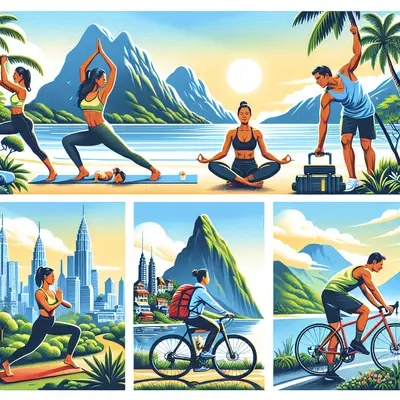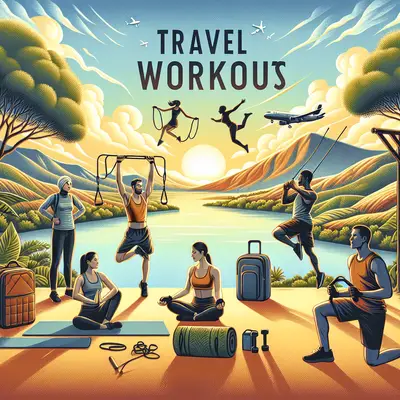
You’re chasing sunsets, border crossings, and café Wi‑Fi… but your muscles don’t care how epic your Instagram looks. They only know if you moved today—or didn’t. The good news: you don’t need a gym, a barbell, or even a consistent time zone to stay strong. You just need a bit of strategy, some portable tools, and a willingness to turn any space into your training ground.
This guide is built for travelers and digital nomads who want their bodies to keep up with their passports—no fluff, no excuses, just adventure-proof fitness you can carry in your daypack.
Building a “Zero-Excuse” Travel Workout Framework
Travel routines are chaos: flight delays, surprise invitations, late-night work calls. Traditional programs crumble under that kind of unpredictability, so your workout framework has to be rugged and flexible.
Think in modules instead of full sessions. A module is a 10–15 minute block focused on one quality: strength, mobility, conditioning, or recovery. Stack modules when you have time, or just knock out one when your schedule implodes. This approach keeps your body progressing without depending on perfect conditions.
Anchor your training to non-negotiable triggers instead of the clock. For example: “After I brush my teeth in the morning, I do a mobility module,” or “Every time I get back from a long transit day, I do a 10-minute strength module before showering.” Location-independent habits beat time-dependent habits when you cross time zones.
Finally, choose movements that travel as well as you do: bodyweight basics, portable resistance, and patterns you can do in a 2×2 meter space with low noise (for thin apartment walls and quiet guesthouses). Your body becomes the constant, even when everything else changes.
Portable Gear That Multiplies Your Options
You can stay fit with pure bodyweight, but a few ultra-light tools turn any room into a legitimate training zone without eating up your luggage space.
A long resistance band (or two) is the MVP of nomad strength. It weighs almost nothing and lets you load rows, presses, deadlifts, and hip hinges in tiny spaces. Hook it around a sturdy bedpost, a door hinge (on the frame, not the handle), or your own foot to mimic gym machines and cable systems.
Mini loop bands are perfect for glute activation, hip stability, and shoulder work—clutch after long flights or bus rides. They fit in a jacket pocket yet unlock serious leg and posture training.
A lightweight jump rope doubles as your mobile conditioning tool. When space allows, it gives you high-intensity cardio without hunting down a treadmill. No room? The same movement pattern can be done with “ghost jumping”—no rope, same tempo.
If you’re up for a tiny bit more weight, a collapsible travel yoga mat helps maintain grip on slippery hotel floors and cushions your joints. It also becomes a visual cue: lay it down and your brain knows, “Time to move,” no matter what country you’re in.
Five Trail-Proof Fitness Tips for Travelers and Digital Nomads
Here are five practical tactics you can deploy anywhere—from airport lounges to beach huts—to keep your body ready for whatever the road throws at you.
Tip 1: Use the “20 Reps or 10 Minutes” Rule
When motivation is low or time is tight, decision fatigue kills workouts. Strip away the mental debate with one simple rule: either do 20 quality reps of two movements or train for 10 minutes, nonstop.
Example micro-session:
- 10 push-ups
- 10 air squats
Repeat this pairing until you hit either 20 total reps each (on a busy day) or 10 minutes of work (when you have more time).
This rule keeps the barrier to entry low while still pushing your muscles. Over a week of travel, those “tiny” sessions add up to real volume and help you maintain strength and work capacity.
Tip 2: Train Major Movement Patterns, Not Muscle Groups
Traditional splits (chest day, leg day) fall apart when your schedule is unpredictable. Instead, program your workouts around movement patterns you can repeat anywhere:
- Push (horizontal & vertical): push-ups, pike push-ups, band presses against a wall
- Pull: band rows, towel rows anchored in a door frame, table rows (only if stable)
- Squat: bodyweight squats, split squats, suitcase squats with a backpack
- Hinge: banded deadlifts, hip thrusts on a bed or couch, good mornings with a backpack
- Carry / Core: loaded suitcase carries, plank variations, dead bug patterns
Hit each pattern 2–3 times a week in any combination, and you’ll retain strength and joint integrity even if your training looks different every single day.
Tip 3: Turn Transit and Exploration into Mobility Work
Being on the move doesn’t just attack your schedule; it stiffens your hips, shoulders, and spine. Instead of waiting for a “proper session,” weave mobility straight into your travel days.
At airports or bus stations: set a timer for every 60–90 minutes you’re sitting. When it goes off, stand up and run through:
- 10 hip circles per side
- 10 arm circles forward/back
- 10 slow bodyweight good mornings
On walking-heavy adventure days, add 5-minute “mobility breaks” before bed: gentle cat-cows on the floor or bed, ankle circles, and thoracic rotations. These micro-sessions keep your joints moving well so tomorrow’s hike, surf, or city exploration feels smoother.
Tip 4: Use Your Backpack as a Mobile Weight Room
Your daypack is more than a gear hauler—it’s a free, adjustable load. Pack it with your laptop, water bottles, and a couple of books or packing cubes, then use it as a makeshift kettlebell or weight.
Try:
- Backpack goblet squats
- Backpack rows (standing hinged over at the hips)
- Overhead presses (if your shoulders tolerate it and ceiling height allows)
- Front-loaded lunges, holding the backpack hugged to your chest
You can increase or decrease weight by adding or removing items. The goal isn’t to match your home-gym numbers—it’s to remind your muscles they still have a job, even when you’re living on carry-on luggage.
Tip 5: Build a Two-Location Routine: “Inside” and “Outside”
Travel days differ wildly, so build two default workouts: one for inside (small hotel rooms, apartments, hostels) and one for outside (parks, courtyards, beach spots).
Inside session (space-tight, low-noise):
- 8–12 slow push-ups
- 10–15 squats or split squats
- 20–30 second side planks per side
- 10–15 band rows or towel rows
- Walking or jogging warm-up (5 minutes)
- 5 rounds of: 10 walking lunges per leg, 10 push-ups, 20 jumping jacks or 30 seconds of fast steps
- 3–5 minutes of easy stretching and breathing to cool down
Outside session (more room to move):
Rotate between these two templates as you move from city to jungle to seaside. You’ll always know exactly what to do the moment you decide, “Okay, it’s time to train.”
Making Your Training as Memorable as Your Trip
The road will always throw curveballs—missed trains, sudden storms, new friends, and late nights. Waiting for the “perfect” moment to work out means it rarely happens. But when your training is modular, portable, and gear-light, your body becomes as adaptable as your itinerary.
Treat workouts like you treat visas and power adapters: essential travel items. You don’t need long sessions, fancy equipment, or a stable address to stay strong—you just need a plan rugged enough to survive real-world travel and flexible enough to bend with your adventures.
Train anywhere, adapt everywhere, and let your fitness be the engine that powers the next climb, dive, trek, or side quest you didn’t even know was on the itinerary.
Sources
- [Physical Activity Guidelines for Americans, 2nd edition (HHS)](https://health.gov/sites/default/files/2019-09/Physical_Activity_Guidelines_2nd_edition.pdf) - Official U.S. guidelines on recommended activity levels and health benefits
- [American Council on Exercise: Resistance Band Training 101](https://www.acefitness.org/resources/pros/expert-articles/7048/resistance-band-training-101/) - Practical overview of resistance band benefits and exercise ideas
- [Mayo Clinic: How Much Exercise Do You Really Need?](https://www.mayoclinic.org/healthy-lifestyle/fitness/in-depth/exercise/art-20048389) - Explains duration and intensity recommendations for general health
- [Harvard Health: The Importance of Stretching](https://www.health.harvard.edu/staying-healthy/the-importance-of-stretching) - Covers why mobility and flexibility matter, especially when sitting or traveling a lot
Key Takeaway
The most important thing to remember from this article is that this information can change how you think about Travel Workouts.