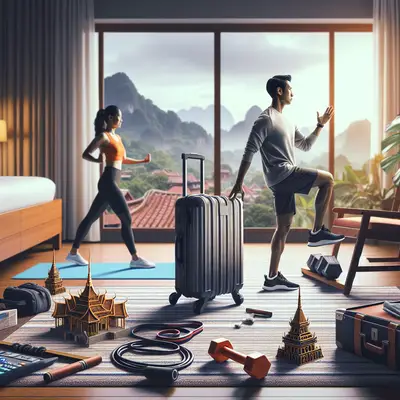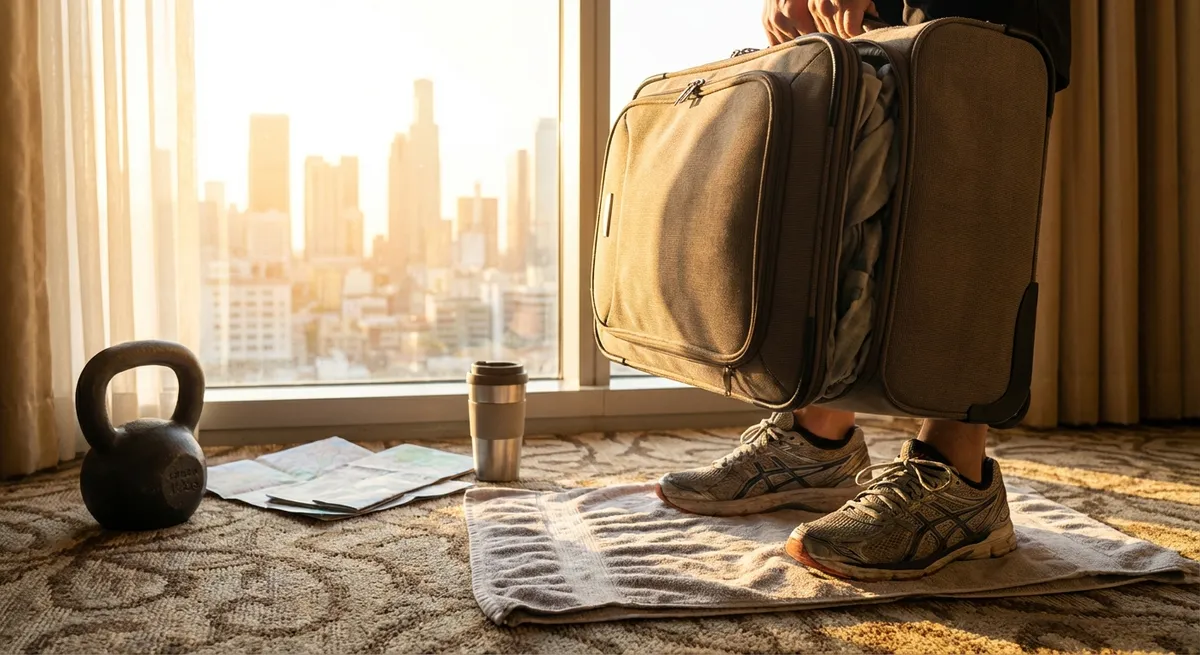
Hotel doors close, laptops flip open, and suddenly your “travel day” becomes a 12-hour sit-fest. But your passport lifestyle doesn’t have to wreck your strength or stamina. With a little strategy (and almost no gear), any hotel can feel more like a basecamp than a crash pad.
This isn’t about perfect workout programs or Instagram abs. It’s about staying capable: strong enough to sprint for a gate change, mobile enough to hike that volcano, and steady enough to handle long-haul flights without your back revolting.
Rewriting What “Hotel Workout” Really Means
Most travelers picture hotel fitness as a sad treadmill facing a blank wall and a couple of dusty dumbbells. That’s optional. Your real “gym” is a triangle: your body, your room, and whatever environment you’re in.
The win isn’t grinding through a 90-minute routine; it’s stacking small, consistent efforts that survive jet lag, time zone chaos, and client calls. Think micro-sessions: short bursts that keep your joints happy, your muscles online, and your energy up for exploring new cities. When you stop chasing the perfect workout and start collecting small wins, you stop breaking your routine every time you scan a boarding pass.
Instead of asking, “How do I stay as fit as home?” ask, “How do I stay ready for the next adventure?” That shift makes every hotel hallway, staircase, and desk a tool—not an obstacle.
Tip 1: Turn Check-In Into Your Warm-Up Ritual
Travel days are sneaky. You “just traveled,” but your activity level is closer to a houseplant’s. The first hour after you hit your room is prime time to reset your body.
As soon as you drop your bags, before you open your laptop or lie down “for five minutes,” run through a short arrival ritual:
- Spine reset: Cat-cow on the floor, then slow standing forward folds to undo the airplane chair posture.
- Hip wake-up: 10–15 slow lunges each side, focusing on stretching the hip of the back leg.
- Shoulder opener: Hands on the edge of the desk or bed, walk your feet back and sink your chest down, like a standing child’s pose.
- Ankle mobility: Heel raises off a stair or step (or just off the floor), 15–20 controlled reps.
This takes 5–8 minutes, needs zero gear, and tells your nervous system: “We’re off the plane. We move here.” Repeat the same ritual in every city, and your body starts associating hotel rooms with movement instead of collapse.
Tip 2: Build a “No-Excuse” Bodyweight Circuit
Hotel gym closed, or packed, or just sad? Perfect. Bodyweight training shines on the road because it’s portable, scalable, and quiet enough for thin walls.
Create a simple circuit you can drop into any schedule:
- Push movement: Push-ups (hands on floor, bed, or desk depending on strength)
- Pull / upper back: Backpack rows (use your loaded bag as a weight) or towel isometrics (pull a towel against a fixed point)
- Legs: Squats or split squats (rear foot on the bed if you want spice)
- Hips & core: Glute bridges and dead bugs or slow mountain climbers
- Conditioning finisher: Fast step-ups on a low step, high-knees in place, or hallway shuttle runs if the layout allows
Structure a quick session like this:
- 30–40 seconds of each exercise, 20–30 seconds rest
- Cycle through 3–5 rounds depending on your energy and schedule
- Total time: 15–25 minutes
This kind of training preserves strength, keeps your joints loaded, and pushes your heart rate up just enough to matter—all without depending on whatever random equipment the hotel happens to have.
Tip 3: Pack a Micro-Gym That Weighs Almost Nothing
You don’t need to lug kettlebells through customs. A few smart, ultra-light items can turn any hotel into a compact training zone:
- Mini resistance band loop: Great for glute work, shoulder warm-ups, and turning bodyweight moves into strength training.
- Long resistance band: Anchor it in a door (using a door anchor or wrapping around the hinge side) for rows, presses, pulls, and face-pulls.
- Jump rope (if ceiling height and neighbors allow): Fast, brutal conditioning in tiny spaces.
- Massage ball or lacrosse ball: Your secret weapon for long-haul flights and stiff hotel mattresses.
These live in a small pouch in your backpack and cover nearly every movement pattern: push, pull, hinge, squat, and carry (using your bag as the “weight”).
If you’re sharing space or dealing with paper-thin walls, focus on quiet tension: slow push-ups, isometric holds, banded pulls, and glute bridges instead of jumping, burpees, or loud plyometrics.
Tip 4: Treat the Hotel Itself Like an Adventure Course
If you think of the hotel as just a place to sleep, you’ll miss half your training options. Explore it like a curious scout:
- Stairwells: The ultimate nomad conditioning tool. Power walk or jog up, walk down. Add a backpack for extra load.
- Hallways: Perfect for walking lunges, side shuffles, or acceleration sprints if it’s quiet and safe.
- Outdoor spaces: Many hotels hide courtyards, rooftop terraces, or small gardens—amazing for fresh-air movement and mobility.
- Railings & benches: Great for incline push-ups, triceps dips, or supported step-ups.
You can pair “exploring the property” with a short workout: spend 5–10 minutes mapping the stairwells and outdoor nooks, then do a 10–15 minute session right there. It feels less like “working out” and more like recon before the rest of your day.
Tip 5: Lock In Recovery So You Don’t Crash-Train
On the road, most people don’t fail from lack of motivation; they fail from fatigue and chaos. Sleep, hydration, and simple eating habits are your real performance enhancers.
Practical, hotel-friendly moves:
- Hydration anchor: Every time you enter your room, drink a glass of water before doing anything else. Travel is dehydrating, and even mild dehydration dents performance and brain power.
- Snack insurance: Keep a small stash of protein-focused snacks (nuts, jerky, protein bars, Greek yogurt cups from the lobby store) so you’re not at the mercy of vending machines.
- Sleep hygiene on the go: Use the hotel blackout curtains, turn the room cooler, and kill screens 20–30 minutes before sleep. If noise is an issue, run the room fan or a white-noise app.
- Move before coffee: When possible, get 3–5 minutes of movement—mobility, squats, or a short walk—before your first coffee. It nudges your body into “active day” instead of “zombie mode.”
Recovery is what lets you stack days and weeks of travel without feeling like you’re constantly starting over. You’re not just exercising; you’re maintaining a body that can keep chasing flights, trails, and late-night city walks without falling apart.
Conclusion
Hotel life doesn’t have to mean losing your edge. When you build simple rituals, carry a tiny kit of tools, and treat each property like an obstacle course instead of a cage, your training becomes travel-proof.
You don’t need the perfect gym. You need a repeatable system: a quick arrival reset, a go-to circuit, a micro-gym in your bag, and a commitment to move a little—no matter what the airline, time zone, or hotel throws at you.
Your passport gets you into new countries. Your fitness keeps you exploring them on your own terms.
Sources
- [American College of Sports Medicine – Position Stand: Exercise and Physical Activity for Adults](https://www.acsm.org/education-resources/trending-topics-resources/acsm-guidelines) - Outlines evidence-based recommendations for aerobic and resistance training, including minimum effective doses
- [CDC – Physical Activity Guidelines for Americans](https://www.cdc.gov/physicalactivity/basics/adults/index.htm) - Summarizes weekly activity targets and benefits of regular movement for adults
- [Harvard T.H. Chan School of Public Health – Travel and Health](https://www.hsph.harvard.edu/nutritionsource/travel-and-health/) - Discusses practical strategies for staying healthy and active while traveling
- [Sleep Foundation – How Sleep Affects Physical Performance](https://www.sleepfoundation.org/physical-health/how-sleep-affects-performance) - Explains the relationship between sleep quality, recovery, and exercise capacity
- [Mayo Clinic – Strength Training: Get Stronger, Leaner, Healthier](https://www.mayoclinic.org/healthy-lifestyle/fitness/in-depth/strength-training/art-20046670) - Provides an overview of strength training benefits and principles that can be adapted to bodyweight and band-based hotel workouts
Key Takeaway
The most important thing to remember from this article is that this information can change how you think about Hotel Fitness.