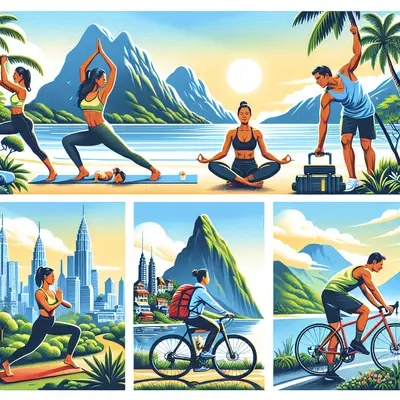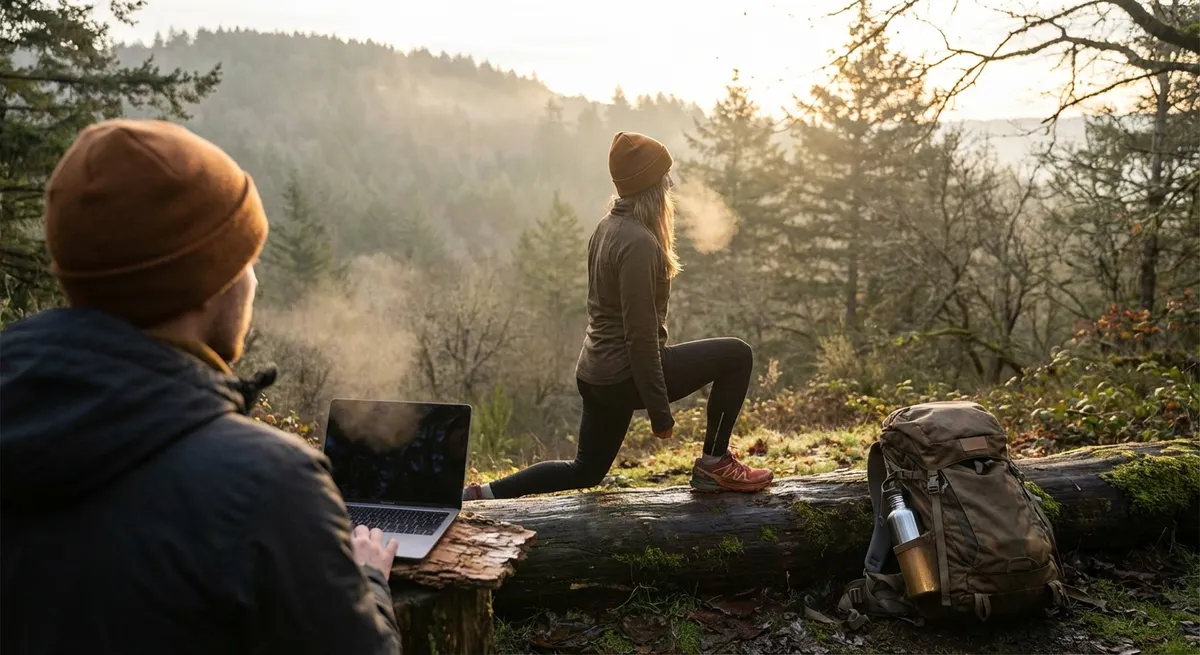
Your office might be a café in Lisbon today and a guesthouse in Chiang Mai next week, but your body comes with you to every timezone. Travel doesn’t have to be a detour from getting stronger—it can actually sharpen you. When flights, deadlines, and new cities collide, the key is simple: portable strategies that work anywhere, from a train platform to a hostel balcony.
This guide is built for digital nomads and adventure travelers who want to feel ready for sunrise hikes, last-minute surf sessions, and those random “10,000 steps by accident” sightseeing days—without needing a full gym or perfect schedule.
Building a “Nomad Baseline” Instead of Chasing Perfect Workouts
When you’re on the move, chasing perfect programs usually leads to zero training. Instead, aim for a baseline: a minimum standard you hit no matter where you wake up.
Your baseline is a short, repeatable routine you can do in a cramped hostel room, park, or airport hotel. Think 10–20 minutes, 3–6 exercises, and zero dependence on equipment. The goal is to keep joints moving well, muscles engaged, and your nervous system familiar with effort—even when travel days go sideways.
This approach shifts your mindset from “I missed my full workout” to “I never miss my baseline.” Over weeks and months, that consistency keeps strength, mobility, and energy high, so your body can handle surprise hikes, long travel days, and the occasional 12-hour laptop marathon. It’s less about crushing every session and more about never completely dropping the thread.
Tip 1: Use a 15-Minute “Anywhere Circuit” as Your Default
Your first weapon: a go-to short circuit you can run almost daily, even between calls or before a late dinner. No scheduling drama, no overthinking.
Here’s a simple framework you can scale up or down:
- 40 seconds of work, 20 seconds of rest
- Rotate through 5 moves
- Do 2–3 rounds depending on time and energy
Example Anywhere Circuit (no equipment):
Squat variation (air squats, slow tempo squats, or squat-to-chair if space is tight)
Push (incline push-ups on a bed/desk, regular push-ups, or knee push-ups)
Hip hinge / glutes (good mornings, single-leg Romanian deadlifts with bodyweight, or glute bridges)
Pull / posture (isometric “row” pulling against a towel looped around a solid object, or scap squeezes with arms straight in front)
Core / anti-rotation (plank variations, dead bugs, or side plank)
The idea isn’t to hit PRs; it’s to keep patterns alive: squatting, hinging, pushing, pulling, and bracing. If you’re wiped from a night bus or red-eye flight, run one gentle round. If you’re buzzing with energy in a new city, hit three faster rounds and turn it into a sweat session. Same structure, different intensity.
Tip 2: Pack One Lightweight Tool That Multiplies Your Options
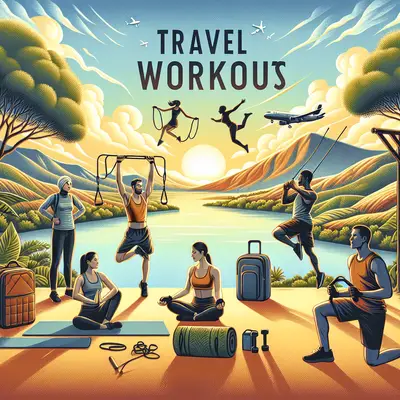
You don’t need a portable gym—just one smart piece of gear that weighs almost nothing but massively increases your options. Pick one of these and build your travel training around it:
- Long resistance band (loop or tube)
Great for rows, presses, deadlifts, face pulls, and even assisted pull-ups when you find a bar or sturdy tree. Packs flat in any backpack and turns hotel rooms into real training spaces.
- Suspension trainer (e.g., TRX-style)
Hooks onto doors, beams, or sturdy tree branches. Lets you row, squat, lunge, and work core at angles that challenge strength without needing heavy weights. Ideal if you’re often in Airbnbs or hotels with solid doors.
- Mini-bands
Excellent for glute activation, shoulder warm-ups, and adding resistance to squats, walks, and hip hinges. Tiny, cheap, and perfect when you truly have zero space.
Choose based on your style of travel: if you’re ultra-minimalist, a long band or one mini-band is usually enough. If you’re slower-traveling and can spare a bit more pack space, a suspension trainer turns any room or park into a legitimate training zone.
Tip 3: Let the Landscape Be Your Gym (Without Losing Training Intent)
New cities and wild landscapes are built-in training environments, but to get real benefit you need just a little structure. Instead of only counting steps, turn your surroundings into deliberate movement sessions.
Some practical ideas:
- Stair sessions: Find stadium steps, metro exits, or steep alleys. Walk one flight, jog one flight, repeat for 10–15 minutes. Add slow, controlled calf raises on the edge of a step for lower-leg strength.
- Park “stations”: Use benches for step-ups, incline or decline push-ups, and Bulgarian split squats. Combine with walking lunges between benches to build a simple strength circuit.
- Beach or soft trail power walks: Walking or light jogging on sand or uneven ground challenges stabilizing muscles and balance more than flat pavement—just start small to avoid overuse aches.
- Urban loaded carries: Grab your packed backpack or suitcase and walk 5–10 minutes at a brisk pace, keeping posture tall and shoulders back. This hits grip, core, and conditioning in one shot.
Treat these as intentional sessions, not just “incidental exercise.” Pick a time, set a duration, and go in with a focus: stairs for legs, park bench circuit for full-body strength, or a backpack carry loop for conditioning.
Tip 4: Anchor Your Day with Micro-Sessions, Not Marathon Workouts
Travel days are chaotic: delayed flights, surprise meetings, and Wi-Fi dramas. Long workouts are the first thing to get sacrificed. Instead of relying on 60-minute blocks, design your training around micro-sessions of 5–10 minutes.
Ways to plug micro-sessions into your day:
- Wake-up primer: 5 minutes of mobility (neck, shoulders, hips, ankles) and 2–3 bodyweight sets (like squats and push-ups) to flip on your nervous system.
- Screen break strength burst: Between deep work blocks, hit 5 minutes of band rows, push-ups, and planks to reset posture and wake up your brain.
- Pre-dinner finisher: A short EMOM (every-minute-on-the-minute) style bout—e.g., 5 squats + 5 push-ups at the top of each minute for 5–10 minutes.
These micro-sessions stack. Ten focused minutes, three times a day can rival or beat one long, half-distracted session. They also help combat the stiff, compressed feeling of long travel or laptop-heavy days by sprinkling movement throughout your timeline instead of cramming it in once.
Tip 5: Use Movement to Fight Jet Lag and Protect Sleep
Time zones punish your body when you’re sedentary, poorly hydrated, and over-caffeinated. Movement becomes less about “burning calories” and more about resetting your internal clock and keeping you functional.
Practical tactics around flights and time shifts:
- Day of travel:
- Walk the terminal between flights instead of sitting at the gate the whole time.
- Do ankle circles, calf raises, and easy hip stretches in the aisle or at the back of the plane when possible.
- Skip intense workouts right before overnight flights; opt for light movement to avoid feeling overly wired.
- First 24 hours in a new timezone:
- Get morning daylight exposure and walk outside—this helps adjust your circadian rhythm.
- Do a short, moderate session (like your Anywhere Circuit) at local morning or early afternoon, not late at night.
- Keep caffeine earlier in the day and use gentle stretching or breathing work in the evening to wind down.
Think of your workouts as anchors that tell your body: “This is when we’re awake and strong in this new place.” Combine them with light exposure, hydration, and consistent meal times to make jet lag shorter and less brutal.
Conclusion
Being on the road doesn’t mean hitting pause on your strength—it just demands a more adaptable playbook. A simple baseline routine, one smart piece of portable gear, and the willingness to treat stairs, parks, and sidewalks as your training ground can keep you trail-ready in any time zone.
You don’t need perfect conditions; you need repeatable patterns. Keep your Anywhere Circuit in your back pocket, pack that one piece of gear, stack micro-sessions into messy days, and let movement be the constant that keeps your travel life adventurous instead of exhausting. Every time you roll out of bed in a new city and move with intent, you’re not just sightseeing—you’re building a body that can actually keep up with the life you’re chasing.
Sources
- [American Council on Exercise: Staying Fit While Traveling](https://www.acefitness.org/resources/pros/expert-articles/6655/6-tips-to-stay-fit-while-traveling/) - Practical guidance on maintaining fitness with limited equipment and space
- [CDC: Physical Activity Basics](https://www.cdc.gov/physicalactivity/basics/index.htm) - Evidence-based recommendations for activity levels and why consistency matters
- [Harvard Health Publishing: Why Exercise Helps Jet Lag](https://www.health.harvard.edu/blog/why-exercise-helps-jet-lag-2018040513553) - Explains how movement and light exposure can help reset your internal clock when changing time zones
- [Mayo Clinic: Resistance Band Basics](https://www.mayoclinic.org/healthy-lifestyle/fitness/multimedia/resistance-bands/sls-20076934) - Overview of resistance band benefits and exercises suitable for small spaces
- [Sleep Foundation: Jet Lag and Sleep](https://www.sleepfoundation.org/jet-lag) - Details how jet lag affects your body and strategies to adjust faster while traveling
Key Takeaway
The most important thing to remember from this article is that this information can change how you think about Travel Workouts.