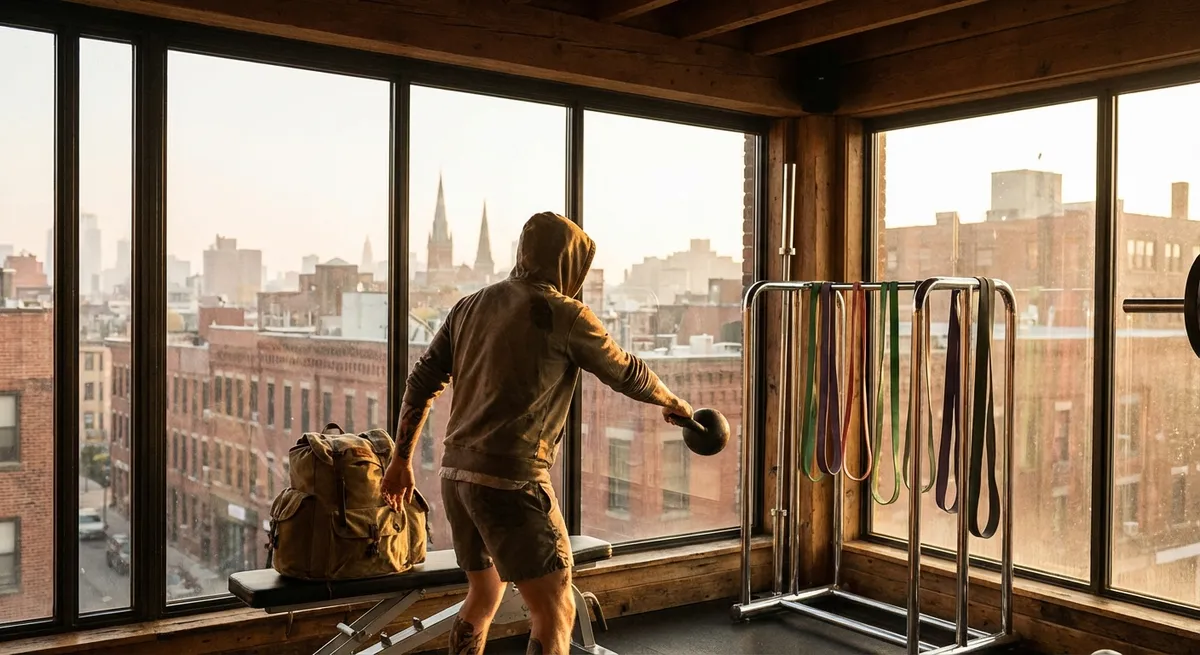
Hotel key card in one hand, laptop in the other, and your training goals somewhere in between? This is where most travelers lose their edge—somewhere between the lobby bar and “I’ll start again when I get home.” But your hotel can be more than a place to crash; it can be your temporary stronghold. With the right tactics, you can build strength, maintain conditioning, and stay mentally sharp without sacrificing the adventure that brought you on the road in the first place.
This guide turns any hotel stay—from budget layovers to five-star retreats—into a practical, portable training base, with five field-tested fitness tips built for travelers and digital nomads who refuse to go soft.
Scouting the Terrain: Turn Your Hotel into a Training Base
Before you unpack, recon your environment like an athlete on a mission. Most travelers glance at the mini bar; you’re here to locate power outlets, open floor space, and anything that can become improvised equipment.
Walk the room and look for:
- A clear 6x6 foot area for bodyweight work (often beside or at the foot of the bed)
- A stable chair or bench (for split squats, dips, step-ups)
- A solid door that can handle a resistance band anchor (hinge side is usually safest)
- Stairwells for conditioning bursts and loaded carries (with your backpack)
- Any railings or ledges that can safely support incline push-ups or elevated planks
If there’s a hotel gym, don’t just check if it “exists”—check what it offers. Dumbbells, cables, rowing machines, or a single cable tower can change your entire plan. Treat each hotel like a new level in a game: different layout, same mission—leave fitter than you arrived or, at minimum, not detrained.
Tip 1: Build a “Go-Bag” Workout Kit That Lives in Your Luggage
The easiest workout is the one you’re already equipped for. A small, dedicated corner of your suitcase can become your permanent mobile arsenal, giving you consistency in wildly inconsistent environments.
Practical, space-efficient items to pack:
- Light and medium resistance bands: For rows, presses, pull-aparts, and hip work
- Mini-loop band: Great for glute activation, lateral steps, and hip stability drills
- Lightweight jump rope: Perfect for quick conditioning in parking lots, quiet corners, or even rooftop terraces
- Door anchor (for bands): Turns almost any room into a makeshift cable station
- Packable suspension trainer (optional): If you travel often, this is a game-changer for rows, push-ups, and single-leg work
With this kit, you can run full-body sessions even if the “fitness center” is just a broken treadmill and a dusty yoga mat. Keep your go-bag packed between trips so there’s zero friction when you hit the road again.
Tip 2: Train on Travel Time, Not Local Time
Time zones and late check-ins wreck most people’s routines. Instead of waiting to “feel normal,” lock in training triggers tied to events, not the clock.
A few field-tested rules:
- After check-in = movement reset: Once you drop your bags, do a 10–15 minute session—mobility, light circuits, or bands. This fights travel stiffness and sets an immediate fitness tone for the trip.
- Before first work block = power-up: Nomads working remotely can stack a micro-workout before opening the laptop: 10 minutes of squats, push-ups, and band rows.
- On long stays, rotate intensities: Heavy day (or hardest session) within 24 hours of arrival, moderate day mid-stay, lighter recovery day before checkout. This structures your week even if days blur together.
You’re not chasing a perfect training schedule; you’re building a flexible rhythm that survives red-eyes, delays, and last-minute client calls.
Tip 3: Build a Full-Body Routine That Fits in a Carry-On
You don’t need a full rack to train like you mean it. Create a default full-body session you can run in any hotel room, then adjust based on gear and energy.
Sample “anywhere” full-body circuit (no equipment needed):
- Squat or split squat – Lower body strength
- Push-up variation (full, incline, or hands on bed) – Chest & triceps
- Hip hinge (good mornings or single-leg hip hinge) – Hamstrings & glutes
- Glute bridge or hip thrust off the bed – Posterior chain
- Plank or dead bug – Core stability
Perform 3–5 rounds of 8–15 reps (or 20–30 seconds per exercise), resting briefly between movements. If you have bands or a suspension trainer, swap in:
- Band rows or suspension rows
- Band presses or overhead presses
- Banded good mornings or Romanian deadlifts
This becomes your baseline: short, efficient, and adaptable. On high-energy days, push volume or pace. On low-energy days, strip it down to two or three movements and focus on quality.
Tip 4: Use Micro-Sessions to Outsmart Jet Lag and Long Workdays
Hotel days can evaporate: client calls, deadlines, late dinners, and suddenly the gym is closed. Instead of banking on one “big workout,” break your training into small missions through the day.
Practical ways to use micro-sessions:
- 5-minute mobility every morning: Ankles, hips, thoracic spine, and shoulders. This offsets sitting in planes, cars, and cafés.
- Movement snacks between calls: 10 squats, 10 push-ups, 10 band pull-aparts, repeat for 3–5 minutes. It adds up across a workday.
- “Room-to-lobby rule”: Every time you leave your room for coffee or a meeting, do 30 seconds of something (wall sits, calf raises, or band pull-aparts).
These brief bursts boost alertness and blood flow, which can help combat jet lag and screen fatigue. Over days and weeks, they also preserve your capacity for more structured sessions.
Tip 5: Guard Sleep and Hydration Like Performance Gear
The best hotel workout means nothing if sleep and hydration collapse. Travel stress, dry cabin air, late-night work, and unfamiliar beds can all blunt your performance and recovery.
Practical, travel-proof tactics:
- Hydrate as a habit, not a reaction: Get water in as soon as you arrive at the hotel and keep a bottle visible on the desk. Aim to drink regularly instead of chugging occasionally.
- Light exposure: Get morning daylight—by a window or outside—to help regulate your body clock. This supports better sleep and more consistent workout energy.
- Pre-sleep wind-down: 10–15 minutes of light stretching or breathwork in your room beats scrolling news in bed. Keep the room cool and dark where possible.
- Protein first: When food options are chaotic, prioritize a protein source at each meal (eggs, Greek yogurt, grilled meat/fish, beans) to support muscle maintenance.
You’re not living in a lab—you’re traveling, exploring, and working—but basic recovery habits keep your body ready for both adventure and training.
Conclusion
You don’t need a home base to train like an athlete—you just need a plan that travels as well as you do. Every hotel becomes a temporary stronghold: a place to regroup, refuel, and rebuild strength before you move on to the next city, client, or summit.
With a small go-bag of gear, a flexible full-body routine, micro-sessions woven into your day, and a recovery strategy that survives jet lag, you can stay ready for whatever the road throws at you—delayed flights, surprise hikes, or a last-minute invite to something epic.
The room may change. The view may change. Your standards don’t have to.
Sources
- [American College of Sports Medicine – Staying Active While Traveling](https://www.acsm.org/docs/default-source/files-for-resource-library/staying-active-while-traveling.pdf) - Practical guidance from ACSM on maintaining physical activity away from home
- [CDC – Tips for Better Sleep](https://www.cdc.gov/sleep/about_sleep/sleep_hygiene.html) - Evidence-based strategies for improving sleep quality, crucial for recovery on the road
- [Harvard T.H. Chan School of Public Health – Healthy Beverage Guidelines](https://www.hsph.harvard.edu/nutritionsource/healthy-drinks/) - Research-backed advice on hydration and beverage choices
- [National Institutes of Health – Jet Lag and Circadian Rhythms](https://www.ncbi.nlm.nih.gov/books/NBK542176/) - Scientific background on time zone changes and how they affect sleep and performance
- [Mayo Clinic – Resistance Band Basics](https://www.mayoclinic.org/healthy-lifestyle/fitness/in-depth/resistance-bands/art-20045626) - Overview of resistance band use and benefits, ideal for portable travel workouts
Key Takeaway
The most important thing to remember from this article is that this information can change how you think about Hotel Fitness.