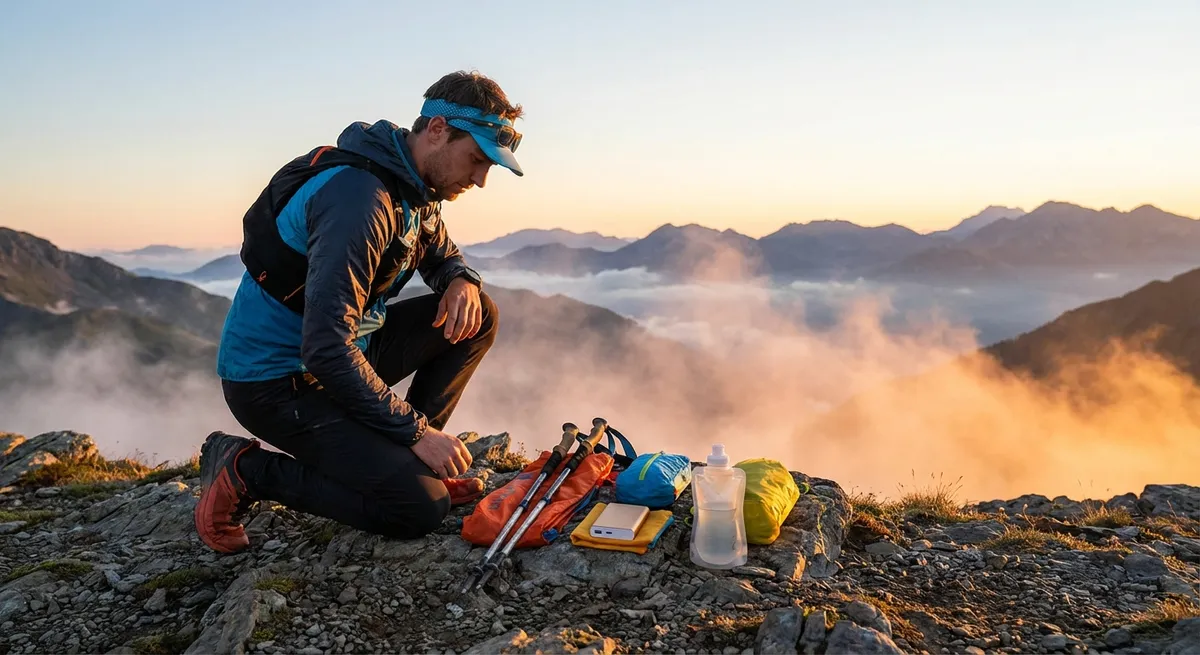
You don’t need a rolling suitcase full of gym gear to stay dangerous on the road. With a smart, ultra-portable kit and a few dialed-in tactics, you can turn train platforms, Airbnb floors, and jungle hostels into real training grounds. This isn’t about “doing something instead of nothing”—it’s about carrying just enough hardware to keep your strength, mobility, and engine sharp while you chase the next stamp in your passport.
Building a Travel-Ready Micro Kit
Think of your portable equipment as a modular weapons cache: small pieces you can combine in different ways depending on space, time, and energy. The goal is density—maximum training value per cubic inch in your bag.
A solid base kit for most travelers and digital nomads looks like this:
- Light-to-medium resistance band loop (for hips, shoulders, and warm-ups)
- Long resistance tube with handles (for rows, presses, and pull-aparts)
- Compact suspension trainer or door-anchor strap (for full-body pulling and core work)
- Jump rope (for conditioning in tight spaces)
- Mini massage ball or lacrosse ball (for recovery and mobility)
All of this can fit in a small pouch and live in your carry-on. Pick durable brands with reinforced stitching and sturdy carabiners—airport security, bus luggage holds, and over-stuffed backpacks will test your gear. Treat the kit like your passport: if you’d be upset to lose it, don’t bury it in checked luggage.
Deploying Your Gear in Any Environment
Portable equipment shines when you know how to adapt it to the terrain. Before you unpack, scan your environment for anchor points and open floor space. Sturdy door? You’ve got a suspension rig. Balcony railing? That’s your band anchor. Park bench? Instant workout station.
In tight hotel rooms, door anchors and bands handle most pushes, pulls, and hinges without hogging space. In hostels or co-working spaces, look for quiet corners or rooftops where a 20-minute blast won’t disturb anyone. Outside, fences, trees, and playgrounds become your pull-up rigs and attachment points. Always check anything you anchor to—if it wobbles under bodyweight or band tension, find something else. Your goal isn’t just “make it work”; it’s “make it repeatable” so you can train reliably every leg of the trip.
Five Field-Proven Fitness Tips for Travelers
These tips keep you strong, mobile, and sane on the road—without needing a full gym.
1. Anchor Your Day with a 12–15 Minute “Non-Negotiable”
Instead of hunting for the perfect workout window, set a short, daily ritual you can do almost anywhere with your kit. For example:
- 3 rounds, minimal rest:
- 15 band squats
- 10 suspension rows or band rows
- 10 push-ups (band-assisted or band-resisted if you’re strong)
- 20 seconds hollow body hold or dead bug
This is your “mission floor”—even on long travel days, hit this quick protocol before breakfast or before bed. You can always add more on good days, but this ritual keeps your baseline fitness from drifting.
2. Use Bands to Load Movements You’re Already Doing
Travel is full of natural movement: stairs, walking, standing in lines. Use your bands to turn those into real training without needing extra time. Wrap a light band around your shoulders for resisted step-ups on hotel stairs. Anchor a band low in your room and perform split squats while you wait for laundry. Use a loop band around your ankles for lateral walks during long conference calls.
By layering resistance onto movements that are already happening, you stack strength work on top of your existing itinerary instead of fighting your schedule.
3. Alternate “Heavy” Body Days with “Engine” Rope Days
Structure your week with clear intent so you don’t just do random circuits. On strength-focused days, lean on suspension trainers and bands for rows, presses, hinges, and single-leg work. On conditioning days, grab your jump rope and chase short, sharp intervals: for example, 30 seconds hard, 30–60 seconds easy, repeated 10–15 times.
If jump-rope space is limited, use “silent” intervals instead: fast mountain climbers, high-knee marches with a band, or shadowboxing. A simple alternating pattern—Strength / Engine / Off or Mobility—keeps your training honest without requiring exact equipment or perfect conditions.
4. Treat Mobility and Recovery as Travel Insurance
Hours in planes and buses are basically low-grade assaults on your hips and spine. Use your portable tools for short, targeted mobility blocks that protect your ability to train. A mini ball or lacrosse ball can unlock stiff glutes, hip flexors, and upper back in just 5–10 minutes.
Aim for a small ritual each evening:
- 1–2 minutes per side on glutes and hip flexors with the ball
- 1–2 minutes of banded shoulder dislocates or pull-aparts
- 1–2 minutes of hip openers (deep squat sits, lunges, or pigeon variations)
These sessions aren’t glamorous, but they keep your joints working so that when you do have time and energy for a hard session, your body actually cooperates.
5. Use “Location Rules” to Stay Consistent Across Time Zones
When your time zones keep changing, time-based habits fall apart. Instead of “I work out at 7 a.m.,” use location-based rules tied to your gear. For example:
- “Every time I check into a new room, I do 2 sets of rows, push-ups, and squats.”
- “Every workday before opening my laptop, I do 5 minutes of rope or band work.”
- “Every airport layover longer than 90 minutes, I walk loops and do 3 mobility drills.”
These rules are simple, survive jet lag, and let your portable equipment act as a trigger. The moment you see your band or rope, your brain knows what’s next.
Sample Portable-Equipment Session for the Road
Use this as a template and adjust reps/tension to your level and available space.
Warm-Up (3–5 minutes)
- 30–60 seconds jump rope or high-knee marching
- 10 band pull-aparts
- 10 bodyweight squats
- 10 arm circles each direction
- 8–12 suspension rows or heavy band rows
- 8–12 band-resisted squats or split squats (each leg)
- 8–12 push-ups (add band resistance if needed)
- 20–30 seconds plank with band row (anchor band low, alternate arms)
Strength Circuit (3–5 rounds)
Rest 30–45 seconds between exercises and 60–90 seconds between rounds. This setup hits major movement patterns—push, pull, squat, core—using nothing bigger than a coiled strap and a loop of rubber.
Finisher (4–6 minutes)
- 20 seconds fast jump rope
- 40 seconds walk or easy bouncing
Repeat 4–6 times. No rope? Sub in fast step-ups on a stair or bench.
Conclusion
Your passport takes you across borders; your portable kit carries your strength between them. With a handful of compact tools and a few field-tested rules, you can stay capable, conditioned, and ready for whatever the next city, trail, or terminal throws at you. Don’t wait for the perfect gym or the ideal schedule—pack light, move daily, and let your training travel as far as you do.
Sources
- [American Council on Exercise – Resistance Band Workouts](https://www.acefitness.org/resources/everyone/blog/7447/what-are-the-benefits-of-resistance-bands/) - Overview of resistance band benefits and sample applications for strength and mobility
- [Harvard T.H. Chan School of Public Health – Physical Activity Guidelines](https://www.hsph.harvard.edu/nutritionsource/staying-active/) - Evidence-based recommendations for weekly activity and practical strategies
- [Mayo Clinic – Exercise and Chronic Disease Prevention](https://www.mayoclinic.org/healthy-lifestyle/fitness/in-depth/exercise/art-20048389) - Research-backed explanation of how consistent exercise protects long-term health
- [Cleveland Clinic – Foam Rolling and Self-Myofascial Release](https://health.clevelandclinic.org/what-is-foam-rolling) - Details on how tools like balls and rollers support recovery and mobility
- [Centers for Disease Control and Prevention – Travel Health and Jet Lag](https://wwwnc.cdc.gov/travel/page/travel-by-air-health) - Official guidance on staying healthy while flying, including movement considerations
Key Takeaway
The most important thing to remember from this article is that this information can change how you think about Portable Equipment.