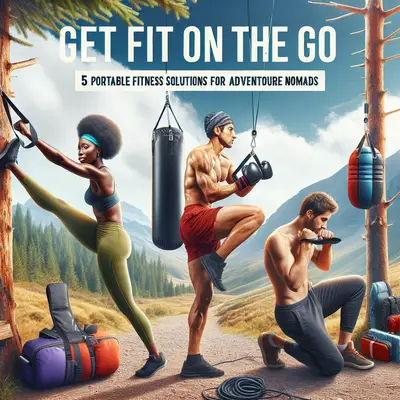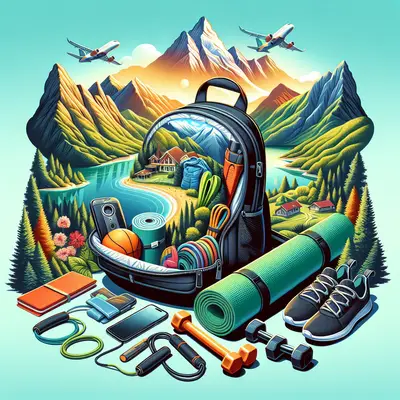
If your backpack is your closet, office, and gear closet all in one, every gram has to earn its place. The good news: you don’t need a trunk full of equipment to stay strong and adventure-ready on the road. With a few smart pieces of portable gear and a dialed-in strategy, you can turn hostels, Airbnbs, and layovers into your own roaming training ground.
This guide breaks down practical, packable equipment plus five field-tested fitness tips built for travelers and digital nomads who refuse to choose between movement and mileage.
Build a “Micro-Gym” That Fits in Your Daypack
Think of your training kit like ultralight camping gear: compact, multi-use, and tough enough to survive missed connections and dusty bus rides.
Prioritize gear that can train your whole body, anchors easily in unfamiliar spaces, and weighs less than a pair of shoes. A minimalist setup might include resistance bands (loop and tube), a light suspension trainer, a compact jump rope, and a travel massage ball. Together, they cover strength, mobility, and conditioning without hogging luggage space.
Look for high-tension bands that don’t snap under real use; braided or “anti-snap” options are worth the grams. A suspension trainer that hangs from doors, beams, or sturdy branches can turn any room or shaded park into a strength station. A speed rope coils into a tiny pocket while delivering serious conditioning when time or space is tight.
Build your micro-gym once, and you’ll never again blame your training on a “bad hotel fitness center” or another long-haul bus ride.
Essential Portable Gear That Punches Above Its Weight
Not all travel-friendly gear is created equal. Focus on equipment that multiplies your options, not your baggage.
A set of mini loop bands can handle glute warm-ups, shoulder activation, and higher-rep strength work when you don’t have weights. Heavier long resistance bands mimic cable machines for rows, presses, pull-aparts, and assisted pull-ups if you find a bar or sturdy tree branch. A door-anchor-equipped band gives you dozens of angles for push, pull, and rotation work in cramped rooms.
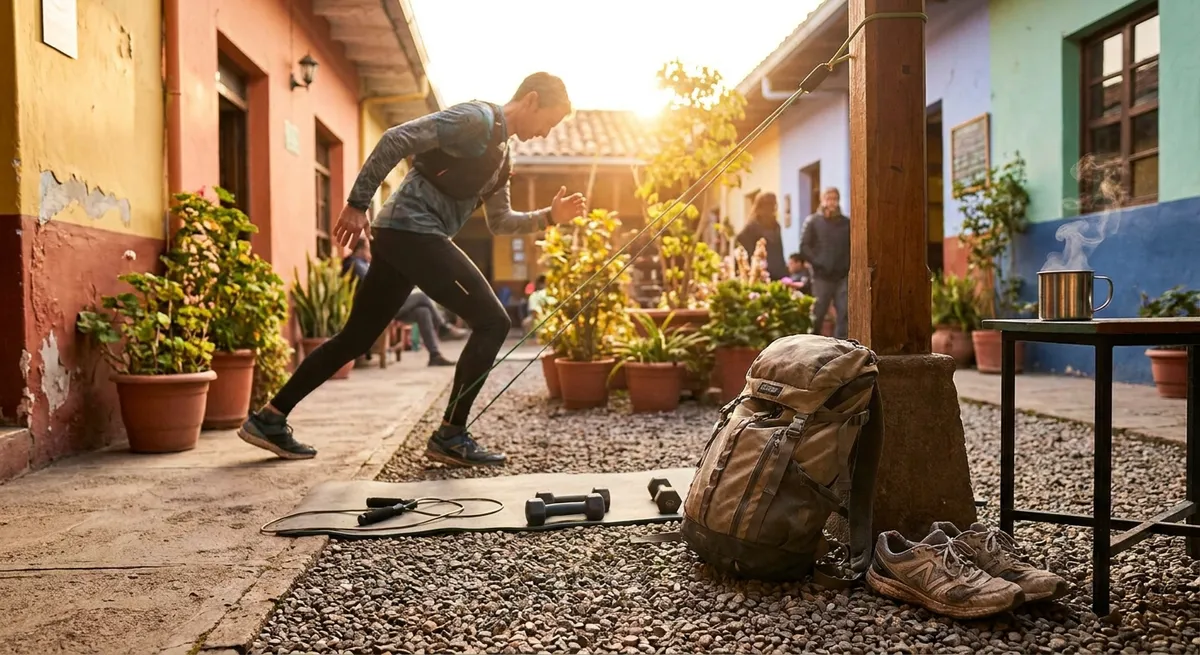
A lightweight suspension trainer unlocks full-body movements—rows, push-ups, single-leg squats, core work—while letting you adjust difficulty just by changing your foot position. Add a compact jump rope and you’ve got a mobile conditioning tool that works in courtyards, quiet streets, and even hotel hallways when you’re desperate.
Round out your kit with one or two recovery tools—a lacrosse ball or small massage ball and a short fabric strap—or even a long band doubled as a stretching aid. Recovery gear might not feel “essential” while packing, but it can be the difference between waking up creaky and waking up ready for the next day’s hike, surf session, or city sprint.
Fitness Tip 1: Anchor Your Day with a 15-Minute “Arrival Circuit”
Travel scrambles your schedule, but one reliable anchor can keep your body (and brain) from sliding into perpetual jet lag mode: an “arrival circuit” you run whenever you land someplace new.
Once you drop your bag, set a 15-minute timer and cycle through a short full-body routine using your portable gear. For example: band-resisted squats, suspension rows (or band rows), push-ups, banded good mornings or hip hinges, core work (planks or dead bugs), and a quick mobility flow.
The point isn’t to chase fatigue; it’s to reboot your circulation, wake up stiff joints, and teach your body, “We move here.” This ritual helps reset your internal clock after flights, burns off the static from long sits, and mentally marks your new base as a place where training happens, not just sleeping and emailing.
Treat this like brushing your teeth: non-negotiable, short, and automatic—especially on the first day in a new city.
Fitness Tip 2: Use “Frictionless” Workouts When Your Brain Is Fried
Long travel days, client calls across time zones, and navigating new places burn mental energy. On those days, complex workouts are a recipe for skipping movement altogether.
Enter the “frictionless” workout: a simple, repeatable session that uses only the gear you can reach in three seconds and a structure you don’t have to think about. For instance, choose just three moves with your most versatile tool: band Romanian deadlifts, band rows, and band presses; or suspension squats, rows, and fall-out planks.
Set your timer for 10–20 minutes and cycle reps at a steady pace. No apps, no deep planning—just move. If energy is low, you go lighter or slower; if you feel good, you push the pace or add resistance. The key is lowering the mental barrier so “some training” happens instead of “no training” because you’re waiting for the perfect window.
Pack your frictionless plan before you leave home, write it in a note on your phone, and use it anytime jet lag, unfamiliar surroundings, or decision fatigue show up.
Fitness Tip 3: Turn Transit Time into Micro-Strength Sessions
You might not break out bands in a crowded aisle, but travel days still offer hidden pockets of strength work—if you’re willing to look a little odd in the name of strong legs and a happy back.
In airports or train stations, perform slow calf raises while standing in line, single-leg balances while waiting at gates, and isometric glute squeezes or core brace holds while seated. During layovers, walk the terminals carrying your pack “farmer’s carry” style to build grip and postural strength. On trains or ferries with more space, sneak in wall sits, light band pull-aparts, and shoulder rotations.
These aren’t full workouts; they’re “micro-doses” that stop your body from fully slipping into travel stiffness. Over weeks and months, these small interruptions to long sitting add up—your hips, low back, and neck will complain less, and your bigger workouts will feel better.
Think of transit days as “maintenance mode” rather than “lost days.”
Fitness Tip 4: Match Your Gear to the Terrain You’re Exploring
Your portable gear isn’t just backup for when you can’t find a gym; it’s a way to plug strength work directly into the landscapes you’re traveling through.
Beach town with an empty shoreline at sunrise? Combine jump rope intervals on packed sand with band-resisted sprints, crab walks, and band rows looped around a lifeguard stand (where permitted). Forest campsite or rural guesthouse with sturdy trees? Hang your suspension trainer for rows, single-leg squats, and suspended push-ups, then use bands for face pulls and pull-aparts.
Urban stopover with only concrete and railings? Anchor bands around benches or railings for rows and presses, use stairs for step-ups and calf work, and add a suspension trainer to lamp posts or goal posts at parks (always check stability and local rules).
Matching your gear to the terrain turns training from a chore into exploration—it’s another way to map each place with your body, not just your camera.
Fitness Tip 5: Protect Your Joints with a “Mobile Warm-Up Kit”
Constantly changing beds, chairs, and luggage loads can make your joints feel older than they are. A few minutes of targeted prep with portable tools before big days of walking, hiking, or laptop time can keep you moving smoothly.
Use a short loop band around your legs for hip activation: lateral walks, monster walks, and glute bridges on the floor. This wakes up the muscles that keep your knees tracking well when you’re climbing unfamiliar staircases or cobblestone hills. Add light band pull-aparts and external rotations to prime your shoulders before long laptop sessions on questionable hostel chairs.
A small massage ball earns its keep by releasing hotspots in your feet, glutes, upper back, and hip flexors after heavy sightseeing days or cramped buses. Spend 5–10 minutes most evenings hunting for tight areas and gently rolling—think of it as nightly maintenance on the “vehicle” that carries you from country to country.
Over time, this “mobile warm-up kit” helps you recover faster between adventures and reduces the odds that a cranky knee or stiff neck derails your plans.
Conclusion
Travel doesn’t have to be a detour from getting stronger. With a micro-gym that fits in your daypack and a handful of adaptable routines, you can keep your body adventure-ready while your passport fills with stamps.
Pack tools that earn their space, build simple rituals that survive chaotic schedules, and let the landscapes you pass through become part of your training ground. The world is already your playground—your portable gear just makes it official.
Sources
- [American Council on Exercise (ACE) – Resistance Bands 101](https://www.acefitness.org/resources/everyone/blog/7441/how-to-use-resistance-bands/) - Overview of resistance band benefits, safety tips, and example exercises
- [Harvard Health Publishing – Benefits of Strength Training](https://www.health.harvard.edu/staying-healthy/strength-training-builds-more-than-muscles) - Explains why maintaining strength matters for health, mobility, and aging
- [Mayo Clinic – The Importance of Stretching and Flexibility](https://www.mayoclinic.org/healthy-lifestyle/fitness/in-depth/stretching/art-20047931) - Covers why regular mobility work can help prevent injury and improve performance
- [Cleveland Clinic – Foam Rolling and Self-Myofascial Release](https://health.clevelandclinic.org/foam-roller-benefits/) - Discusses how simple tools like massage balls and rollers assist recovery and reduce muscle tightness
- [Centers for Disease Control and Prevention – Physical Activity Guidelines](https://www.cdc.gov/physicalactivity/basics/adults/index.htm) - Provides baseline recommendations for weekly activity that travelers can adapt on the road
Key Takeaway
The most important thing to remember from this article is that this information can change how you think about Portable Equipment.