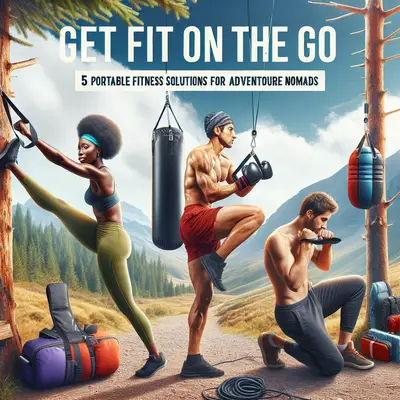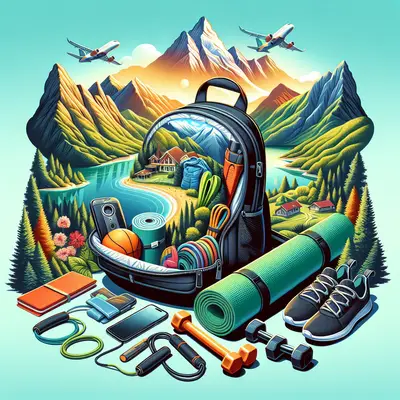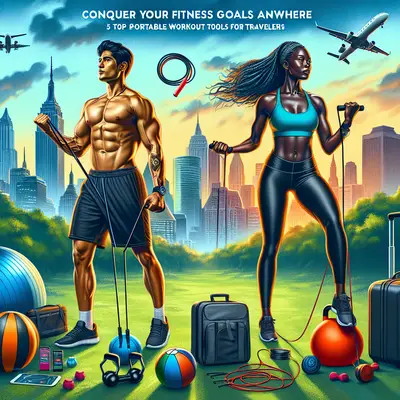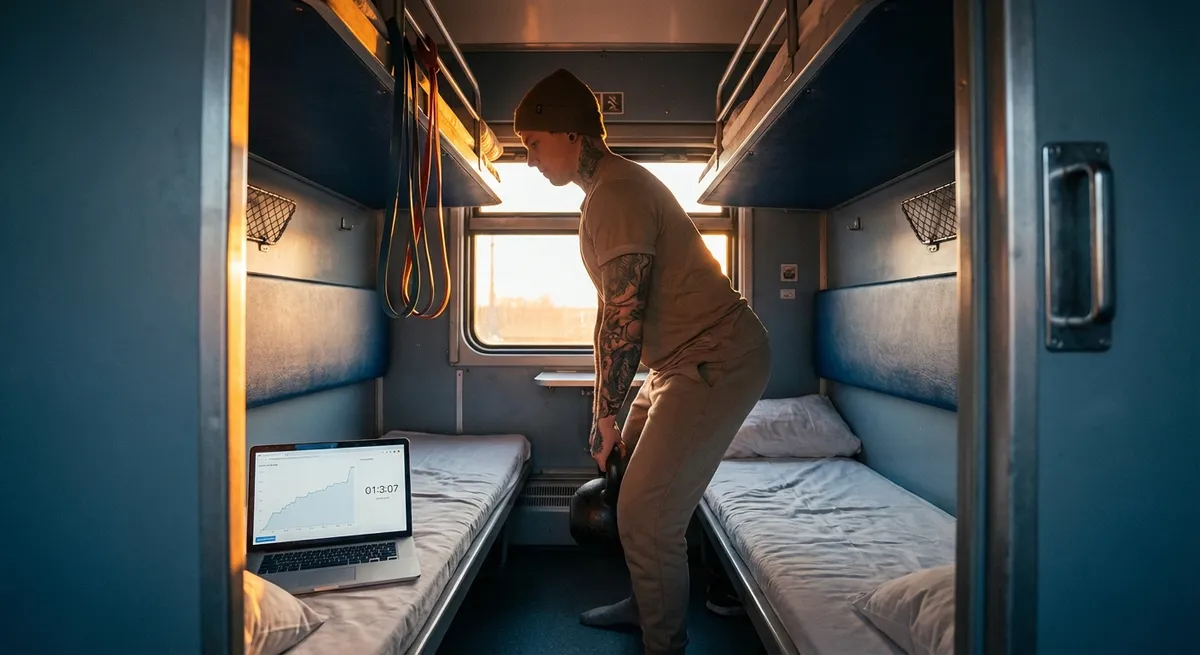
Your passport gets more stamps, your body gets less structure—that’s the trade-off most travelers quietly accept. But it doesn’t have to be that way. With the right portable gear and a few smart tactics, you can keep your strength, stamina, and mobility dialed in from Airbnbs, sleeper trains, and mountain huts across the map.
This isn’t about turning your backpack into a gym. It’s about carrying a tiny toolkit that multiplies what your body can already do—so you stay durable enough for sunrise hikes, city sprints, and long-haul laptop hours.
Building a Micro Gym That Fits in Your Backpack
Think of your gear in categories: resistance, recovery, and stability. Your mission is to cover all three with as little bulk as possible.
For resistance, a pair of light-to-medium resistance bands and one long loop band can replace dumbbells for pulls, presses, squats, and hip work. They weigh almost nothing, coil flat, and can anchor to doors, railings, or your own body. A light suspension trainer or gymnastic rings (if you’re okay with slightly more weight) expand your vertical pulling and core options dramatically when you find a sturdy tree branch or playground.
Recovery is where a mini massage ball or lacrosse ball earns its keep. It takes up less room than a pair of socks but can rescue stiff hips, cramped feet, and laptop neck in minutes. If you’ve got a bit more space, a compact travel foam roller or collapsible roller can double down on mobility.
For stability, a simple hip band (short loop band) is a powerhouse. It forces your glutes and deep hip muscles to work harder in squats, hinges, and side steps, which protects knees and lower back when you’re lugging bags through uneven streets or hiking unfamiliar terrain. One packing cube of gear is all it takes to turn any room into a capable training ground.
Five Trail-Tested Fitness Tips for Travelers and Digital Nomads
1. Anchor your day with a 10–15 minute “movement minimum.”
Instead of chasing perfect workouts, commit to a non-negotiable daily block. Use bands for a simple circuit: 10 squats, 10 band rows, 10 push-ups, 10 hip hinges, 30 seconds of planks. Cycle it for time, not reps, and you’re done before your coffee cools. This practice keeps your joints familiar with full ranges of motion and stops “one missed workout” from becoming “two wasted weeks.”
2. Train for the way you actually travel.
If your trips involve backpacks and stairs, prioritize posterior chain work: banded deadlifts, hip thrusts, and single-leg Romanian deadlifts using a backpack as a weight. If you’re mostly city-walking, build calf strength, ankle mobility, and basic conditioning with loaded backpack marches in place, step-ups on curbs or stairs, and banded ankle drills. Match your training to your likely stressors so you’re not wrecked by one long transfer day.
3. Use gear that multiplies bodyweight, not replaces it.
Bodyweight alone can take you far—push-ups, lunges, split squats, glute bridges, and hollow holds require nothing. Your portable equipment’s job is to add angles you can’t hit easily: horizontal pulling (band rows), anti-rotation (Pallof presses with a band), and vertical pulling (suspension rows). This mindset keeps your pack light: one or two tools that open an entire movement category.
4. Cycle “hard” and “easy” days around your travel schedule.
On long travel days, keep it mobility-focused: 5–8 minutes of hip openers, thoracic rotations, band pull-aparts, and calf stretching at the gate, in the lounge, or in your room. On stationary days (no major transport), go heavier: resistance circuits, unilateral work, and short, intense intervals like band-resisted squats plus fast step-ups. This rhythm respects jet lag, odd checkout times, and unpredictable days while still driving real adaptation.
5. Protect your “working body parts” first.
Digital nomads live in a weird hybrid of athlete and office worker. Your wrists, neck, and hips take the brunt of laptop hours; your lower back and feet take the brunt of travel. Prioritize 3–5 minutes daily of wrist circles, forearm stretches, band pull-aparts, neck isometrics, and hip CARs (controlled articular rotations). Use your massage ball under your feet, between your shoulder blades, and around your hips while you answer emails. A body that feels good is far more likely to chase spontaneous adventures.
Portable Gear Combos for Different Kinds of Travelers
Not every trip is the same, and your gear shouldn’t be either. Build a “modular” approach so you can scale up or down depending on space, terrain, and how much you care about training on that particular journey.
For ultra-light missions (carry-on only, lots of movement), go with a single long resistance band and a hip band. This combo lets you hit most major patterns: band rows, presses, squats, good mornings, hip thrusts, lateral walks, and glute bridges. Paired with bodyweight push-ups, lunges, and planks, you’ve covered the essentials with almost no weight penalty.
For medium-load trips where you’ll stay put for a bit (co-working month, house-sit, or beach apartment), add a suspension trainer and massage ball. The suspension trainer unlocks horizontal rows, face pulls, challenging push-up variations, and brutal core drills like body saws and fallouts. The massage ball becomes your built-in recovery therapist after surf sessions, hikes, or long desk stints.
For adventure-heavy routes (trekking, climbing, or multi-day excursions), think of your gear as “performance insurance.” A hip band for glute activation, a long band for quick strength work on down days, and a compact roller to manage tissue after long descents can save you from knee pain or cranky Achilles tendons mid-expedition. Your training plan here is minimal but targeted—just enough to keep the engine running and the chassis stable.
Turning Any Space Into a Training Zone
Instead of hunting for perfect conditions, learn to “read” your environment for movement options. Hotel bed frames become anchors for long bands; balcony railings become row stations; doorways become isometric holds and support points. Park benches become step-up platforms and hip thrust stations. Stairwells become conditioning hills when real hills aren’t available.
Travel also gives you built-in “odd objects”—water jugs, backpacks loaded with clothes, or even your suitcase. Hug the bag for goblet squats, front-loaded split squats, or loaded carries down a hallway. Pair those with band work and you’ve built a respectable strength session using what you already packed.
Noise and space don’t have to be deal-breakers. Quiet, low-impact circuits—iso-holds, slow eccentrics, band presses, and core work—can all be done in tight rooms with thin walls. On days where you feel cooked from transit, drop intensity and work on technical practice: controlled push-ups, deep squats, balance work, and breath-focused mobility. The win is consistency, not heroics.
Conclusion
You don’t need a trunk full of iron to stay strong on the move—just a deliberate handful of tools and a willingness to train wherever you land. Portable equipment is less about gear obsession and more about freedom: the freedom to say yes to last-minute hikes, street-food detours, and all-day walking tours without wondering if your body can keep up.
Pack smart, move daily, and let your kit earn its space in your bag by keeping you adventure-ready in any timezone, on any floor, in any city.
Sources
- [American Council on Exercise (ACE) – Resistance Band Training 101](https://www.acefitness.org/resources/everyone/blog/7604/resistance-bands-101-pros-cons-and-best-exercises/) - Overview of benefits, exercise options, and practical tips for using resistance bands effectively
- [Mayo Clinic – Exercise: How to Get Started](https://www.mayoclinic.org/healthy-lifestyle/fitness/in-depth/exercise/art-20045506) - Guidance on building sustainable exercise habits, useful for structuring travel-friendly routines
- [Harvard Health Publishing – The Importance of Stretching](https://www.health.harvard.edu/staying-healthy/the-importance-of-stretching) - Evidence-based explanation of why mobility and stretching matter, especially for sedentary or travel-heavy days
- [World Health Organization – Physical Activity Fact Sheet](https://www.who.int/news-room/fact-sheets/detail/physical-activity) - Global recommendations for physical activity levels and health impacts, providing context for staying active while traveling
- [Cleveland Clinic – Benefits of Strength Training](https://health.clevelandclinic.org/benefits-of-strength-training) - Details on why maintaining strength matters for joint health, posture, and long-term resilience on the road
Key Takeaway
The most important thing to remember from this article is that this information can change how you think about Portable Equipment.