Your flight’s delayed, your “gym” is a patch of floor between backpacks, and your schedule changes with every new stamp in your passport. Perfect. That’s exactly where travel-built strength is forged. This isn’t about maintaining some fragile routine that only works in one zip code—it’s about training a body that can haul bags up hostel stairs, hike surprise trails, and adapt as fast as your itinerary changes.
Let’s turn every border crossing, layover, and coworking pit stop into an opportunity to get stronger, not just “stay in shape.”
Build a Minimalist Movement Kit That Fits in Any Bag
You don’t need a trunk full of gear to stay adventure-strong; you need a smart, portable setup that pulls its weight in multiple environments.
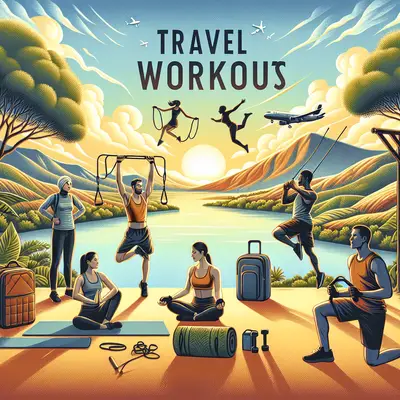
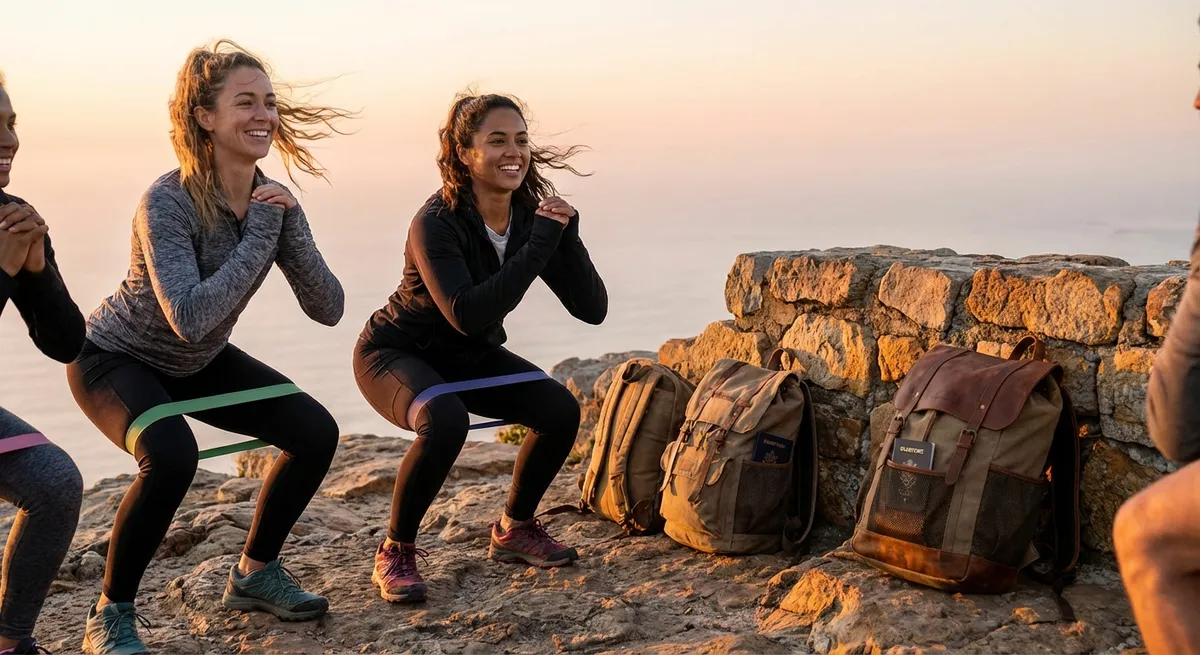
Start with one or two ultra-light resistance bands (a light and a medium/heavy). They take up less space than a T-shirt, pass easily through airport security, and instantly turn any quiet corner into a strength station for rows, presses, and hip work. Add a compact jump rope for quick conditioning in hotel courtyards, rooftops, or parking lots—just check ceiling height and nearby guests. If you want a little more firepower, a suspension trainer or DIY version using sturdy straps can hook onto a solid door, tree, or railing to unlock pull-style moves when you’re far from a pull-up bar.
Round it out with the basics: a foldable travel yoga mat or grippy towel for floor work, plus a small loop band for glutes and shoulders. The goal is not to carry a mobile gym, but to carry tools that multiply your options anywhere—hostels, Airbnbs, bus terminals, beaches, or a low-key park you spotted on the way to coffee.
Anchor Your Day with a 15-Minute “No Excuses” Circuit
Travel days are unpredictable, but you can still plant one unshakable flag in your schedule: a short, high-impact circuit that needs no equipment and nearly no space.
Pick five reliable moves that hit your whole body and require zero gear. For example:
Squats or split squats
Push-ups (regular, incline on a bed, or against a wall)
Hip hinges or glute bridges
Rows with a band or isometric pulls against a door frame
Core plank variation (front, side, or shoulder taps)
Set a timer for 15 minutes. Move through each exercise for 40 seconds, rest for 20 seconds, and cycle through as many quality rounds as you can. This structure gives you a built-in plan whether you wake up in a sleeper train compartment or a luxury hotel suite.
The secret is consistency, not complexity: same time each day as often as possible—maybe right after you wake up or just before your first work block. Travelers and digital nomads don’t need perfection; they need a ritual that still works when Wi-Fi drops, meetings move, or a sunrise hike calls your name. Treat this circuit like brushing your teeth—non-negotiable, short, and portable.
Train for the Terrain: Let Your Destination Shape Your Workout
Your surroundings can be more than a backdrop for selfies—they can become your training partners.
In hilly cities or mountain towns, let the landscape dictate your session: power walk or jog uphill, then walk down to recover. If you’re in a flat beach town, use long stretches of sand for barefoot walking lunges, sprints, or farmer’s carries with your backpack. Urban environments offer benches for step-ups and dips, stairwells for leg burners, and playgrounds or outdoor fitness stations for hangs, rows, and pull-ups.
If you’re a digital nomad settling somewhere for a few weeks, scout your “movement map” on day one. Identify a nearby park, a set of reliable stairs, an outdoor gym, and a walkable loop you can use for intervals. This turns the unknown into an advantage—each new destination becomes a fresh training playground. Instead of asking, “Where’s the gym?” ask, “What does this place let my body practice?”
Sync Your Workouts with Your Work and Recovery
Travel and remote work can wreck your energy if you don’t set boundaries. Instead of squeezing workouts into random gaps, pair them intentionally with your work and recovery rhythms.
If you’re battling time zones, use a short strength or mobility session to signal “morning” to your body, even if the clock disagrees. After long laptop stretches in a café or coworking space, drop into a 5-minute movement break: band pull-aparts, neck and shoulder CARs (controlled articular rotations), air squats, and a quick walk around the block. These micro-sessions stack up and protect your back, hips, and wrists from desk damage.
In the evenings, shift to lower-intensity work: slow stretches, gentle yoga flows, or deep-breathing while holding relaxed positions. This calms your nervous system after crowded buses, busy airports, or overstimulating cities. Sleep is your actual recovery coach while traveling—protect it by finishing intense training at least a few hours before bed and avoiding heavy conditioning late at night.
By linking strength work to the start of your day, movement breaks to your work blocks, and mobility to your wind-down, you end up with a sustainable system that survives erratic schedules and changing time zones.
Five Adventure-Ready Fitness Tips for Travelers and Digital Nomads
Here are five field-tested tips designed specifically for life on the move:
1. Train “movement categories,” not specific exercises.
Instead of obsessing over specific machines or a favorite bench, think in patterns: push, pull, squat, hinge, lunge, carry, rotate. As long as you hit these 2–4 times a week with some form of resistance, you’ll stay strong—whether that’s push-ups on a hostel floor or rows with a band tied to a lamppost.
2. Use your backpack as a portable weight.
Load your pack with water bottles, books, or gear and you have an adjustable training tool. Hug it for squats, hold it in one hand for suitcase carries, or press it overhead for shoulder work. Just be mindful of your surroundings and straps—secure everything before you start moving.
3. Build a “jet lag” plan instead of skipping workouts.
After long-haul travel, swap max-effort training for low-intensity movement: walking in natural light, gentle mobility for hips and spine, and light band work to wake up your muscles. Once your sleep normalizes, ramp intensity back up. This keeps your habit alive without digging a deeper fatigue hole.
4. Set a minimum standard for “success days.”
Define the smallest meaningful session you’re willing to count as a win—like 10 minutes of movement or 3 rounds of your core circuit. On chaotic travel days, hit that minimum and call it good. This keeps your identity as “someone who trains” intact, even when conditions are terrible.
5. Let rest days follow your travel stress, not the calendar.
If you’ve just endured two bus rides, a border crossing, and a time change, that’s a recovery day, even if it’s “supposed” to be leg day. Flip the script: walk, stretch, hydrate, and sleep. Then hit a solid session once your body catches up. Flexibility with your schedule is what keeps your training alive long-term.
Conclusion
The road doesn’t have to be the enemy of your fitness; it can be the forge where you build a body and mindset that match your appetite for adventure. With a minimalist kit, a reliable 15-minute anchor routine, terrain-driven sessions, smart work-recovery rhythms, and a handful of traveler-specific tactics, you’re not just “getting by” while you move—you’re leveling up.
Pack your passport, shoulder your backpack, and bring your training with you. Every new city is now more than a destination—it’s another chapter in how strong, capable, and adaptable you can become.
Sources
- [American College of Sports Medicine – Fitness on the Go](https://www.acsm.org/docs/default-source/files-for-resource-library/fitness-on-the-go.pdf) - Practical guidance from ACSM on staying active while traveling
- [CDC – Physical Activity Guidelines for Adults](https://www.cdc.gov/physical-activity-basics/guidelines/adults.html) - Baseline recommendations for weekly activity and intensity
- [Harvard Health – Exercising While Traveling](https://www.health.harvard.edu/staying-healthy/6-ways-to-stay-fit-on-a-trip) - Evidence-informed tips for maintaining fitness away from home
- [Mayo Clinic – Strength Training: Get Stronger, Leaner, Healthier](https://www.mayoclinic.org/healthy-lifestyle/fitness/in-depth/strength-training/art-20046670) - Overview of the benefits and basics of strength training
- [NHS (UK) – Benefits of Exercise](https://www.nhs.uk/live-well/exercise/exercise-health-benefits/) - Health and wellbeing benefits of regular physical activity
Key Takeaway
The most important thing to remember from this article is that this information can change how you think about Travel Workouts.