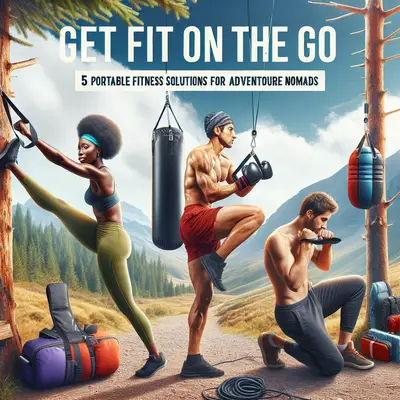
Office today, jungle tomorrow, redeye the next day—your body doesn’t care where you are; it only knows whether it’s ready. Portable equipment is your secret weapon: compact tools that disappear into your backpack but hit like a full gym when it’s go time. This isn’t about “staying kind of active on the road.” It’s about building a mobile strength base that travels as hard as you do.
Below are five field-tested fitness tips for travelers and digital nomads—each anchored by portable gear that earns its space in your pack.
Travel Tip #1: Turn Resistance Bands Into Your Mobile Weight Rack
Resistance bands are the nomad’s barbell. Light, cheap, and airport-proof, they can mimic most big lifts without ever touching a dumbbell.
Use a heavier loop band for squats, deadlifts, and rows: stand on the band, choke it up in your hands, and drive through your feet like you’re picking up a barbell. A lighter band can handle presses, pull-aparts, and shoulder prehab when your upper body feels wrecked from backpacks and laptops.
Anchors are everywhere if you know where to look: a sturdy bed frame for rows, a door hinge level for presses, a park rail for face pulls. Think in movement patterns, not machines—push, pull, hinge, squat, carry. With 2–3 bands of different strength, you can hit all of them in a tiny corner of a hostel room.
Aim for 2–4 sets of 10–20 controlled reps, chasing smooth tension rather than speed. When the band starts feeling easy, step farther from the anchor or double up bands instead of cranking out sloppy reps. Your goal is repeatable strength, not airport bathroom pump photos.
Travel Tip #2: Pack a Suspension Trainer and Own Any Overhead Space
A suspension trainer (like TRX-style straps) turns doorways, tree branches, and balcony railings into a fully functional gym. If resistance bands are your mobile weight rack, straps are your moving pull-up bar, cable stack, and core station combined.
Strap them to a sturdy door using the door anchor, or loop them over a playground swing set or tree branch. With just that setup, you’ve got rows, chest presses, hip hinges, single-leg squats, and brutal core work on tap. The steeper your body angle relative to the ground, the harder each move hits.
Use them to balance out travel posture: hammer horizontal rows, Y-raises, and face-pull variations to undo hours of laptop hunching. For lower body, elevate a foot in the strap and crush split squats and hip thrusts—perfect when you don’t want to slam your joints with hotel-room jump circuits.
Keep tension by bracing like you’re about to get shoved—ribs stacked over hips, glutes on. Think of the straps as your traveling training partner: always there, never complains, demands clean form or you’ll feel it immediately.
Travel Tip #3: Use a Travel Mat and Mini-Ball to Build a Bulletproof Core
Your core is your portable foundation—if it’s weak, every suitcase, scooter, and sleeper train is going to beat you up. A foldable travel mat and a small inflatable ball (or mini Pilates ball) give you a full core lab that fits in a daypack.
The mat saves your spine from questionable hostel floors and random tarmac breaks between flights. The mini-ball slots between knees, under your low back, or between shoulder blades to change leverage and crank up difficulty without adding weight.
Focus on anti-movement more than endless crunches: dead bugs with the ball between your knees, side planks with feet elevated on the ball, and glute bridges with the ball between your thighs for adductor and glute engagement. These drills teach your core to resist rotation and extension—exactly what you need when you’re hauling bags, sprinting for trains, or hiking with a pack.
String together 3–4 exercises for 20–40 seconds each, 2–3 rounds, on days when you’re short on time. Think of these sessions as body armor tuning: light, quick, and consistent beats occasional gut-busting marathons.
Travel Tip #4: Let a Jump Rope and Mini-Bands Replace the Treadmill
If you’re tired of hunting for “decent hotel cardio,” pack two items: a speed rope and a set of mini-loop bands. Together, they’re a rolling conditioning lab that fits in a jacket pocket.
The jump rope gives you scalable cardio: beginner? Try 20–30 seconds of easy skips followed by 20–40 seconds of rest. More advanced? Use intervals like 40 seconds on / 20 seconds off for 10–15 minutes. It’s joint-friendlier than pavement sprints and way more engaging than zombie-walking a treadmill in a windowless room.
Mini-bands wrap around ankles, shins, or above your knees to light up hips and glutes. Walks, lateral steps, monster walks, and standing kickbacks keep your lower body awake after long travel days. This pays off on steep city streets, mountain paths, or unexpected last-minute hikes.
Build quick hybrid sessions when time is tight: 1 minute jump rope, 30 seconds lateral band walks, 30 seconds glute bridges, rest 1 minute, repeat 4–6 times. You’ll bump your heart rate, crank your hip stability, and finish faster than your boarding group queues up.
Travel Tip #5: Use Your Pack as a Shape-Shifting Weight
The one “weight” you always have on the road is your backpack or carry-on. With smart packing, it can double as your adjustable kettlebell or sandbag.
Stuff it with clothes, books, a water bag, or anything dense you’re already hauling. Cinch down the straps so the load doesn’t flop around, and you’ve got a surprisingly versatile training tool. Hug it for goblet squats, hold it by the straps for rows, or clean it to your chest for loaded carries around your room or down a quiet hallway.
In smaller spaces, try suitcase deadlifts (one hand on the pack, pick it up from the side), front-loaded split squats, and overhead press variations if the ceiling’s high enough. Outdoors, it becomes your go-to for stair climbs, lunges, and carry intervals.
This is minimalist training at its purest: use what you already have. When your luggage becomes your gym, there’s no such thing as “I didn’t have equipment.” There’s only “Did I have the creativity to use it?”
Conclusion
Portable equipment isn’t about replacing “real” training—it's about removing excuses. Bands, straps, a rope, a mat, a mini-ball, and your pack can collectively weigh less than a laptop but keep your body ready for whatever the next border crossing, night bus, or surprise adventure throws at you.
Travel will always be chaotic. Flights will shift, Wi-Fi will die, and your “perfect” plan will get steamrolled. The win is staying consistent anyway—threading short, focused sessions through your days with tools that live in your bag. Build that mobile strength base, and your body stops being the limiting factor in your adventures and starts becoming the engine that drives them.
Sources
- [American Council on Exercise – Resistance Band Training 101](https://www.acefitness.org/education-and-resources/lifestyle/blog/6649/resistance-bands-101/) - Overview of resistance band benefits and sample exercises
- [TRX Training – Research on Suspension Training Effectiveness](https://www.trxtraining.com/train/research) - Summaries of studies examining strength, balance, and core gains with suspension trainers
- [Harvard Health Publishing – The Benefits of Strength Training](https://www.health.harvard.edu/staying-healthy/the-importance-of-strength-training) - Evidence-based discussion of why maintaining muscle and strength matters for health and function
- [Mayo Clinic – Jump Rope and Aerobic Exercise Basics](https://www.mayoclinic.org/healthy-lifestyle/fitness/in-depth/aerobic-exercise/art-20045541) - Explains cardio benefits and how short sessions can improve health markers
- [Centers for Disease Control and Prevention – Physical Activity Guidelines for Adults](https://www.cdc.gov/physicalactivity/basics/adults/index.htm) - Official recommendations on weekly strength and aerobic activity targets for adults
Key Takeaway
The most important thing to remember from this article is that this information can change how you think about Portable Equipment.