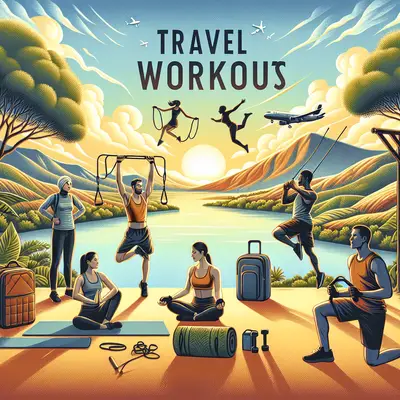
Travel days can blur together: airports, late checkouts, time zones that don’t care about your sleep schedule. But your body doesn’t have to turn into carry-on cargo just because you’re on the move. With a little intention and a few portable strategies, you can treat every city, layover, and lunch break like a mini training ground.
This guide gives you five adventure-proof fitness tips built for travelers and digital nomads who’d rather explore than sit in a hotel gym. No complicated gear, no rigid schedules—just practical, packable tactics that keep you strong, mobile, and ready for whatever the next stamp in your passport brings.
Build a “Default Travel Session” You Can Do Anywhere
When you’re hopping between time zones, you don’t need the “perfect” workout—you need a reliable one you can hit on autopilot.
Create a simple 15–20 minute session that fits in a hotel room, airport corner, or quiet park. Think 4–6 movements that cover your whole body and require zero or minimal gear. For example: push-ups, split squats, hip hinge (good mornings), a row variation (with a band or bag), a core move, and something that gets your heart rate up like fast step-ups or jumping jacks. Keep the structure the same—like 40 seconds of work, 20 seconds rest, or 8–10 controlled reps per exercise, 2–4 rounds—so you don’t waste mental energy planning. The goal is consistency, not complexity: when your brain is fried from travel, you hit the default session, check the box, and move on with your day.
Turn Transit Time into Movement Time
You don’t have to accept “travel days = zero movement.” You just have to redefine what counts as a workout.
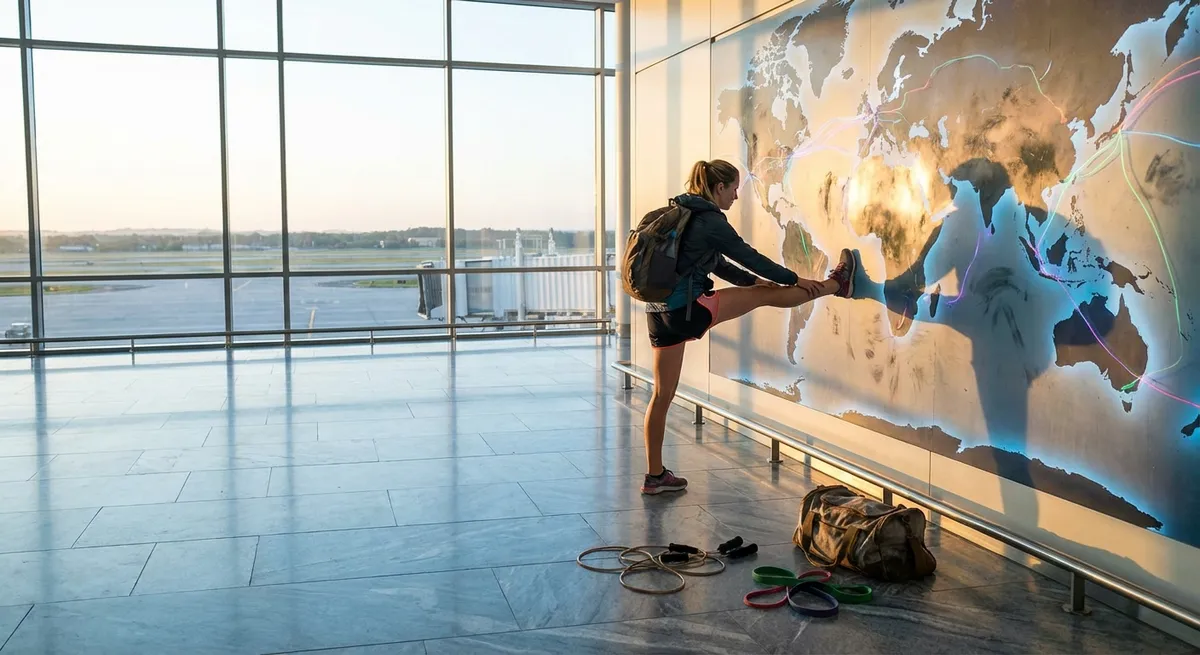
At airports and train stations, use waiting time to walk long loops instead of sitting at the gate. Pick a distant restroom or coffee stand and treat it like a mini hike with your backpack as a light load. On planes and buses, set a quiet alarm for every 45–60 minutes to stand up, walk the aisle when possible, and run through a quick mobility sequence—ankle circles, calf raises, hip circles, and gentle torso twists. During long drives, choose rest stops that have some open space and use 3–5 minutes for walking lunges, arm circles, and a few rounds of air squats. These micro-sessions won’t feel like “training,” but they dramatically reduce stiffness, help blood flow, and make it easier to hit a real workout once you land.
Pack One Small Piece of Gear That Multiplies Your Options
You don’t need a mobile gym; you just need one piece of gear that turns almost any space into a training zone.
A loop resistance band or light–medium long band weighs almost nothing and disappears into your backpack, yet unlocks rows, presses, curls, pull-aparts, deadlifts, and glute work without touching a single dumbbell. If you prefer bodyweight only, a lightweight suspension trainer or even a sturdy yoga strap can attach to a door, balcony rail, or tree to add pulling and core options. Use your backpack as a makeshift weight: load it with books, water bottles, or gear for goblet squats, weighted step-ups, or bent-over rows. Choose one primary tool, learn 6–8 solid movements with it before you travel, and you’ll never again walk into a tiny hotel room and think, “Well, I guess I can’t train today.”
Anchor Your Day with Short, High-Intent Sessions
Travel days are unpredictable; your workouts shouldn’t depend on a perfect hour block that may never appear.
Instead, commit to short, high-intent sessions that fit into the natural cracks of your day. That might mean 10–15 minutes right after you wake up, a quick burst before lunch, or a fast bodyweight blast between calls. Use clear boundaries: for example, “Every day, I’ll hit 3 focused sets each of a push, a pull, a squat or lunge, and a core move.” If time is tight, run them as a circuit with minimal rest. On heavy travel or work days, that might be all you do—and that’s enough to maintain strength, mobility, and habit. On lighter days, you can expand into a longer session or explore a local park or trail. The key is to protect the habit of training, even when the dose is small.
Let the Local Environment Shape Your Workout
Your surroundings are a moving playground—use them.
In cities, stairs are your built-in cardio and leg training. Run or walk multiple flights, use landings for push-ups and split squats, and treat the whole stairwell like an interval hill workout. In coastal or lakeside spots, alternate brisk shoreline walks or runs with bodyweight intervals in the sand for added challenge and foot strength. In parks, benches become stations for step-ups, hip thrusts, Bulgarian split squats, dips, and incline or decline push-ups. If you’re near trails, use natural terrain for hiking intervals: power up hills, walk down for recovery, and add tension by carrying your pack. By designing workouts around each location, you’ll not only stay fit—you’ll connect more deeply to the places you’re passing through.
Conclusion
You don’t need to “pause” your fitness until you get home. Home is wherever your backpack hits the floor, and your training can travel with you.
With one dependable travel session, micro-movement baked into transit, a single smart piece of gear, short high-intent blocks, and workouts shaped by your surroundings, you can stay strong, clear-headed, and adventure-ready—even when the schedule is chaos. The goal isn’t perfection; it’s momentum. Keep moving, keep exploring, and let every new stop stamp its own workouts into your personal road warrior sweat map.
Sources
- [Centers for Disease Control and Prevention – Physical Activity Basics](https://www.cdc.gov/physical-activity-basics/index.html) - Guidelines on how much activity adults need and why short, frequent movement breaks matter
- [World Health Organization – Physical Activity](https://www.who.int/news-room/fact-sheets/detail/physical-activity) - Global recommendations and health benefits of regular movement, relevant for travelers and nomads
- [American College of Sports Medicine – ACSM Guidelines for Exercise Testing and Prescription](https://www.acsm.org/education-resources/books/guidelines-exercise-testing-prescription) - Evidence-based recommendations on structuring time-efficient workouts
- [Harvard Health Publishing – The Importance of Stretching](https://www.health.harvard.edu/staying-healthy/the-importance-of-stretching) - Covers travel-friendly mobility concepts to combat stiffness on long trips
- [Mayo Clinic – Exercise: How to Get Started](https://www.mayoclinic.org/healthy-lifestyle/fitness/in-depth/exercise/art-20048389) - Practical tips on building sustainable exercise routines that can adapt to life on the road
Key Takeaway
The most important thing to remember from this article is that this information can change how you think about Travel Workouts.