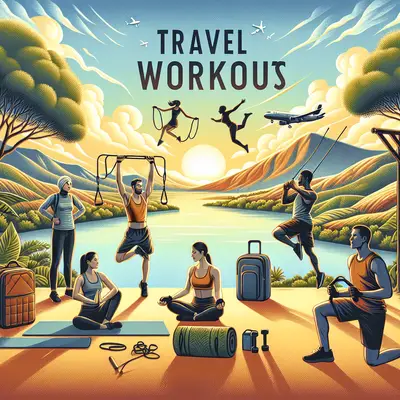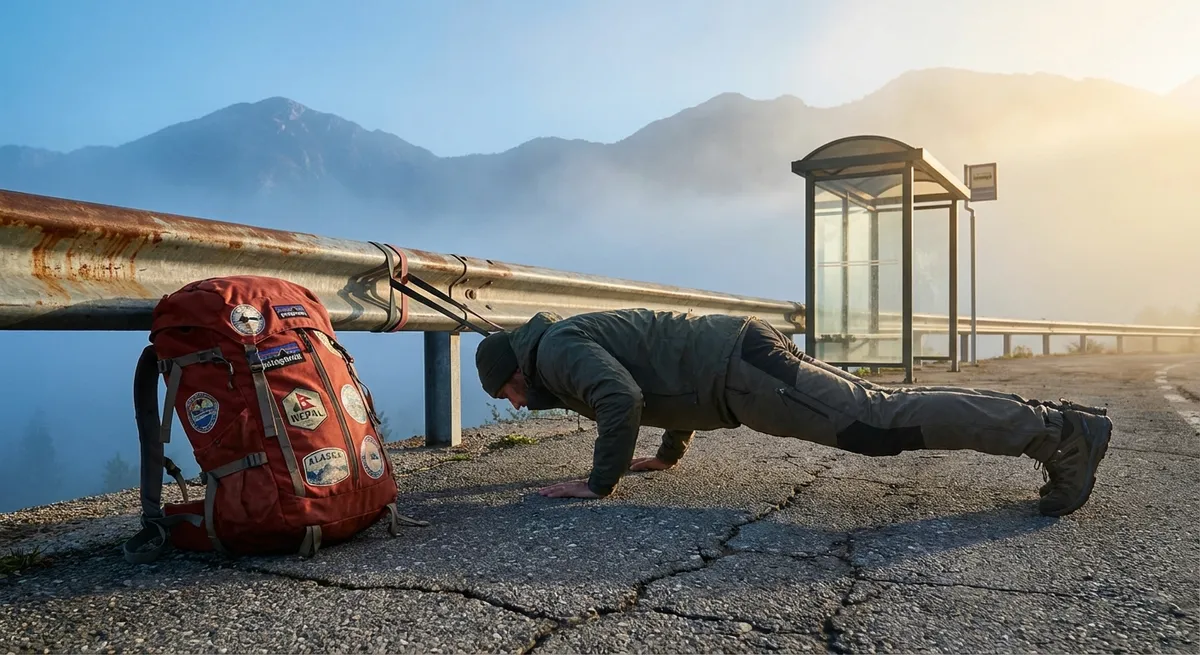
You don’t need a home gym, a perfect schedule, or a familiar city skyline to stay strong. If your life fits into a backpack and your office is wherever the Wi‑Fi happens to be, your training should travel as light and adapt as fast as you do. This guide is built for travelers and digital nomads who want strength, stamina, and sanity on the move—without hauling a suitcase full of equipment.
Building a “Go-Anywhere” Fitness Mindset
Your strongest travel workout tool is not a resistance band or a collapsible mat; it’s how you think about training when nothing is predictable. Flights get delayed, sidewalks disappear, “gyms” turn out to be a dusty treadmill and a broken cable stack, and your jet-lagged brain wants excuses—not reps.
Instead of chasing perfect conditions, shift to a “minimum effective dose” mindset. Aim to hit short, focused sessions you can slot between check‑out and check‑in, or between calls, even if they’re just 10–20 minutes. Trade the idea of a fixed weekly schedule for a move-when-you-can approach: if today is heavy on walking and sightseeing, maybe that’s your cardio and you stack a strength session tomorrow.
Anchor your workouts to triggers that travel with you: waking up, pre‑lunch, or shutting down your laptop. That way, your environment can change and your routine still holds. You’re not “on a break” from fitness while traveling—you’re simply training in a different arena.
Tip 1: Turn Any Room into a Micro-Gym
Whether it’s a hostel corner, a tiny Airbnb, or a coworking phone booth, almost any space can be turned into a micro‑gym if you think in movements, not machines.
Design a basic “room workout” that needs no more than the floor and a wall:
- Lower body: squats, reverse lunges, split squats using a chair or bed, wall sits
- Upper body: push‑ups (hands elevated on a chair if needed), pike push‑ups against the wall, incline/decline push‑ups using the bed
- Core: dead bugs, planks, side planks, slow mountain climbers
- Conditioning: fast step‑ups on a low, stable surface; shadow boxing; burpees if your neighbors won’t mutiny
Pick 3–4 moves, set a timer for 12–15 minutes, and cycle them with minimal rest. Keep a couple of variations for each movement so you can scale up or down based on your energy and space.
If privacy is scarce, build a “silent session”: static holds (wall sit, plank, isometric push‑up hold), slow tempo squats and lunges, and balance drills. You can get a serious burn without a single thud on the floor.
Tip 2: Pack a Pocket-Sized Strength Kit
You don’t need a trunk of gear—just a few tools that punch far above their weight and fit into carry‑on:
- Long resistance band (loop or tube): anchor it around a door frame, bed leg, or your own foot. You instantly unlock rows, presses, pull‑throughs, and banded squats.
- Mini loop band: perfect for glute bridges, lateral walks, and shoulder work. Takes up less space than a pair of socks.
- Light jump rope (optional): for days when you’re stuck indoors but want a quick cardio spike.
Build a “band-only” backup workout for days when you can’t or don’t want to leave the room:
- Banded rows
- Banded chest presses or push‑ups with the band across your back
- Banded good mornings or Romanian deadlifts
- Banded squats or split squats
- Banded face pulls or pull‑aparts for posture
Aim for 2–4 rounds of 10–15 controlled reps. Keep the band in a side pocket of your bag so you never have the “I don’t have equipment” excuse. Your backpack becomes a mobile training cache.
Tip 3: Use the City as Your Conditioning Course
Cities, beaches, and mountain towns are all just obstacle courses with better views. Instead of hunting for treadmills, use your surroundings for conditioning that actually feels like adventure, not punishment.
Look for:
- Stairs or hills: turn a staircase into sprints, power walks, or carry intervals if you’ve got a pack.
- Parks and waterfronts: jog, power walk, or do intervals between landmarks (bench to lamp post, bridge to bridge).
- Benches and low walls: step‑ups, elevated push‑ups, Bulgarian split squats, triceps dips if your shoulders tolerate them.
A simple “city circuit” could be: walk or jog for 3–5 minutes, stop for 1–2 minutes of bodyweight moves (e.g., 10 squats, 10 push‑ups, 20 walking lunges), repeat for 20–30 minutes. You get exploration, sunlight, and fitness in one loop.
For time‑crunched days, play with interval blocks: 30 seconds fast (jog, stairs, brisk uphill) and 60–90 seconds easy. Ten rounds nets you a serious cardio hit in under 20 minutes, with no gym membership required.
Tip 4: Train Around Jet Lag and Weird Schedules
Jet lag, late‑night client calls, and early buses can wreck your ideal plan, but they don’t have to wreck your progress. Instead of demanding consistency in time of day, aim for consistency in total weekly movement.
A practical approach:
- Post‑flight mobility reset: after long travel, hit 5–10 minutes of gentle movement—hip circles, cat‑camel, thoracic rotations, ankle circles, easy bodyweight squats. This wakes up stiff joints and helps shake off that “airplane statue” feeling.
- Micro‑sessions on heavy workdays: split 15–20 minutes into two or three 5–10 minute bursts—morning push‑ups and squats, midday band rows and bridges, evening walk. You’re stacking volume without needing a big window.
- Anchor days instead of a rigid schedule: for example, plan for three strength-focused days and two movement/conditioning days per week, but let the calendar flex around your travel.
Listen to your sleep and stress signals: if you’re severely short on rest, downshift. Do a low‑intensity mobility and walking day instead of trying to crush a high‑intensity workout. You’re building a durable “travel body,” not chasing a single perfect session.
Tip 5: Protect Your Posture and Joints Like Gear
Long flights, bus rides, and laptop marathons can beat you up faster than any workout. Good travel fitness isn’t just about how hard you train—it’s how well you protect your body from the grind.
Build simple “maintenance rituals” into your days:
- Laptop posture breaks: every 30–60 minutes, stand up for 1–2 minutes. Do 10 band pull‑aparts or shoulder rolls, 10 chair squats, and a quick chest stretch in a doorway.
- Hip and ankle check‑ins: before bed or after travel, spend 5 minutes on hip flexor stretches, gentle lunges, and ankle circles or calf stretches. Your future self on the next hike will thank you.
- Neck and upper back resets: seated thoracic rotations, chin tucks, and wall slides if you’ve got a blank wall nearby. Ideal after long work blocks in a café.
Think of this as preventive maintenance, like checking your backpack straps or updating your backups. Keeping joints mobile and posture decent means you can say yes to last‑minute hikes, spontaneous surf sessions, or sunrise city walks without wondering if your back will revolt.
Conclusion
Your passport may be full of stamps, your SIM card full of data, but your body still needs a consistent signal: “We move. We adapt. We stay strong.” Travel doesn’t have to be a pause button on your fitness—it can be the ultimate proving ground.
With a room‑ready micro‑gym, a pocket‑sized strength kit, a city‑as‑playground mindset, flexible scheduling, and daily joint care, you carry a complete training system wherever you land. The gear is light, the rules are simple, and the payoff is huge: more energy for adventures, more resilience for long hauls, and a body that feels like an asset, not dead weight, on every leg of the journey.
Roam far, travel light, and keep your training as portable as your life.
Sources
- [Centers for Disease Control and Prevention – Physical Activity Basics](https://www.cdc.gov/physicalactivity/basics/index.htm) - Guidelines on how much weekly activity supports health, useful for planning travel routines
- [American College of Sports Medicine – Exercise and Physical Activity Recommendations](https://www.acsm.org/docs/default-source/brochures/physical-activity-and-public-health.pdf) - Evidence-based recommendations for strength and cardio you can adapt on the road
- [Harvard T.H. Chan School of Public Health – The Importance of Strength Training](https://www.hsph.harvard.edu/nutritionsource/strength-training/) - Overview of why resistance work matters, even (or especially) when traveling
- [National Health Service (NHS) UK – Sitting and Sedentary Behaviour](https://www.nhs.uk/live-well/exercise/sitting-less-at-work/) - Explains the health impact of prolonged sitting and offers strategies relevant to flights and laptop time
- [Mayo Clinic – Jet Lag Disorder](https://www.mayoclinic.org/diseases-conditions/jet-lag/symptoms-causes/syc-20374025) - Details on how jet lag affects the body and why flexible, lighter training days may be needed
Key Takeaway
The most important thing to remember from this article is that this information can change how you think about Travel Workouts.