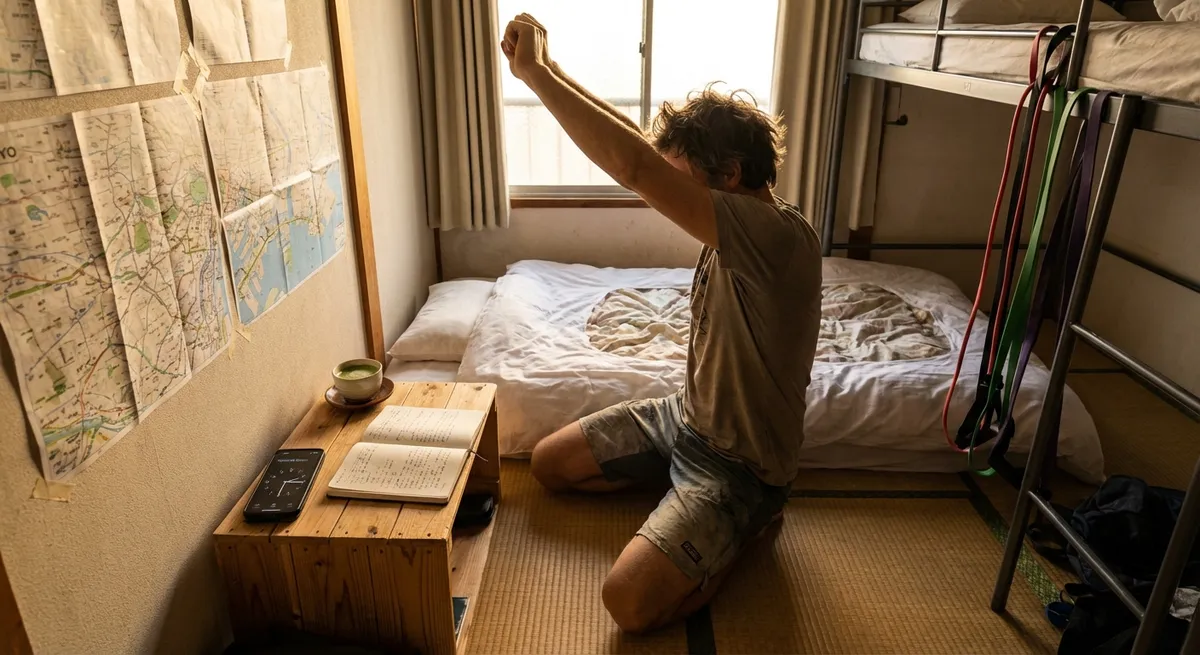
You don’t need a home gym, a perfect schedule, or a familiar city skyline to stay strong. Your passport, backpack, and laptop can coexist with a body that’s ready for sunrise hikes, surprise surf days, and long-haul flights. Nomad health isn’t about perfection—it’s about portable systems that survive jet lag, tiny rooms, and unpredictable Wi‑Fi. This is your field guide to staying fit while the map keeps changing.
The Nomad Mindset: Train for the Trip You’re Living
Nomad life is controlled chaos: red-eye flights, overnight buses, coworking marathons, and “yes” to last‑minute adventures. If you try to copy a stable, gym-based routine, you’ll lose. Instead, treat your health like your travel gear: lightweight, modular, and ready to deploy anywhere.
Start by redefining what “a real workout” means. Forget the 60-minute, perfectly periodized plan. Your new standard is: “Did I push my body in a meaningful way today with what I had?” Ten focused minutes beats zero perfect minutes. A few stair sprints in a metro station, a mobility session while your laundry spins, or a power set between Zoom calls—this is nomad training.
Anchor your routine to consistent triggers instead of locations. Maybe you always move for 10–15 minutes after your first coffee, or you hit a mini-workout every time you check into a new place. The terrain and time zone can change; your triggers stay the same. That’s how your body stays ready when the next adventure shows up unannounced.
Tip 1: Turn Transit into a Training Ground
Travel days shred routines, but they don’t have to be dead days. Airports, bus terminals, and long train rides can either stiffen you up or sharpen you.
In airports, treat waiting as a mobility mission instead of a scrolling session. Walk the terminal instead of sitting at the gate. Every 5–10 minutes, pause for calf raises, ankle circles, and shoulder rolls. Find a quiet corner near an empty gate and cycle through slow, controlled squats, hip hinges, and gentle lunges with your backpack on for light resistance.
On long flights or buses, your non-negotiable is circulation. Stand when you can, or at least every few hours. Do seated marches, toe taps, and isometric glute squeezes. These aren’t “gains” exercises—they’re damage control against stiffness, swelling, and that wrecked feeling when you finally arrive. Think of transit as a warm‑up for the destination, not a write‑off.
Tip 2: Build a Bodyweight System That Fits in Your Head
Your most reliable “equipment” is the one thing that never gets lost in baggage: your own body. Instead of memorizing dozens of moves, build a tiny toolbox of compound exercises you can adapt in seconds.
For lower body, lean on squats, lunges, and hip hinges (like good mornings or single‑leg deadlifts). For upper body, push-ups (hands elevated on a bed or desk if needed), dips on a sturdy chair, and inverted rows using a table edge or low railing. For core, prioritize planks, side planks, and dead bug variations you can do on any floor, yoga mat, or even a beach towel.
From those basics, create a few simple “templates” you can run anywhere: for example, pick 3–4 moves and do them in a circuit for 10–15 minutes, or do ladder sets (1–2–3–4–5 reps and back down). When your brain is fried from travel or work, you don’t negotiate with yourself—you just run the template. The more automatic your system, the less likely you are to skip.
Tip 3: Use the City as Your Unofficial Outdoor Gym
Every new city is secretly a training playground if you know how to see it. Stairs become your hill sprints. Park benches are your step-up, box squat, and incline push-up station. Low walls or sturdy railings stand in for dip bars or elevated planks. Even your packed backpack can double as a weight for loaded carries, goblet squats, and overhead presses.
Start by scouting your area on foot when you arrive. Instead of only hunting for coffee and coworking, look for open spaces, parks, riverside paths, and public workout areas. Many cities—from Berlin to Bangkok—have outdoor calisthenics parks or simple pull-up bars. If you’re staying near a waterfront or promenade, that’s your new running loop or speed-walk circuit.
Treat micro-adventures as training, too. Take stairs instead of elevators in tall buildings. Hike the viewpoint instead of grabbing the cable car. Rent a bike instead of hailing a ride for short distances. These choices compound over weeks of travel, turning “just exploring” into stealth conditioning.
Tip 4: Pack a Minimalist “Invisible Gym” Kit
You don’t need to haul around half a sports store to train hard. A tiny, well-chosen kit can disappear into your backpack and still unlock serious options anywhere on the globe.
Resistance bands (loop and/or long bands) weigh almost nothing and add pull, row, and press variations that bodyweight alone can’t. A light, packable jump rope gives you high-intensity cardio in the smallest footprint—perfect for short sessions in a courtyard or quiet side street. If you have a bit more room, a compact suspension trainer (or even a sturdy DIY alternative) can hang from doors, beams, or tree branches, turning any space into a full‑body station.
The key is to learn a few high-value exercises for each piece instead of relying on complicated routines. For example, with bands you might focus on rows, presses, pull‑aparts, and anti-rotation holds. With a rope, mix basic jumps with short, intense intervals. Your kit should feel like a trusty multi-tool, not a puzzle.
Tip 5: Sync Recovery with Your Moving Time Zones
Adventure is only fun if your body can keep up. Sleep disruption, unfamiliar food, and shifting time zones will hit you harder if you only focus on workouts and ignore recovery.
Start by protecting sleep like it’s your most valuable gear. When hopping time zones, get outside into natural light soon after local morning to help reset your internal clock. If you’re arriving late, keep the lights low and screens dim before bed. A simple pre-sleep routine—light stretching, a few deep breathing cycles, maybe reading a paperback instead of scrolling—can signal your body that it’s time to power down, even in a new room.
Hydration is your second line of defense. Flights and hot climates can drain you fast, which makes workouts feel heavier and recovery slower. Keep a reusable bottle with you and aim to drink regularly rather than chugging occasionally. When food is unpredictable, focus on “anchor choices” you can usually find anywhere: some kind of lean protein, some color from vegetables or fruit, and at least one slower-digesting carb like oats, rice, or potatoes. You’re not chasing perfection—you’re steering away from total chaos.
Conclusion
Being a healthy nomad isn’t about living like you’re at home—it’s about building a rugged routine that travels as well as you do. Your bodyweight becomes your default gear. Cities become obstacle courses. Travel days turn into mobility days. A few grams of simple equipment unlock a global gym network, and smart recovery keeps you sharp enough to say “yes” when the next detour appears.
You don’t need ideal conditions to train; you need portable habits that survive imperfect ones. Pack your passport, shoulder your backpack, and bring a rogue routine that can set up anywhere you can open a laptop or drop your bag. The world is your gym—keep moving like you believe it.
Sources
- [Centers for Disease Control and Prevention – Physical Activity Basics](https://www.cdc.gov/physicalactivity/basics/index.htm) - Overview of recommended activity levels and health benefits for adults
- [American College of Sports Medicine – ACSM Guidelines for Exercise Testing and Prescription](https://www.acsm.org/education-resources/books/guidelines-exercise-testing-prescription) - Evidence-based guidelines that inform safe, effective training principles
- [Harvard T.H. Chan School of Public Health – Sleep and Health](https://www.hsph.harvard.edu/nutritionsource/sleep/) - Research-backed insights on why sleep and circadian rhythms matter for performance and recovery
- [Mayo Clinic – Travel and Deep Vein Thrombosis](https://www.mayoclinic.org/diseases-conditions/deep-vein-thrombosis/in-depth/travel/art-20045903) - Explains why movement during long trips is crucial for circulation and safety
- [World Health Organization – Physical Activity Fact Sheet](https://www.who.int/news-room/fact-sheets/detail/physical-activity) - Global recommendations and data on physical activity and health impacts
Key Takeaway
The most important thing to remember from this article is that this information can change how you think about Nomad Health.