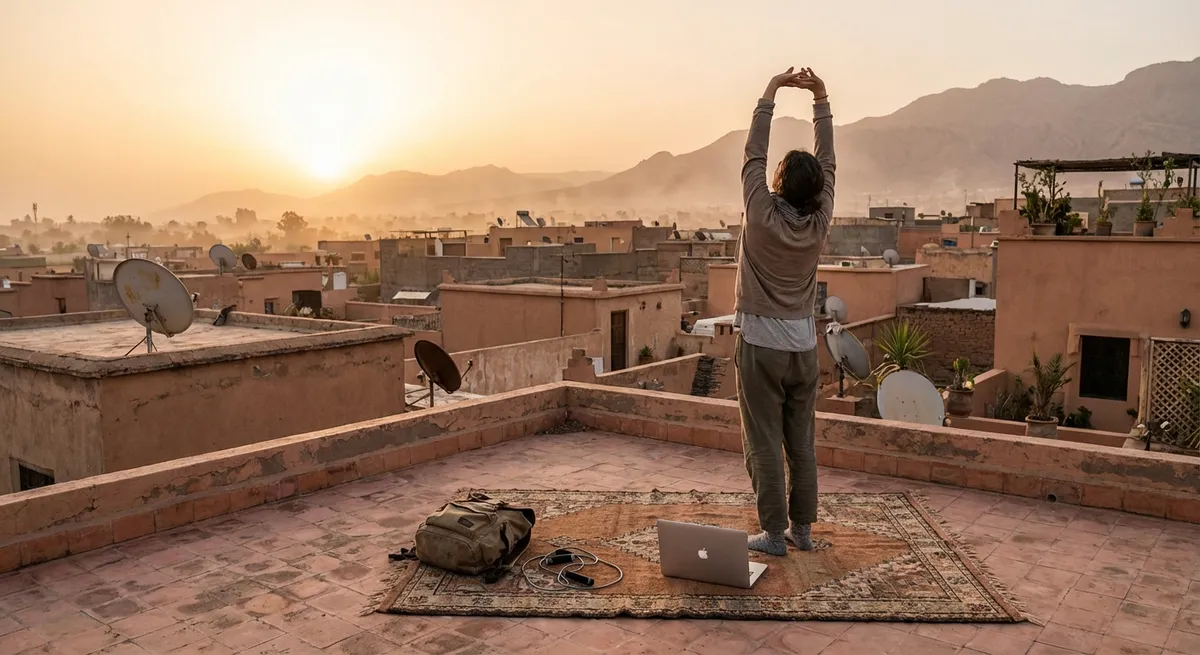
Your passport is full, your inbox is wild, and your body is… somewhere between three time zones and a questionable airport sandwich. Nomad life is epic, but it can quietly strip your strength, mobility, and energy if you don’t have a plan. The good news: you don’t need a squat rack, a perfect schedule, or a home base. You just need a portable strategy that travels as light as your carry-on.
This is your field guide to staying strong, mobile, and clear-headed while the scenery never stops changing—built for travelers, digital nomads, and anyone who spends more nights in transit than at home.
Building a “Rogue Routine” You Can Deploy Anywhere
Forget perfect. Nomad fitness lives on “deployable.” Your routine should be something you can launch in a small hotel room, on an Airbnb balcony, or beside a jungle hostel—all without depending on local gyms or stable schedules.
The core idea: create a small set of “non‑negotiables” that move with you. Think of them as your daily mission parameters: a short strength block, a movement reset, and a simple nutrition rule. Your training has to be modular—easy to compress into 10 minutes or expand to 40 depending on delays, calls, and border crossings.
Anchor your day with just one fixed event: a movement window that happens at the same relative time (e.g., right after waking, or before your first work block), no matter the city. This becomes your portable “home base” in a life without one. You’re not chasing perfection—you’re protecting momentum. Miss a day? Reset the next morning. The win is in the reload, not in never missing.
Tip 1: Run a “Backpack Gym” With Three Lightweight Tools
If your training depends on finding a good gym in each city, you’ve already lost. Build a backpack gym that weighs less than a laptop but can hit every major movement pattern.
Three rock-solid tools:
- Long resistance band (with handles or loop) – For rows, presses, pull-aparts, face pulls, assisted squats. Anchors to doors, bed frames, or balcony railings.
- Mini loop band – For glute work, hip stability, lateral walks, and adding resistance to squats or push-ups. Takes up less space than socks.
- Jump rope – For conditioning, coordination, and quick warm-ups when you don’t have space to run.
Everything else is optional. With these, you can stack:
- Push pattern: push-ups with bands or feet elevated
- Pull pattern: band rows or pulldowns from a door anchor
- Hinge pattern: good mornings and single-leg deadlifts with bands
- Squat pattern: band-resisted squats and split squats
- Core work: planks, dead bugs, banded anti-rotation holds
Pack these in a small pouch in your daypack so there’s never a “my gear is at the apartment” excuse. Your muscles shouldn’t know whether you’re in Lisbon or Laos—they should only know they’re getting work.
Tip 2: Treat Airports and Transit Hubs as Training Zones
Transit days don’t have to be black holes for your body. With the right mindset, they become movement-rich environments instead of 12-hour sitting marathons.
Before security or during layovers, swap doom-scrolling for a 10–15 minute “transit circuit”:
- Walking laps around the terminal to quietly stack 3,000–5,000 steps
- Calf raises on stairs or curbs to fight ankle stiffness and swelling
- Wall sits near empty gates for leg strength without gear
- Heel-to-toe walks and balance drills to reset coordination after long sits
- Doorway or wall pec stretch to undo the laptop-hunch you’ve been collecting
On long flights or buses, your main enemies are blood pooling, stiffness, and low-back crankiness. Stand up every 60–90 minutes to walk the aisle, do ankle circles, and gentle hip flexor stretches. Hydrate more than you want to; yes, you’ll use the bathroom more, but frequent bathroom trips are built‑in movement breaks.
You’re not trying to “crush a workout” in transit. The mission is to land in the next city feeling like a human, not a folded suitcase.
Tip 3: Use “Micro-Blocks” to Outsmart Chaotic Schedules
Nomad calendars are allergic to predictability. Calls run long. Buses break down. Sunsets demand your attention. Instead of trying to carve out a pristine 60‑minute training window, break your day into micro-blocks you can deploy whenever you find 5–15 minutes.
A sample “rogue day” might look like:
- Morning (8–10 minutes)
- 2 sets of: 10–15 push-ups, 15 squats, 20 band pull-aparts
- Midday (5–8 minutes) between calls or cafés
- 3 rounds: 30 seconds plank, 30 seconds jump rope, 30 seconds rest
- Evening (8–12 minutes)
- 10 minutes of hip mobility, hamstring stretches, and deep breathing
Individually, these blocks look insignificant. Together, they’re a full-body training session woven through a busy day. The secret: treat each micro-block as a non-negotiable meeting with yourself. Put it in your calendar. Name it something that matches your style: “Systems Check,” “Mobility Patrol,” “Strength Sweep.”
The goal is consistency over intensity. You want to be the person who trains most days at 60–70% effort, not the person who annihilates themselves once, then disappears for a week of taxis and takeout.
Tip 4: Run a Simple Nutrition Protocol That Survives Street Food
You’re not out here to eat boiled chicken out of Tupperware while your friends chase tacos at midnight. You are out here to not feel wrecked by every food decision. That means building a simple nutrition protocol that works across cultures and currencies.
A practical, portable framework:
- Prioritize protein at every anchor meal – eggs, yogurt, legumes, fish, meat, tofu, cottage cheese, or tempeh. Aim for roughly a palm-sized serving (or two) each time you sit down to eat.
- Make “1 green thing” a daily rule – salad, sautéed veggies, a veggie-heavy soup, or a big plate of mixed greens at least once a day.
- Treat high-sugar snacks as fuel, not default – enjoy the gelato or pastel de nata, but pair it with walking or a training block instead of using it to break up boredom.
- Hydrate aggressively on new-arrival days – travel days and first days in a new city are dehydration traps. Start with water before coffee and keep a collapsible bottle in your backpack.
If cooking, lean on ultra-simple, repeatable meals: eggs plus veggies, canned fish with bread and salad, yogurt with fruit and nuts, or rice/beans plus whatever protein you can find. This keeps you from decision fatigue in foreign supermarkets.
You’re not chasing perfect macros on the road. You’re aiming for “good enough, most of the time” so your energy and recovery don’t fall off a cliff.
Tip 5: Guard Your Sleep Like It’s Your Gear
Your body doesn’t care how noble your goals are if you’re sleeping like a broke vampire under neon signs and street noise. For nomads, sleep is recovery, mood regulation, immune support, and injury prevention all rolled into one.
A portable sleep defense kit can be as basic as:
- Eye mask – for bright hotel rooms and overnight flights
- Foam or silicone earplugs – to mute traffic, hostel doors, and hallway chaos
- Lightweight hoodie or scarf – doubles as a pillow booster or blackout aid
Then, set simple rules you can follow anywhere:
- Anchor your wake time as much as time zones allow. Your body loves consistent wake signals.
- Screen cutoff or filter 30–60 minutes before bed—if you must work, use blue light filters or night mode.
- Mini wind-down ritual: 2–5 minutes of stretching, box breathing (inhale 4 seconds, hold 4, exhale 4, hold 4), or journaling the next day’s “must-do” items so your brain isn’t solving problems at 2 a.m.
If you land in a new time zone, expose yourself to local daylight as soon as possible and avoid heavy naps. Think of daylight and darkness as levers helping your internal clock catch up to your passport stamps.
Strong training with weak sleep is like high-end headphones with low battery—they technically work, but you’re missing their real power.
Conclusion
You don’t need a fixed address to build a powerful, resilient body. You need a rogue routine: a few portable tools, simple rules, and a willingness to train wherever your boots—or bare feet—hit the ground.
Treat every city as a new training environment, every airport as a movement zone, and every day as another chance to run your systems check. Strength, mobility, and energy don’t belong to people with perfect routines—they belong to people who keep showing up, even when the GPS is still recalculating.
Your map can keep changing. Your health doesn’t have to.
Sources
- [CDC – Physical Activity Guidelines for Adults](https://www.cdc.gov/physicalactivity/basics/adults/index.htm) – Baseline recommendations for weekly exercise volume and intensity
- [World Health Organization – Physical Activity](https://www.who.int/news-room/fact-sheets/detail/physical-activity) – Global guidelines and benefits of staying active, useful for building minimum movement standards on the road
- [Harvard Health – The Importance of Sleep](https://www.health.harvard.edu/newsletter_article/the-importance-of-sleep-and-how-to-get-more-of-it) – Explains why sleep quality matters for performance, recovery, and immune health
- [Harvard T.H. Chan School of Public Health – Nutrition Source](https://www.hsph.harvard.edu/nutritionsource/healthy-eating-plate/) – Practical framework for structuring balanced meals in any cuisine
- [American Heart Association – Resistance Training Basics](https://www.heart.org/en/healthy-living/fitness/fitness-basics/strength-and-resistance-training-exercise) – Evidence-based overview of strength training benefits and simple approaches without heavy equipment
Key Takeaway
The most important thing to remember from this article is that this information can change how you think about Nomad Health.