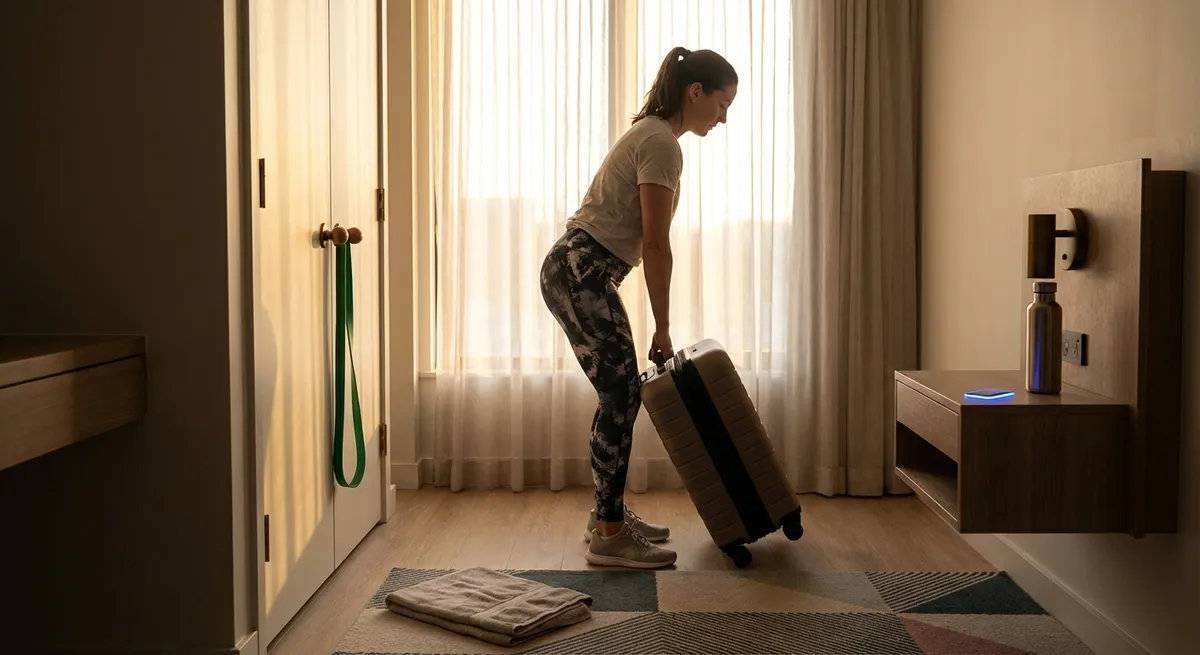
You step into the hotel room, drop your bag, and the pull of the bed hits you hard. But you didn’t cross time zones just to lose your edge. Hotel life doesn’t have to mean stalled progress or “I’ll start again when I get home.” With a bit of intention and a few portable tools, your room key can double as your reset button—keeping you strong, sharp, and ready for whatever the road throws at you.
This guide breaks down five practical fitness tactics designed for travelers and digital nomads who live out of suitcases but still want adventure-ready bodies.
Turn Your Hotel Room Into a Micro-Gym
Most hotel rooms are more functional than they look. When you start seeing furniture as equipment, the space becomes your training partner.
Use the edge of the bed or a sturdy chair for elevated push-ups, triceps dips, or Bulgarian split squats. A towel on a smooth floor turns into a slider for hamstring curls, mountain climbers, or lateral lunges. The wall can handle isometric wall sits and handstand progressions.
Aim for short, dense “micro-sessions”: 10–20 minutes where you move nonstop with minimal rest. For example, cycle through push-ups, bodyweight squats, and hip bridges for five rounds. It’s fast, simple, and easy to fit between meetings, flights, or city walks. The goal is consistency, not perfection.
Pack One Piece of Gear That Does Heavy Lifting
You don’t need a trunk full of equipment. One lightweight tool can cover most of your strength needs on the road.
Resistance bands, a compact suspension trainer, or a lightweight jump rope all fit easily into a carry-on. Resistance bands can mimic cable machines: rows, presses, deadlifts, and face pulls are all on the menu. A suspension trainer uses any solid anchor point (door, beam, rail) for full-body pulling, pushing, and core work. A jump rope handles conditioning when running outside isn’t practical or safe.
Pick the tool that best fits how you like to train, then build a simple “road routine” around it—one push movement, one pull movement, one lower-body move, and one core exercise. Cycle that mini-circuit 3–4 times. You’ll have a go-to hotel workout no matter what city you land in.
Anchor Your Day With a 15-Minute Movement Ritual
Travel destroys routines—but it doesn’t have to destroy rituals. Even when schedules are chaotic, a short daily non-negotiable session keeps your body in the game.
Set a simple rule: 15 minutes of movement right after waking or right before your first work block. Keep it repeatable and low-friction: think mobility flows, light core work, and easy strength moves. For example, combine hip openers, spinal rotations, plank variations, and slow tempo squats.
This ritual reduces stiffness from flights, improves circulation, and sharpens focus before laptop time. It’s not about maximal gains; it’s about keeping your body “online” so that when you do hit a trail, surf break, or local climb, your joints and muscles are ready to play.
Use the Hotel’s Hidden Assets (Beyond the Gym)
The hotel gym is nice if it exists and isn’t packed at peak hours—but it’s not your only option.
Stairwells are built-in conditioning tools. Climb them for intervals: hard effort going up, easy walk coming down. Hallways work for walking lunges or brisk walking if you’re respectful and quiet. A quiet corner of the lobby can be a mobility space during off-hours.
If there’s a pool, turn it into a low-impact workout zone: swimming laps, water jogging, or simple mobility work in the shallow end can reset a travel-worn body. When in doubt, walk: use the neighborhood as your treadmill and explore the local area on foot, logging steps while getting to know the city.
Train for the Road: Sleep, Hydration, and Recovery
Staying fit on the road isn’t only about workouts; it’s about how quickly you bounce back from travel stress.
Jet lag, dry airplane air, new time zones, and odd mealtimes all hit recovery hard. Prioritize hydration from the moment you hit your room—keep a water bottle visible and aim to drink through flights and meetings. Do a short mobility session before bed to unwind hips, back, and neck after sitting all day.
Guard your sleep like gear you can’t replace: use eye masks, earplugs, or white noise apps if the hotel is noisy. Trying to keep roughly the same sleep-and-wake window helps your body adapt faster, so you don’t drag through half your trip feeling foggy and sluggish. A well-rested traveler trains better, thinks clearer, and gets more from each adventure.
Conclusion
Your passport might change borders every week, but your fitness doesn’t have to restart with every check-in. With one smart piece of gear, a 15-minute daily ritual, clever use of hotel spaces, and a focus on recovery, you can stay adventure-ready in any time zone.
You don’t need a perfect gym to stay strong—you just need a plan that fits in your carry-on and a willingness to move wherever you drop your bag.
Sources
- [Centers for Disease Control and Prevention – Physical Activity Basics](https://www.cdc.gov/physicalactivity/basics/index.htm) - Overview of recommended activity levels for adults and why consistency matters
- [American College of Sports Medicine – Staying Active While Traveling](https://www.acsm.org/docs/default-source/files-for-resource-library/staying-active-while-traveling.pdf) - Practical guidance on maintaining exercise routines on the road
- [Harvard T.H. Chan School of Public Health – Importance of Hydration](https://www.hsph.harvard.edu/nutritionsource/water/) - Explains hydration’s role in performance, energy, and health
- [Sleep Foundation – Travel and Sleep](https://www.sleepfoundation.org/travel-and-sleep) - Evidence-based strategies for managing jet lag and protecting sleep while traveling
- [American Heart Association – Benefits of Walking](https://www.heart.org/en/healthy-living/fitness/walking) - Details on how walking supports cardiovascular health and daily activity goals
Key Takeaway
The most important thing to remember from this article is that this information can change how you think about Hotel Fitness.