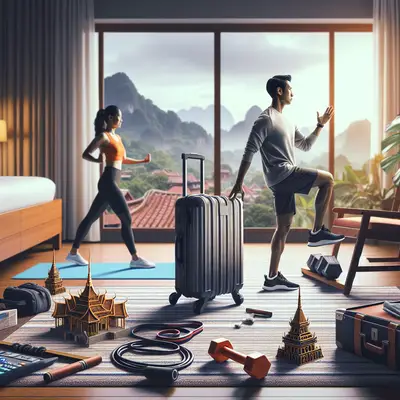
Hotel key in one hand, laptop in the other, jet lag creeping in—this is where most travelers throw fitness out the window. But your hotel room can be more than a place to crash; it can be a basecamp that keeps you strong, focused, and ready for the next adventure. With a bit of intention and a few portable tools, you can turn any check-in into a training opportunity—no fancy gym required.
Claim the Room: Turn Your Space into a Mini Training Zone
Before you open your laptop or dive into emails, scout your room like a mission.
Clear a training area: slide a chair, small table, or luggage stand to the side to create a 2x2 meter “movement zone.” That’s enough space for full-body workouts—lunges, push-ups, planks, and mobility drills.
Scan for assets: the bed for elevated push-ups or hip thrusts, a towel for sliding exercises on smooth floors, a sturdy chair for step-ups or Bulgarian split squats, and a wall for isometric holds. Almost every hotel room has these built-in “tools.”
Set a visible anchor: lay out your jump rope, resistance band, or travel mat where you’ll see it from the bed. That visual cue makes it harder to skip and easier to start.
Finally, lock in a time. Tie your session to an existing habit: “After brushing my teeth in the morning, I train for 15 minutes,” or “After shutting my laptop at night, I move before showering.” Your environment and timing will carry your motivation when energy dips.
Tip 1: Use Time-Boxed Micro-Workouts, Not Marathon Sessions
When you’re crossing time zones or stacked with calls, long workouts are often unrealistic—and that’s when people give up entirely. Instead, think in short, sharp doses: 10–20 minutes that you can drop into any day.
Try this simple timer framework:
- Pick 4 movements: push (push-ups), pull (band rows/doorframe isometrics), legs (squats, lunges), core (planks, dead bugs).
- Work 30–40 seconds, rest 20–30 seconds.
- Cycle through 3–5 rounds depending on time.
Example hotel-room micro-workout:
- Push-Ups (standard, incline on bed, or knees)
- Split Squats (rear foot on bed or chair)
- Backpack Rows (load with laptop, water bottles, books)
- Forearm Plank (or side planks if you want a challenge)
If your day is chaos, break it into “movement snacks”: 5 minutes before breakfast, 5 minutes mid-afternoon, 5 minutes before bed. The cumulative effect keeps your joints loose, your legs from stiffening up, and your head clear.
Tip 2: Pack a “Pocket Gym” You’ll Actually Use
You don’t need a trunk full of gear to stay in shape on the road. You just need 2–3 items that disappear into your bag and let you hit every major muscle group.
Smart, portable tools:
- Long resistance band (loop style): For rows, pull-aparts, good mornings, presses, and assisted pull-ups on playgrounds or park bars.
- Light jump rope: For quick conditioning when you’re short on time or stuck in a city.
- Mini-band (hip band): For glute activation, lateral walks, and hip stability in cramped spaces.
With just a band and a bit of floor space, you can run a full-body session:
- Band Rows anchored around a door hinge or heavy table leg
- Band Good Mornings for hamstrings and back
- Overhead Press or Chest Press with the band
- Banded Lateral Walks for glutes
- Hollow Body Holds or Dead Bugs on the floor for core stability
Keep the gear in an easy-access pocket of your backpack or suitcase. If you bury it under your clothes, it becomes “travel clutter.” If it’s reachable, it becomes part of your daily rhythm.
Tip 3: Train Like You’re on Expedition—Prioritize Function, Not Perfection
When you’re living out of hotels, the goal isn’t a perfect bodybuilding split. Your aim is “adventure readiness”: strong enough to carry your pack, mobile enough to hike on short notice, and conditioned enough to sprint for a train without wheezing.
Focus on three pillars:
Strength you can use
Train mostly with compound movements: squats, lunges, push-ups, rows, hip hinges. Use unilateral work (single-leg or single-arm) to challenge balance and stability in tight hotel spaces.
Mobility that travels with you
Hit your ankles, hips, and thoracic spine daily. Think deep squat holds, hip flexor stretches, controlled arm circles, and cat-camel drills. Plane seats and hotel chairs stiffen you up faster than you realize.
Conditioning that fits the space
If you can’t run outside or access a treadmill, lean into low-impact conditioning: - Fast-paced shadow boxing - Step-ups on a stable chair - Marching in place with high knees - Low-impact burpee variations (step back, no jump)
Measure success by how ready you feel for spontaneous movement—a morning hike, an unplanned walking tour, a last-minute surf session—rather than by how closely you stuck to a rigid program.
Tip 4: Turn Hotel Hallways and Stairs into Your Cardio Track
If your room walls are thin or the floor is noisy, your best conditioning tools might be just outside your door.
Hallway tactics:
- Walk or light jog the length of the hallway for 5–10 minutes.
- Add walking lunges or side shuffles if space allows and traffic is light.
- Use “door markers” (like the exit sign) as interval points: walk one length, fast-walk or lightly jog back.
Stair tactics:
- Walk the stairs for 10–15 minutes at an easy, steady pace.
- On alternating flights, take two steps at a time for more glute and leg involvement.
- Use intervals: 1 flight easy, 1 flight brisk, repeat.
- Keep one hand on the railing for safety, especially if you’re tired or just landed from a long flight.
Early mornings or late evenings are best for avoiding other guests. Keep noise low—no stomping or jumping—and think “mountain ascent,” not “stadium sprint.”
Tip 5: Build a Simple Recovery Ritual to Fight Jet Lag and Stiffness
Travel doesn’t just hit your schedule—it hits your nervous system, sleep cycle, and joints. A short, reliable recovery ritual can keep you functioning even when time zones blur.
Post-flight or pre-bed hotel routine:
Soft tissue work (if you have a ball or bottle)
Roll under your feet with a water bottle, then gently roll your calves and glutes against the floor or wall. This loosens tight tissues from long sits.
Mobility flow (5–10 minutes)
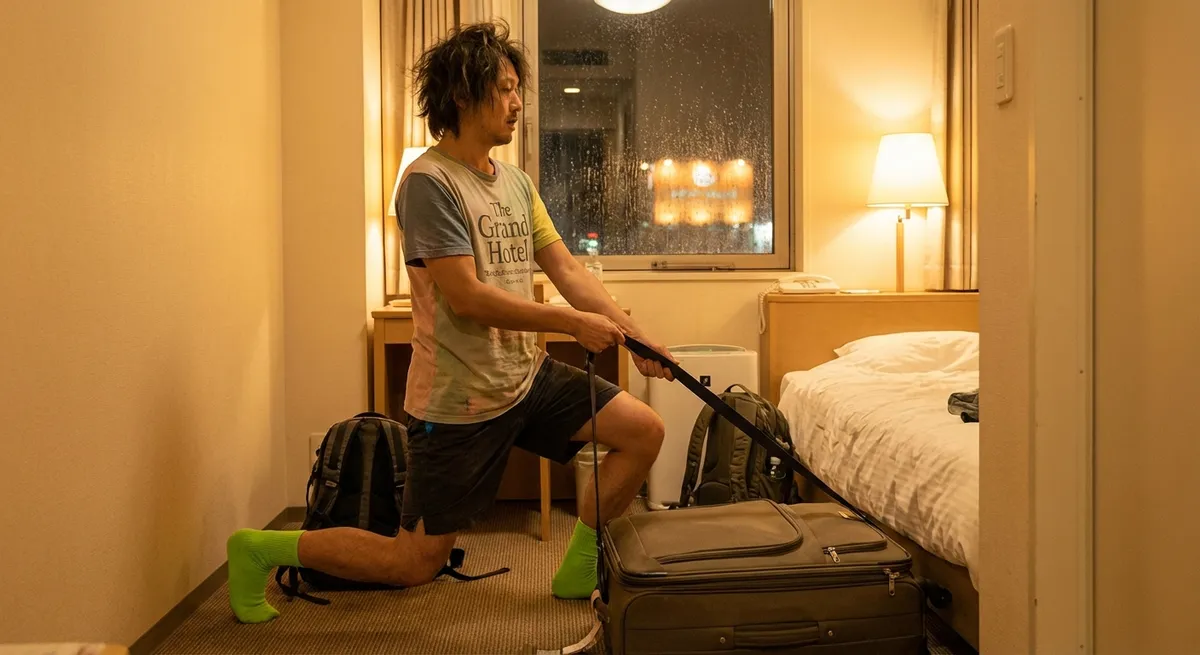
- Cat-Camel on the floor for your spine - Deep Squat Hold using the edge of the bed for support - Hip Flexor Stretch in a half-kneeling position - Thoracic Opener: thread-the-needle from all-fours position
Nervous system downshift
A few rounds of slow nasal breathing (4 seconds in, 6 seconds out) can help counter jet lag and stress. Do it lying on the floor or bed for 3–5 minutes.
Put this ritual on autopilot: whenever you arrive in a new hotel or before you sleep, you run the same sequence. It signals to your body, “We’re grounding, we’re resetting, and tomorrow we move better.”
Conclusion
You don’t need a gleaming hotel gym to stay strong on the road. What you need is a shift in mindset: every room is a training zone, every hallway a track, every staircase a mini ascent. With a few portable tools and a handful of simple tactics, you can keep your body expedition-ready, even when your life is one long layover.
Travel will always be unpredictable. Your fitness doesn’t have to be. Claim the room, move with intent, and let every check-in become a chance to recharge, not just sleep.
Sources
- [American Council on Exercise – Hotel Room Workout](https://www.acefitness.org/resources/healthy-living/fitness-and-performance/hotel-room-workout/) - Practical examples of hotel-friendly exercises using minimal equipment
- [Harvard Health Publishing – Benefits of Short Exercise Bouts](https://www.health.harvard.edu/staying-healthy/short-bouts-of-exercise-can-have-a-big-impact) - Explains why brief, frequent workouts are effective for health and fitness
- [CDC – Physical Activity Guidelines for Adults](https://www.cdc.gov/physicalactivity/basics/adults/index.htm) - Official recommendations for weekly activity levels and intensity
- [Mayo Clinic – Stretching: Focus on Flexibility](https://www.mayoclinic.org/healthy-lifestyle/fitness/in-depth/stretching/art-20047931) - Covers the importance of flexibility and basic stretching strategies
- [Cleveland Clinic – How Exercise Helps with Jet Lag and Sleep](https://health.clevelandclinic.org/exercise-and-sleep) - Discusses the relationship between movement, circadian rhythm, and sleep quality
Key Takeaway
The most important thing to remember from this article is that this information can change how you think about Hotel Fitness.