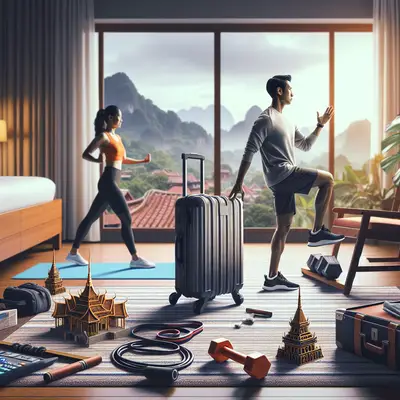
Wheels hit the tarmac, you grab your bag, and suddenly your “gym” is a carpeted room, an ice machine, and a desk chair that wobbles if you look at it wrong. Perfect. Hotel life doesn’t have to mean losing your edge—it just means getting more tactical. With a bit of creativity and a few portable tools, every layover, conference, or nomad stopover can become another chapter in your strength story instead of a detour from it.
This is your field guide to staying strong and sharp when your home base has a front desk and a key card.
Recon the Terrain: Turn the Hotel into Your Training Zone
Before you ever drop for push-ups, scout your surroundings like it’s a new trail.
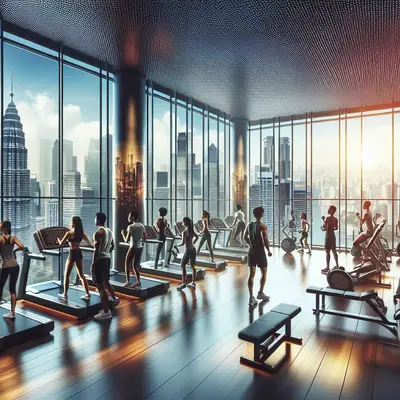
Walk the entire floor. Note where the stairwells are, how far the hallway runs, whether there’s a quiet end you can claim for short bursts of training. Most hotels have at least a small “fitness center”—even if it’s a treadmill and a sad rack of dumbbells, that’s raw material you can work with.
If there’s a lobby or courtyard with solid benches or low walls, log those too; early mornings are prime time for step-ups, dips, and mobility work away from the crowds. Even your room matters: test the desk for stability, find wall space for handstand holds, and check if the bed can be moved a few inches to create a training lane.
This isn’t just about convenience—it’s about mindset. Once you see the hotel as a training environment instead of a holding pattern, you stop “waiting until you get home” and start building right where you are.
Tip 1: Build a Micro-Kit That Fits in Any Carry-On
If you travel often, assume hotel gyms will be inconsistent at best. Your solution: a compact, always-packed “micro-kit” that lives in your backpack.
Reliable, high-impact pieces include:
- A long resistance band (or two): Perfect for rows, presses, pulls, hip work, and assisting harder movements like pistols. One medium and one heavy band cover most needs.
- A light suspension trainer or gymnastics rings: Anchor over a solid door or beam for rows, push-ups, core work, and single-leg movements. Rings pack flatter; trainers can be quicker to set up.
- A jump rope: Minimal space, massive conditioning payoff. Great for quick “bookend” sessions at the start or end of your day.
- Mini-band/loop band: Ideal for hip activation, glute work, and pre-flight/post-flight mobility.
With just these tools, you can create horizontal pulling, resisted hinging, and loaded patterns that bodyweight alone sometimes can’t hit hard enough—especially if you already have a decent strength base. Keep this kit in your personal item, not your checked luggage, so lost bags never cancel your training mission.
Tip 2: Use the Stairs for Serious Conditioning and Leg Strength
Treadmills are fine; stairwells are better. They’re usually empty, echo-y, and built like a vertical track just for you.
Start with a simple pattern:
- Warm-up on flat ground: 3–5 minutes of marching, ankle circles, and light squats in your room or hallway.
- Power climb: March or jog up 2–4 flights focusing on strong, deliberate steps and tall posture. Walk back down.
- Intervals: Alternate 30–45 seconds of fast-but-controlled stair climbing with 60–90 seconds of easy walk-down recovery.
To build strength, use single-leg focus on the way up—drive through the whole foot, lightly tapping the trailing foot each step. For joint-friendly training, keep the power on the ascent and take your time on the descent to manage impact and avoid slips.
Travel days wreck circulation and energy. A short stair session—5–10 minutes hard effort, total 15–20 minutes including warm-up and cooldown—works as a reset button and a serious conditioning hit without needing any machines.
Tip 3: Program “Zero-Noise” Workouts That Won’t Disturb Anyone
Thin walls and late-night hours don’t have to kill your discipline. You just need a quiet arsenal.
Focus on low-impact, low-thud movements:
- Iso holds: Wall sits, plank variations, glute bridges, suitcase holds with your backpack.
- Slow eccentrics: 5–6 second descents on squats, split squats, and push-ups drastically increase difficulty with no extra sound.
- Floor-based core: Dead bugs, side planks, hollow body holds, slow mountain climbers without slamming your feet.
Design 15–25 minute “room ops” sessions like this:
- Pick 4–6 movements (e.g., slow squats, push-ups, glute bridges, side planks, band rows, hollow hold).
- Work 30–45 seconds, rest 15–30 seconds.
- Cycle through 3–5 rounds.
This style respects roommates, neighbors, and weird carpet patterns while still giving your muscles a clear message: “We’re still in operation mode.”
Tip 4: Anchor Your Day with Two Non-Negotiable Movement Windows
Travel days smash routines, but you can still drop rigid anchors into the chaos: one short movement block near wake-up, and one before bed. Even 8–12 minutes each transforms your day from “off” to “on mission.”
Morning anchor ideas:
- 3–5 rounds of: air squats, push-ups (or incline push-ups on the desk), band pull-aparts, and light hip mobility.
- 5 minutes of jump rope + 5 minutes of mobility (hips, thoracic spine, ankles).
Evening anchor ideas:
- Long-held stretches for hips, hamstrings, and chest.
- Light glute bridges, cat-cow, and deep breathing in the 4-6-8 pattern (inhale 4, hold 6, exhale 8).
These anchors aren’t about crushing yourself—they’re about identity. You’re reminding your nervous system, “I’m someone who trains,” no matter what timezone or room number your day ends in.
Tip 5: Train Around Jet Lag, Not Against It
Sleep disruption, time zone shifts, and late check-ins can make you feel like your body belongs in a different country than your passport says. Instead of forcing your “home routine” onto your travel days, treat recovery and training like a negotiation.
Use these guidelines:
- First 24 hours in a new place: Mobilize more than you crush. Focus on walking, light circuits, and stair sessions at low intensity to reset your body clock and circulation.
- Shift heavy efforts to your local afternoon: That’s when most people feel more alert after a long flight, and when body temperature and strength tend to peak.
- Hydrate aggressively and move every changeover: On travel days, make movement the rule—calf raises in line, shoulder rolls, short walks during layovers.
- Respect red flags: If you’re significantly underslept or feel off-balance, skip max-effort training. Do a short, moderate session instead and push the heavy work to the following day.
You’re not dodging the work—you’re playing the long game. A well-timed 20-minute hotel session adapted to your sleep and energy keeps your consistency streak alive without wrecking you for the next day’s travel or meetings.
Conclusion
Hotel living doesn’t have to be a holding pattern for your fitness. Once you start treating each check-in as new terrain to scout—each hallway, stairwell, and desk as potential training equipment—you stop being at the mercy of whatever random “fitness center” the property threw together.
Pack your micro-kit. Own the stairs. Build quiet, ruthless room workouts and lock in those daily movement anchors. Adapt your training to your jet lag instead of pretending it doesn’t exist. Do that, and every trip becomes less of a setback and more of a training mission in disguise—no matter what city, continent, or conference badge you’re wearing.
Sources
- [American Council on Exercise – Hotel Room Workout Tips](https://www.acefitness.org/resources/everyone/blog/7440/how-to-get-a-good-workout-in-your-hotel-room/) - Practical ideas for effective hotel-room training with minimal equipment
- [Centers for Disease Control and Prevention – Travel & Health](https://wwwnc.cdc.gov/travel/page/staying-healthy-on-a-trip) - Guidance on staying healthy and active while traveling
- [Harvard T.H. Chan School of Public Health – Physical Activity and Health](https://www.hsph.harvard.edu/nutritionsource/physical-activity/) - Overview of health benefits of regular physical activity, useful for framing travel fitness priorities
- [Sleep Foundation – Jet Lag and Sleep](https://www.sleepfoundation.org/physical-health/jet-lag) - Evidence-based strategies to manage jet lag and time zone shifts
- [Mayo Clinic – Exercise: How to Get Started](https://www.mayoclinic.org/healthy-lifestyle/fitness/in-depth/fitness/art-20048269) - Foundational exercise recommendations that can be adapted to hotel environments
Key Takeaway
The most important thing to remember from this article is that this information can change how you think about Hotel Fitness.