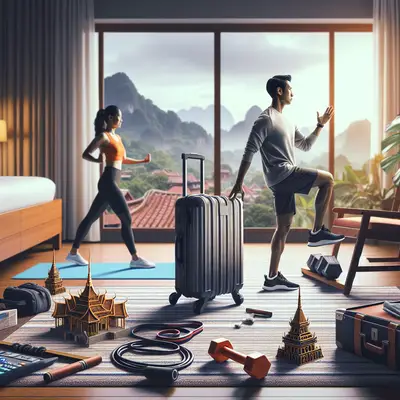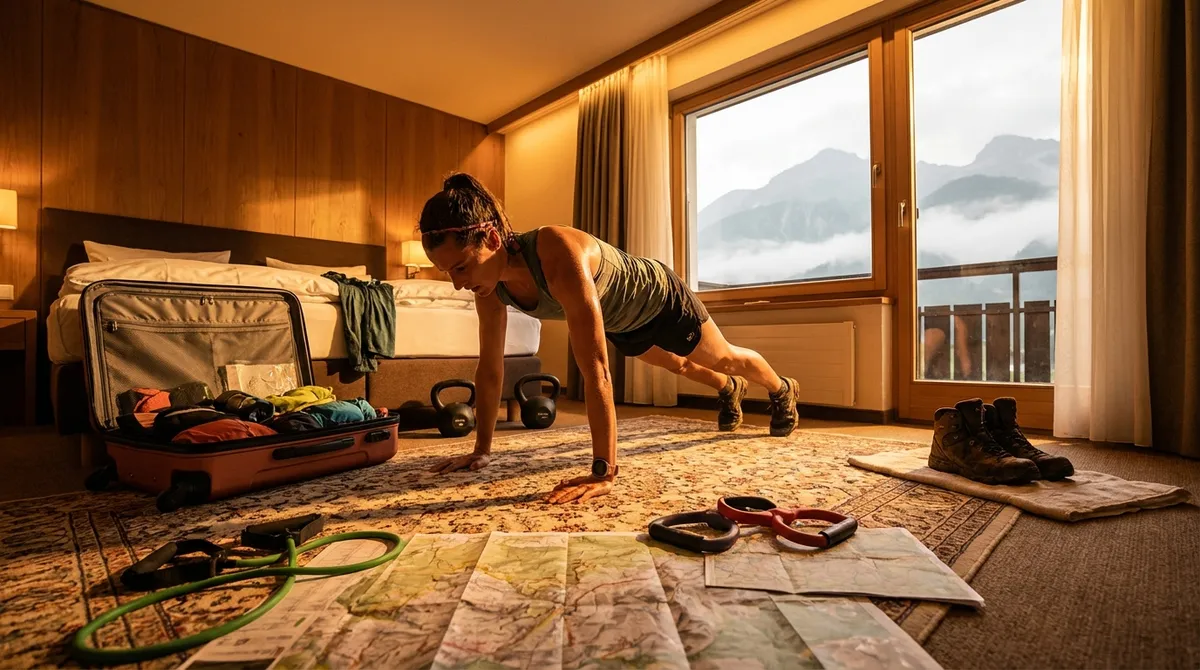
Checking into a new city should feel like gearing up for a mission, not an excuse to let your body go offline. Your hotel room can be more than a Wi‑Fi box and a pillow—it can be a launchpad for strength, stamina, and sharper focus on the road.
This guide is for travelers and digital nomads who want to explore harder, work smarter, and land back home feeling stronger than when they left. No hotel gym required—just creativity, portable tools, and a willingness to turn layovers into training grounds.
Rethinking “Hotel Fitness” as Mission Prep
Most people treat hotel fitness like damage control: a quick treadmill jog, a few random pushups, and a promise to “start again” when they get home. That mindset quietly drains your energy on the road.
Think of your training as mission prep instead:
- You’re not “working off” food—you’re building an engine to chase sunrises, meetings, and side quests.
- Your goal isn’t a perfect program—it’s consistency, adaptability, and staying ready in unpredictable environments.
- Every hotel room is a new terrain: different space, furniture, schedules, and distractions.
When you frame hotel workouts as part of your travel adventure instead of a boring obligation, it becomes easier to show up for 10–20 focused minutes a day. You’re not checking a box; you’re sharpening your tools.
Tip 1: Build a 15-Min Hotel “Field Workout” (No Gear Needed)
You don’t need equipment to get a serious hotel session in—you just need a simple structure you can run anywhere. Use this as your default “field workout” when time or space is tight:
Format: 3–5 rounds (depending on time and energy)
Work 40 seconds, rest 20 seconds per move.
Bodyweight Squats or Split Squats
- Stand by the bed or desk for light support if needed. - Focus on full range of motion to wake up hips after long flights.
Push Variations (Incline Pushups on Desk or Bed)
- Hands on desk for more challenge, on bed for easier angle. - Keep your body in a straight line—no sagging hips.
Hip Hinge: Good Mornings or Single-Leg Deadlift (Bodyweight)
- Slight knee bend, hinge at hips, feel your hamstrings load. - Great for undoing the “airplane chair” posture.
Core: Dead Bugs or Plank on Elbows
- For dead bugs: lie on your back, arms up, knees over hips; extend opposite arm and leg slowly. - Plank: keep ribs down and glutes tight, aim for quality over duration.
Cardio Burst: Fast Step-Ups or In-Place “Skaters”
- Use a low, stable surface like the bedside platform or a sturdy step. - Or do lateral “skater” hops in place if space is limited.
This can be done in 15 minutes, barefoot, in silence (for thin hotel walls), and with zero gear. It's your “no excuses” protocol for any stopover.
Tip 2: Pack a Micro-Gym That Fits in Your Laptop Sleeve
A couple of ultra-portable tools can transform any room into a serious training zone without violating luggage limits. Think “micro-gym,” not full kit.
Consider packing:
- Light & medium resistance bands (loop or tube)
Great for rows, presses, pull-aparts, and hip work. They weigh almost nothing and fold into any pocket.
- A compact suspension trainer or door anchor strap
Clips over a solid door to create instant rows, presses, and core work. Always test the door closes firmly and pulls toward the hinges, not away from them.
- Jump rope (if noise and ceiling height allow)
Perfect for short, high-intensity cardio bursts. Use on carpet or gym floor to protect both the rope and the room.
- Mini massage ball or lacrosse ball
Doesn’t look like “fitness gear” to airport security, but works wonders on calves, glutes, and shoulders after travel days.
With this micro-gym, you can run a full-body session in under 25 minutes: band rows with squats, pushups with band presses, single-leg work, and core finishers. The goal is to keep your movement vocabulary large, even in tiny spaces.
Tip 3: Sync Workouts With Your Travel Rhythm, Not the Clock
Time zones and tight schedules wreck perfect plans, but they don’t have to wreck your training. Instead of chasing an ideal time of day, sync your workouts to travel rhythms:
- Post-check-in reset:
Do a 10–20-minute session within 60–90 minutes of arriving at the hotel. You’ll shake off stiffness, reset your posture, and fight that “I’ll just lie down for a minute” energy crash.
- Pre-meeting activation:
Short, sharp circuit: 3 rounds of squats, incline pushups, band rows, and a 30–45 second plank. It’s like hitting “power mode” for your attention span.
- Jet lag management:
Light-to-moderate intensity training at your target local wake time can help anchor your body clock. Pair it with natural light (open the curtains) and hydration.
- Late-night rule:
If it’s less than 2 hours before your target sleep time, keep it light—mobility and stretching instead of a full workout—to avoid disrupting sleep.
Instead of obsessing over missing your “usual 6 a.m. session,” focus on anchors: a short daily practice that keeps your body online no matter where the plane lands.
Tip 4: Turn the Room Into a Multi-Zone Training Map
Your hotel room is a puzzle. Solve it like a field operator, assigning each section a purpose:
- Door frame zone: Pull and posture work
Use a door anchor or band looped around a hinge-side anchor point (if safe) for rows and face pulls. Great for countering hours of laptop and phone posture.
- Desk/TV stand zone: Incline pressing & dips
Use the desk edge for incline pushups or static holds. A sturdy chair (if it doesn’t roll) can be used for light tricep dips or elevated split squats.
- Bed zone: Core & mobility
The bed works for certain core drills (dead bugs, side-lying leg lifts) and gentle hip mobility if the floor is too hard or dirty.
- Floor zone: Strength & stability
If there’s a carpet or rug, this is your base for planks, side planks, glute bridges, hip thrusts, and single-leg balance work.
This mindset shift—viewing the room as a training environment rather than a cramped box—helps you stay inventive instead of frustrated by limited space.
Tip 5: Create a “Travel Strong” Ritual You Repeat Everywhere
Digital nomads and frequent travelers thrive on rituals that make unfamiliar places feel like a personal HQ. Your fitness should be one of those rituals.
Try building a simple, repeatable Travel Strong sequence:
Arrival reset (5–8 minutes)
- 10 slow squats - 10 hip hinges - 10 band pull-aparts or arm circles - 30–60 seconds plank - 1–2 minutes of deep nasal breathing, lying on the floor
Daily minimum (10–15 minutes)
- Pick 3 moves: 1 lower body, 1 upper body, 1 core or cardio burst - Cycle them for 3–5 rounds with minimal rest - Same pattern, different variations depending on what the room allows
Off-day recovery (5–10 minutes)
- Gentle hip openers, ankle circles, thoracic spine rotations - Calf and glute work with a massage ball - Light breathing to downshift your nervous system before bed
Make it non-negotiable, like brushing your teeth. The point isn’t perfection; it’s identity. You’re someone who trains anywhere, with anything, in whatever space you’re given. Once that identity sticks, the logistics become details, not obstacles.
Conclusion
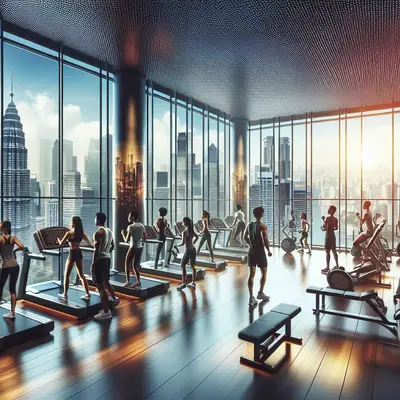
Hotel fitness doesn’t have to mean chasing the same tired treadmill in yet another beige gym. With a small set of tools, a flexible game plan, and an explorer’s mindset, every check-in becomes an opportunity to level up—stronger legs for cobblestone alleys, steadier back for long workdays, sharper mind for last-minute detours.
Your room key isn’t just access to a bed; it’s access to a temporary basecamp. Use it. Build your field workout. Pack your micro-gym. Map your room. And keep your “Travel Strong” ritual rolling from city to city until your body feels less like carry-on baggage and more like your favorite adventure gear.
Sources
- [CDC – Travel Health: Jet Lag](https://www.cdc.gov/features/travelers-jetlag/index.html) – Guidance on managing jet lag and adjusting to new time zones
- [American College of Sports Medicine – ACSM Guidelines for Exercise Testing and Prescription](https://www.acsm.org/education-resources/books/guidelines-exercise-testing-prescription) – Evidence-based recommendations for exercise structure and intensity
- [Harvard Health Publishing – The Importance of Strength Training](https://www.health.harvard.edu/staying-healthy/the-importance-of-strength-training) – Overview of why resistance training matters for health and function
- [Mayo Clinic – Interval Training for a Stronger Heart](https://www.mayoclinic.org/healthy-lifestyle/fitness/in-depth/interval-training/art-20044588) – Explains the benefits of short, intense workouts like circuits and intervals
- [Sleep Foundation – Exercise and Sleep](https://www.sleepfoundation.org/physical-activity/exercise-and-sleep) – How workout timing and intensity can affect sleep quality, useful for planning hotel sessions
Key Takeaway
The most important thing to remember from this article is that this information can change how you think about Hotel Fitness.