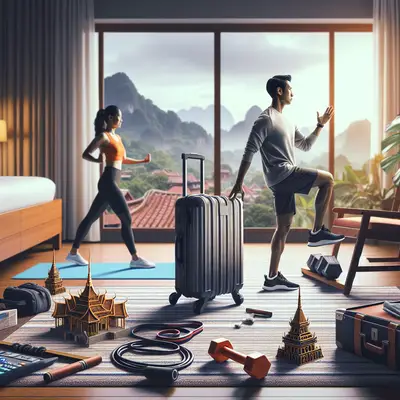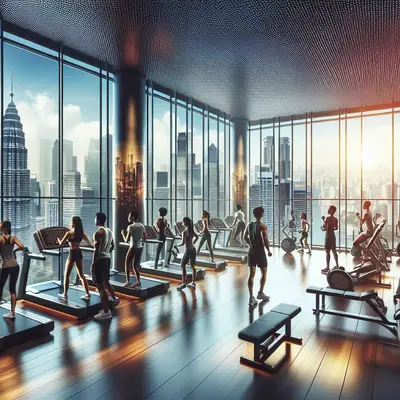
The check-in desk isn’t the end of your adventure—it’s the next launch point. Whether you’re chasing Wi‑Fi and sunsets as a digital nomad or stacking meetings across time zones, your hotel can be more than a place to crash. It can be a compact training base that keeps you strong enough for sunrise hikes, street-food missions, and last‑minute detours. This guide gives you portable, no‑drama strategies to turn almost any room, hallway, or stairwell into a functional, adventure-ready gym.
Build Your “Pocket Gym” Before You Board
Most hotel fitness fails start in your suitcase. If you land with nothing but good intentions and a laptop, the lobby bar wins. A tiny “pocket gym” changes that.
Pack a light, modular kit that covers strength, mobility, and conditioning without hogging luggage space. Resistance bands (mini and long-loop) weigh next to nothing and can recreate most cable-machine moves using doors, bed frames, or your own body as an anchor. A lightweight jump rope turns any open patch of carpet or parking lot into a cardio zone. A compact suspension trainer or doorway pull-up bar (for sturdier frames) multiplies your options for pulling movements—a pattern most hotel gyms underserve.
Think in categories, not gear: one tool for pushing/pulling (bands or suspension trainer), one for legs (mini-bands), one for conditioning (rope or just your body and a timer), and one for recovery (a lacrosse ball or travel-sized massage ball). That’s a full gym hiding in a shoe compartment, ready to deploy the second Wi‑Fi drops.
Scout Your Hotel Like an Urban Trail
Before you even peek at the “fitness center” sign, map your terrain. You’re not just a guest—you’re a trail runner in a vertical playground.
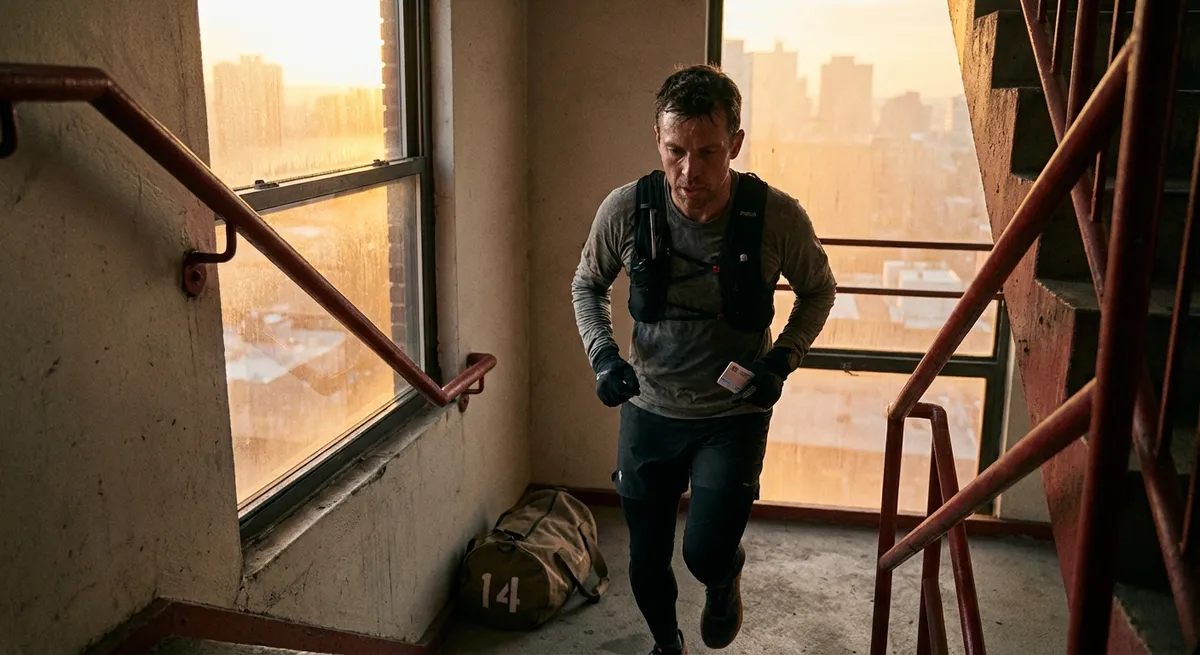
Start with the stairs. Stairwells offer intervals, calf-smashing climbs, and step-up variations no treadmill can match. One or two flights can be used for low-impact marching or loaded carries with your backpack; ten or more flights become a mountain in miniature. Hallways at off-peak hours can host walking lunges, A-skips, or light mobility circuits—quietly, so you stay on the good side of housekeeping.
Then, assess your room like a gear-laden campsite. A sturdy desk becomes a platform for incline push-ups, a chair supports Bulgarian split squats, and a doorway can anchor bands for rows and face pulls. Even the mattress edge can be used for hip thrusts or elevated glute bridges. If there’s a hotel gym, treat it as bonus terrain: quick scans for dumbbells, a cable station, or a rower help you plug gaps your pocket gym can’t fill.
The goal isn’t perfection; it’s adaptability. Once you see hotels as obstacle courses instead of beige boxes, every check‑in turns into a new training route.
Tip 1: Anchor Your Day With a 12-Minute “Arrival Circuit”
Travel days wreck structure. Time zones blur, meals go rogue, and motivation gets shoved behind your carry-on. That’s why you need a non-negotiable “arrival circuit” you run on autopilot the moment you drop your bag.
Set a timer for 12 minutes and cycle through:
- 10 squats (air squats or goblet squats with a backpack)
- 8 push-ups (floor, incline on the desk, or hands on the wall)
- 10 hip hinges (Romanian deadlifts with your backpack or slow bodyweight good mornings)
- 20 seconds of fast marching in place, high knees, or jumping jacks (if noise is okay)
Loop this with minimal rest until the timer ends. Keep the pace crisp but controlled, focusing on smooth reps and full range of motion. This circuit wakes up stiff joints from sitting, gets blood moving after flights, and sends your brain a message: “We train here.”
Make it a ritual, not a decision. Arrive, use the bathroom, drink water, run the circuit. Once that pattern is locked, you stop wasting willpower debating whether you’re “too tired” to move.
Tip 2: Use Time-Boxed Micro Sessions Instead of “Real Workouts”
Long trips rarely leave you with a spare 60-minute training block, and waiting for a perfect window usually means doing nothing. Instead, fracture your training into time-boxed micro sessions that slide into layovers, lunch breaks, or Zoom gaps.
Think in 5-, 10-, and 15-minute slices:
- Morning mobility (5 minutes): neck circles, cat-cow on the floor, hip circles, ankle rocks, and a few deep squats holding the bed frame for balance.
- Midday strength burst (10 minutes): pick two moves—like split squats and rows—and alternate them every minute on the minute (EMOM-style).
- Evening unwind (15 minutes): a slower combo of light band work, long exhale breathing, and static stretches for hips and hamstrings.
These short bouts add up. Research shows that accumulated “exercise snacks” across a day can significantly support heart health and fitness without traditional gym blocks. It’s like drip-feeding your adventure capacity instead of bingeing it and burning out. For nomads juggling work calls and local exploration, micro sessions keep you consistent without hijacking your schedule.
Tip 3: Prioritize “Adventure Muscles” With Minimal Equipment
Not all hotel workouts are equal. If your main goal is staying ready for pop-up hikes, surf lessons, city walking tours, or carrying your life in a backpack, train the muscles that matter most for those demands.
Focus on:
- Legs and hips for climbing, hiking, and long walks
- Split squats, reverse lunges, step-ups onto the bed frame or a sturdy chair
- Glute bridges or hip thrusts on the edge of the mattress
- Back and core for carrying packs and sitting less miserably
- Band rows anchored in a door, bed frame, or around your knees
- Suitcase carries pacing your room with your heaviest backpack or bag
- Side planks and dead bugs for anti-rotation and trunk stability
- Push strength for balance and durability
- Push-ups (incline/decline/floor)
- Band or floor presses (pressing your backpack from the floor)
Build simple 3-move “adventure clusters” you can recycle in any hotel, like:
- Cluster A: Split squats, band rows, side planks
- Cluster B: Hip thrusts, push-ups, suitcase carries
Rotate clusters across travel days instead of inventing new plans with every check-in. You’ll hit the right muscles repeatedly without draining mental bandwidth.
Tip 4: Go Low-Impact (and Quiet) Without Losing Intensity
Paper-thin hotel walls and mystery floor construction can kill your enthusiasm for burpees. Fortunately, you can go intense without jumping or stomping.
Swap high-impact moves for quiet strength and conditioning:
- Instead of jump squats → slow tempo squats (3 seconds down, 1 second pause, stand up fast)
- Instead of running in place → brisk step-ups on a stable platform, or stair marches in the stairwell
- Instead of burpees → walkout push-ups, heavy backpack carries, or slow mountain climbers with hands on the bedframe
Use isometrics—tension without movement—to crank difficulty without noise. Wall sits, plank variations, and static split squat holds light up your legs and core with zero thuds. Pair these with controlled breathing (inhale through your nose, long exhale through your mouth) to double-dip into stress reduction.
Low-impact doesn’t mean “easy.” It means smart pressure on joints and neighbors while still earning that post-workout shower.
Tip 5: Align Your Training With Your Next Adventure, Not a Random Plan
Hotel fitness sticks best when your sessions feel like direct prep for what’s coming next, not box-ticking. Align your training focus with your upcoming adventures so every rep feels like a rehearsal, not a chore.
- Got a weekend city sprint planned? Emphasize walking lunges, calf raises off the stair edge, and banded glute work to handle cobblestones and long days upright.
- Heading for trails or mountains? Prioritize single-leg strength (step-downs, split squats), stair climbs with your backpack loaded, and core stability work.
- Planning water sports or board rentals? Train anti-rotation (Pallof presses with a band), lateral lunges, and balance drills like single-leg stands while brushing your teeth.
At the end of each day, take 2–3 minutes to log what you did: exercises, rough duration, and how you felt. Treat it like updating a trail journal. Over time, you’ll see which patterns keep you feeling powerful on travel days and which leave you flat. That feedback loop lets you adjust your “hotel training” so it evolves with your adventures, not against them.
Conclusion
Your hotel room doesn’t have to be a holding pattern between real life and real training. With a tiny pocket gym, a scout’s eye for usable space, and a few portable strategies, you can stay strong enough to say “yes” when the good stuff shows up—sunrise trails, surprise day trips, rooftop viewpoints, and detours that weren’t on your itinerary.
You don’t need perfect equipment, a flawless schedule, or a glamorous gym selfie wall. You need a willingness to move with whatever space and tools you have, wherever your laptop and luggage land. Treat every hotel as an adventure base camp, not a pause button, and your body will be ready when the next unexpected path appears.
Sources
- [American College of Sports Medicine – ACSM’s Guidelines for Exercise Testing and Prescription](https://www.acsm.org/read-research/books/acsms-guidelines-for-exercise-testing-and-prescription) – Evidence-based recommendations on exercise frequency, intensity, and type
- [Harvard T.H. Chan School of Public Health – Physical Activity and Health](https://www.hsph.harvard.edu/nutritionsource/basics/physical-activity/) – Overview of health benefits of regular movement and practical guidance
- [Centers for Disease Control and Prevention – Physical Activity Basics](https://www.cdc.gov/physicalactivity/basics/index.htm) – Official guidelines on activity duration and intensity for adults
- [Mayo Clinic – Exercise: How to Get Started](https://www.mayoclinic.org/healthy-lifestyle/fitness/in-depth/fitness/art-20048269) – Practical tips for beginning and maintaining a workout routine
- [National Institutes of Health – The Benefits of Exercise](https://newsinhealth.nih.gov/2015/12/benefits-exercise) – Research-backed summary of how consistent exercise supports overall health
Key Takeaway
The most important thing to remember from this article is that this information can change how you think about Hotel Fitness.